STOCKS, BONDS &
FISCAL PAPER
1876
AUSTRIAN EMPIRE GOLD BOND WITH A NAZI CONNECTION

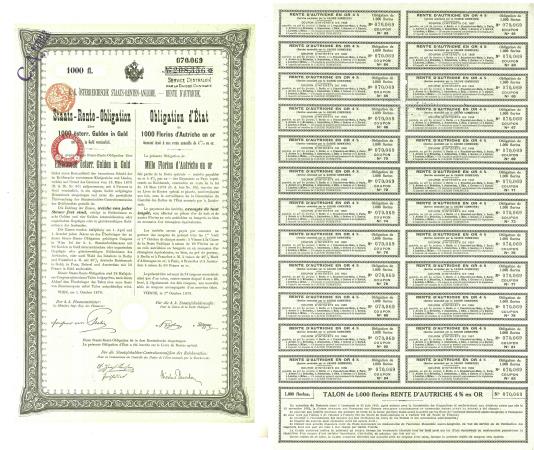
In October 1876 the Austrian Empire issued these 200 and 1000 Florin
(Gulden) perpetual 4% gold bearer bond. According to its original terms
the 200 Florin bond paid a tax-free semi-annual interest payment of 4
Austrian or Hungarian Gold Florins or 10 gold French Francs or 8.1
German Mark. The 1000 Florin bond paid five times that amount. Though
the bond may have been perpetual, governments are not. After
the collapse of the Austrian Empire following World War I the terms of
the bonds were changed. Interest would only be paid annually and the
amount would depend on the amount of funds collected from the successor
nations of the Austro-Hungarian Monarchy. In March 1938 Nazi
Germany annexed Austria and redeemed the bonds. The bonds
were put into storage at the Reichsbank in Berlin where they were
forgotten for over 75 years. The large-sized bonds measure
approximately 9.5" x 15" (24 x 38 cm) Having been
actively traded for over 60 years the bonds show moderate
wear. They are written in both German and French. Included is
a full sheet of 24 coupons, due to be redeemed from 1937 to 1960. The
bond and coupon sheet are cancelled with a single punch.
Item
BND-AT-200FL
AUSTRIA 200 FLORIN GOLD BOND 1876,
VG-F
$9.00
Item
BND-AT-1000FL
AUSTRIA 1000 FLORIN GOLD BOND 1876,
VG-F
$10.00
Item
BND-AT-BOTH BOTH OF THE ABOVE AUSTRIAN 1876
GOLD BONDS
$15.00
 100
YEAR OLD JAPANESE PERPETUAL LOTTERY
BOND
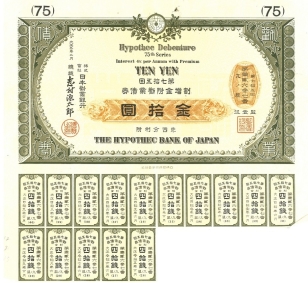
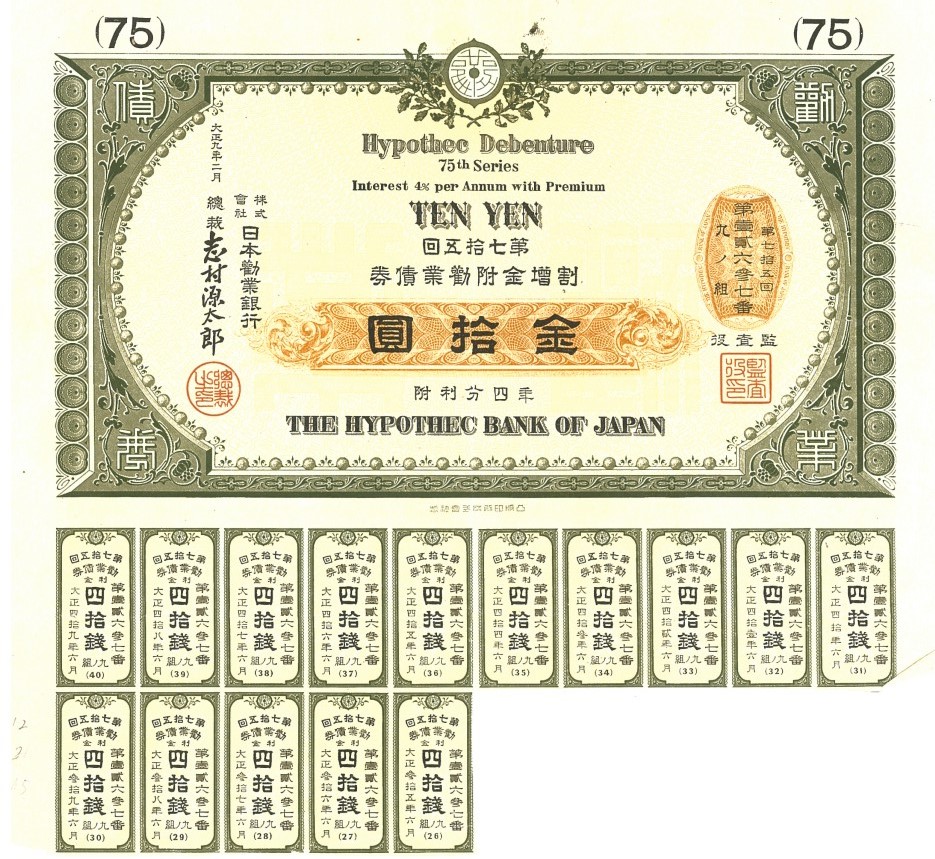
The
Hypothec Bank of Japan issued these 10 Yen Bonds between 1917 and 1920
(Series 67 to 75). The bonds paid 4% perpetual annual
interest and entered the bearer eligible for a semi-annual lottery
drawing of prizes ranging from 5 Yen to 1500 Yen. Many bought the bond
for a chance to win a prize - and be assured of a steady retirement
income. At the time the bonds were issued that was
equivalent to about 2 years salary for an entry level professional or
could purchase a comfortable house. Even the smaller prizes
had significant purchasing power - and the bond would continue to pay
4% interest. Following World War II, the value of the
Japanese Yen plummeted. In 1957 the bonds were called by the
bank, they ceased paying interest and the lotteries were
ended. 10 Yen was a modest copper coin. The annual
interest was too small of an amount to redeem. The top prize
1500 Yen might buy a pair of work shoes or a jacket. For many it was
hardly worthwhile to spend the effort to collect the lottery
prizes. It is an interesting piece of history that survived
World War II, but was killed by inflation. The bond includes
some coupons.
Item
BND-JPH
JAPAN HYPOTHEC BANK 10 YEN BOND
(1917-20) VF
$15.00
1869 CENTRAL LAND COMPANY
STOCK CERTIFICATE
The Central Land Company was incorporated in San Francisco on September
9, 1869 with its headquarters in Oakland. It issued 1600 shares of
stock at $100 each, giving it $160,000 of capital Its primary
business was purchasing and subdividing large tracts in Oakland, the
East Bay and other parts of California. Much of the land was
purchased from the government. It would then sell land and
homes on an installment plan. It was a good time
for such a business. California's population increased over 50% between
1870 and 1880, and all those people needed homes. The business
gradually wound down in the 1890's as the land was sold off.
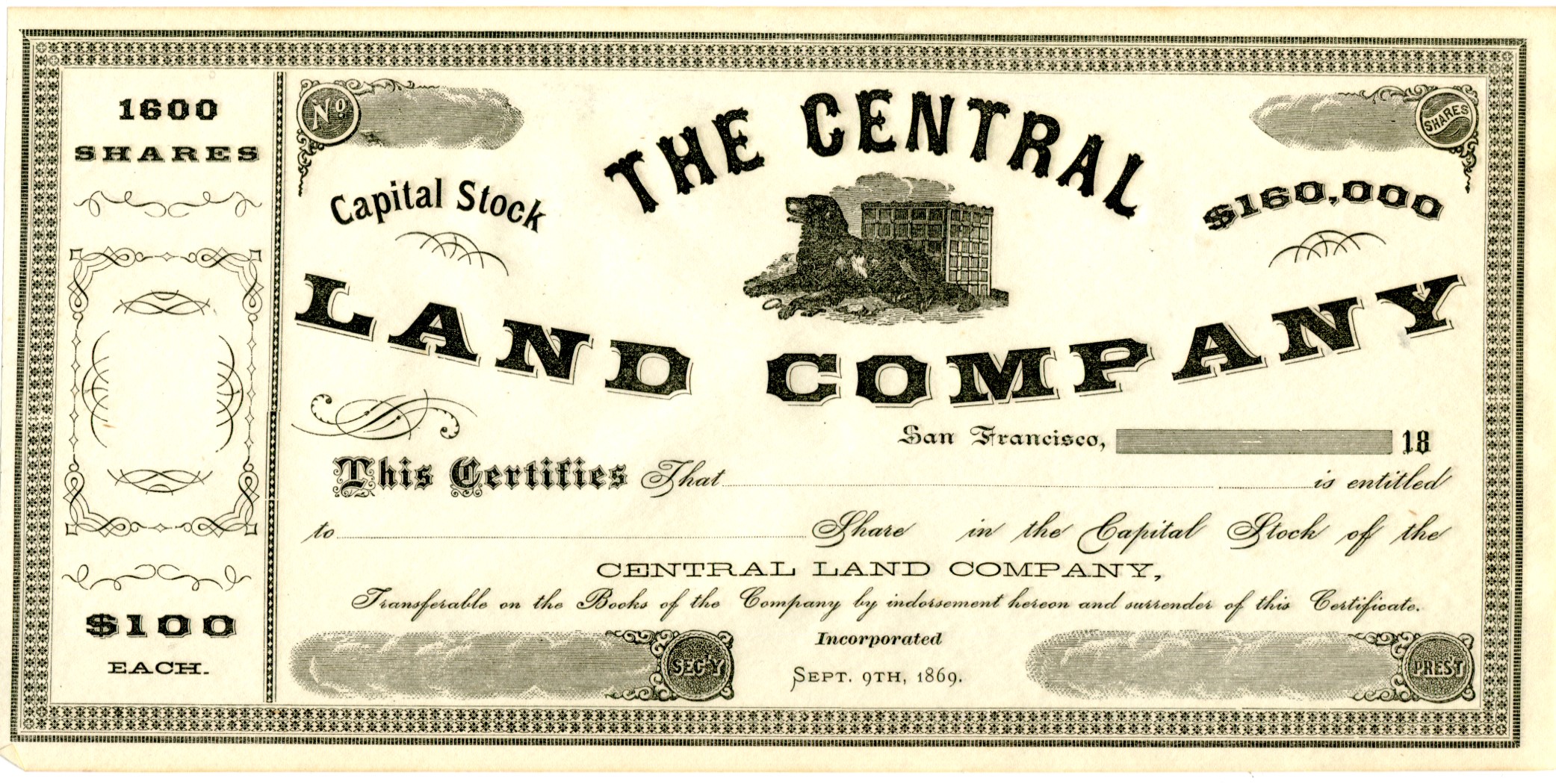
This unissued certificate of The Central Land Company is dated
1869. It features a vignette of a dog guarding a strongbox.
The certificate is approximately 265mm x 130mm (10.5" x 5.25").
Item
STK-LAND THE CENTRAL LAND CO. STOCK
CERTIFICATE, 1869
UNISSUED
$12.00
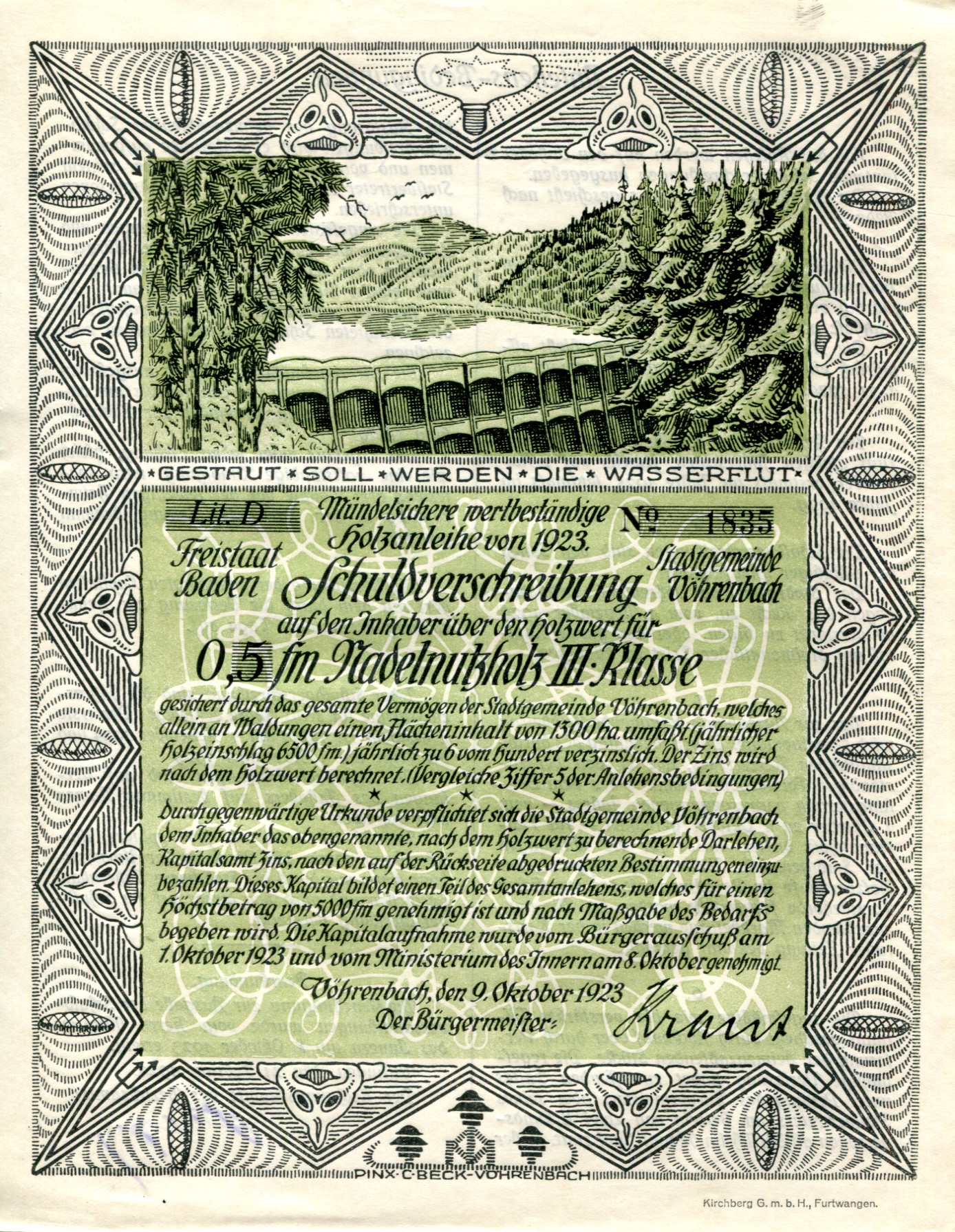
SCARCE AND UNUSUAL GERMAN
TIMBER BONDS
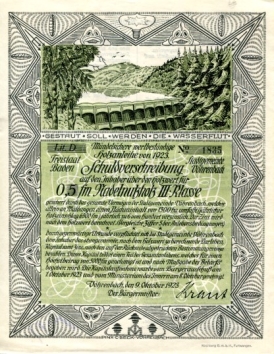
By
1923 Germany was suffering from some of the world's worst
hyperinflation. Few wanted to hold bonds as no-one knew if
they would be worth anything in the future. To get around the
problem bonds were made payable in commodities, rather than rapidly
depreciating German Marks. Interest and principal payments were based
on the value of the commodity, which was expected to keep its buying
power in times of hyperinflation. The small town of
Vohrenbach (population about 2100) in the State of Baden issued these
bonds payable in timber dated October 9, 1923 in order to finance the
construction of the Linach Dam. The dam is pictured on the
bond. It is 143 meters (469 feet) long and 25 meters (82 feet) high and
provided hydro-electric power to the town. The town owned ample timber
resources in the Black Forest to back the bonds. The bonds
are valued at .5 or .25 solid cubic meters of Class III coniferous
commercial timber. The bond paid the equivalent of
6% interest and was paid in five equal annual installments
from 1925 to 1929. The certificate is 180 x 230mm and may
include coupons. It is a scarce and unusual commodity bond issued
during a period of extreme inflation.
Item
BND-TIMBR.5
VOHENBACH, GERMANY .5 CUBIC METERS BOND, 1923
XF
$12.00
Item
BND-TIMBR.25
VOHENBACH, GERMANY .25 CUBIC METERS BOND,
1923
XF
$11.00
BIG
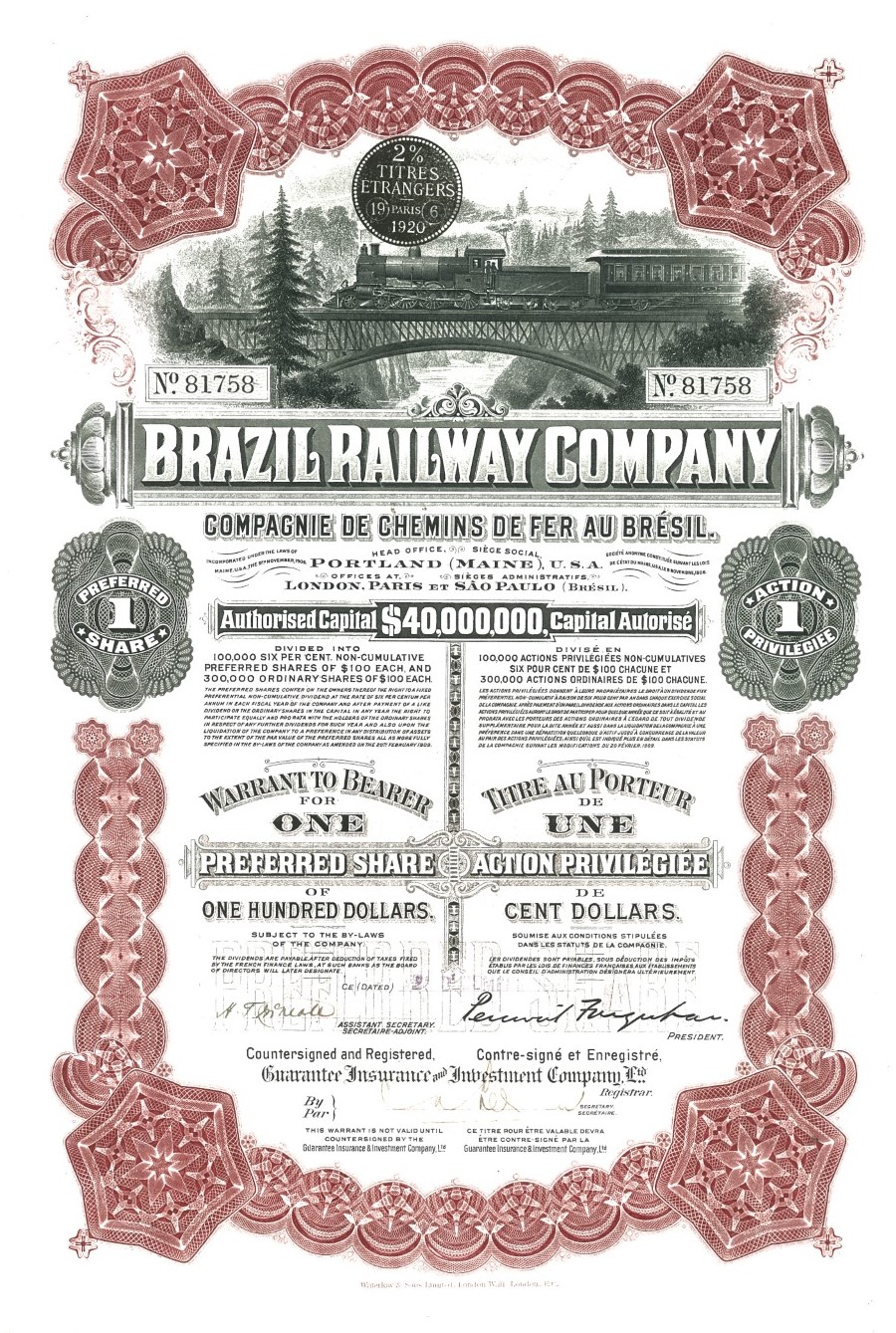
BEAUTIFUL HISTORIC BRAZIL RAILWAY COMPANY STOCK CERTIFICATE
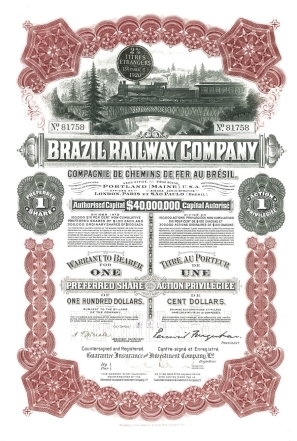
This
big and beautiful red Brazil Railway Company stock certificate
features an attractive vignette of a passenger train crossing a bridge.
The red bearer certificate is for 1 Preferred Share $100 that paid a 6%
dividend. It is 14”x 9.5”(36 x 23cm). The Brazil Railway
Company was founded in 1906 and headquartered in Maine. It
was part of an international consortium of companies operated by
American financier Percival Farquhar which controlled railways, steel
mills, cattle ranches, mines and other industries in the United States,
Latin America and Russia that was largely financed by European
investors. The certificate was printed in London by Waterloo
and Sons, Ltd. It is dated 1910, when it was first
sold to French investors. The first 16 coupons are
clipped, indicating the owner collected quarterly dividends
until 1914. The collapse of the Brazilian rubber industry in
1913, attacks by peasants displaced by the railroad and the outbreak of
World War I forced the company into receivership in October 1914. It
was one of the largest bankruptcies at the time. Little could
be done to resolve bankruptcy until after the war.
As part of the reorganization process the certificate was overprinted
on the back indicating it would no longer collect dividends and was
imprinted with a French revenue stamp dated 1920 to lock in legal
claims against the company. In 1940 Brazil nationalized what
remained of the railroad. The liquidation of the company
continued until l970, by which time most any remaining funds were eaten
up by lawyers and administrators. Shareholders were paid
nothing. It is an impressive and historic stock certificate
that was printed in London, for a company headquartered in the United
States, that ran railroads in Brazil, and was financed by the
French.
Item
STK-BRAZIL RAZIL RAILWAY COMPANY PREFERRED
STOCK
CERTIFICATE,
XF
$20.00
OLD CHINESE
LOTTERY LOAN BOND
The Republic of China issued this 5 Dollar Second Nationalist
Government Lottery Loan bond in 1926 to raise money to finance
improvements in the Port of Whampoa in Canton, (now Pazou, a section of
Guangzhou). Rather than pay interest the bonds were
automatically entered into a tri-monthly lottery that paid prizes from
$1,000 to $50,000. This made the bonds popular with the Chinese, who
are natural gamblers. The front of the bond is in Chinese,
the reverse in English. Both the front and back are
underprinted with a map of the port. The bonds specify that they are
denominated as "5 Dollars Canton Currency". At the
time the bond was issued China was involved in a three-way civil war
between Northern China, Southern China and the Communists, each issuing
its own currency, so it was necessary to specify which exactly Chinese
currency. The bond measures about 7 1/4" x 5" (18cm
x 13cm).
Item
BND-CN26-5D CHINA 5
DOLLARS 1926 LOTTERY LOAN BOND, VF-XF
$10.00
 CLICK
HERE FOR WORLD WAR II COIN & CURRENCY PAGE
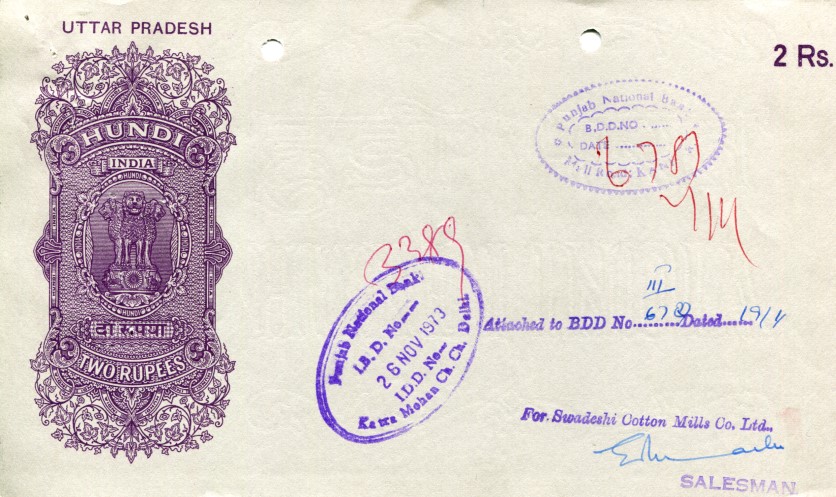
HUNDIS FROM INDIA
The Hundi is a financial instrument developed by the native bankers in
India. It can perform a variety of banking tasks.
Depending on how it is written it may act like a Bill of Exchange,
extension of credit, transfer of funds, or a travelers check. The
Indian government, seeing a lucrative source of revenue, required all
Hundis to be written on a special watermarked government form bearing a
tax imprint. We offer a set of two Hundi notes. One
is mostly blank
form that references another document, The other is on a pre-printed
form for the Swadeshi Cotton Mills
Company Limited. The Hundis are approximately 220mm x 130mm (5.25” x
8.75”) and were issued in the 1970’s. It is an unusual financial
instrument that is rarely offered for sale.
Item
PM-HUNDI SET OF 2 INDIAN HUNDI NOTES:,
CANCELLED $4.50
SOVIET
UNION LOTTERY BONDS
Opportunities for
savings or investment were severely limited in the Soviet
Union. One could put their money into the state bank which
paid 2% to 3% interest or one could buy government issued lottery
bonds. These 25 and 50 Ruble lottery bond was issued by the
Soviet
Union in 1982. Monthly drawings were held over a
20-year period. Prizes ranging from 100 Rubles to 10,000 Rubles
(or a new Volga automobile and 5000 Rubles. Over the 20-year period
approximately 32%
of the bonds would be drawn for a prize, the rest would get back their
principal. With the collapse of the Soviet Union in 1991 and
subsequent inflation, the bonds became virtually worthless.
The green bond measures 160 x 116mm. They are historic items
from the final decade of the Soviet Union.
Item
BND-USSR82-25R
USSR 25 RUBLES BOND, 1982 VF-XF
$3.75
Item
BND-USSR82-50R
USSR 50 RUBLES BOND, 1982 VF-XF
$4.50
Item
BND-USSR82-X2
BOTH OF THE ABOVE USSR 25 & 50 RUBLES BONDS, 1982
$7.00
OLD MINING COMPANY
STOCKS
Mining Companies were once the hottest, most speculative stocks around,
much like technology stocks are today. We have a collection of 8 old
mining stock certificates dating from the late 19th century to the
mid-20th century. The collection includes cancelled certificates from
Dayrock Mining Co., Goldfield Consolidated Mines Co., Marsh Mines
Consol-idated, Monitor Mining Co., Sherman Lead Co., Tamarack &
Custer Consolidated Mining Co., United States Mining Co. and an
unissued certificate of Hercules Mining Co.. The companies are all long
gone. The Goldfield, Monitor, and Tamarack certificates have
nice vignettes of miners at work. It is a fun and historic
collection that is worthy of framing.
Item
STK-MINE8 8 DIFFERENT OLD MINING CO. STOCK
CERTIFICATES
$15.00
<--
PREVIOUS
PAGE NEXT PAGE -->


 The
Hypothec Bank of Japan issued these 10 Yen Bonds between 1917 and 1920
(Series 67 to 75). The bonds paid 4% perpetual annual
interest and entered the bearer eligible for a semi-annual lottery
drawing of prizes ranging from 5 Yen to 1500 Yen. Many bought the bond
for a chance to win a prize - and be assured of a steady retirement
income. At the time the bonds were issued that was
equivalent to about 2 years salary for an entry level professional or
could purchase a comfortable house. Even the smaller prizes
had significant purchasing power - and the bond would continue to pay
4% interest. Following World War II, the value of the
Japanese Yen plummeted. In 1957 the bonds were called by the
bank, they ceased paying interest and the lotteries were
ended. 10 Yen was a modest copper coin. The annual
interest was too small of an amount to redeem. The top prize
1500 Yen might buy a pair of work shoes or a jacket. For many it was
hardly worthwhile to spend the effort to collect the lottery
prizes. It is an interesting piece of history that survived
World War II, but was killed by inflation. The bond includes
some coupons.
 By
1923 Germany was suffering from some of the world's worst
hyperinflation. Few wanted to hold bonds as no-one knew if
they would be worth anything in the future. To get around the
problem bonds were made payable in commodities, rather than rapidly
depreciating German Marks. Interest and principal payments were based
on the value of the commodity, which was expected to keep its buying
power in times of hyperinflation. The small town of
Vohrenbach (population about 2100) in the State of Baden issued these
bonds payable in timber dated October 9, 1923 in order to finance the
construction of the Linach Dam. The dam is pictured on the
bond. It is 143 meters (469 feet) long and 25 meters (82 feet) high and
provided hydro-electric power to the town. The town owned ample timber
resources in the Black Forest to back the bonds. The bonds
are valued at .5 or .25 solid cubic meters of Class III coniferous
commercial timber. The bond paid the equivalent of
6% interest and was paid in five equal annual installments
from 1925 to 1929. The certificate is 180 x 230mm and may
include coupons. It is a scarce and unusual commodity bond issued
during a period of extreme inflation.
 This
big and beautiful red Brazil Railway Company stock certificate
features an attractive vignette of a passenger train crossing a bridge.
The red bearer certificate is for 1 Preferred Share $100 that paid a 6%
dividend. It is 14”x 9.5”(36 x 23cm). The Brazil Railway
Company was founded in 1906 and headquartered in Maine. It
was part of an international consortium of companies operated by
American financier Percival Farquhar which controlled railways, steel
mills, cattle ranches, mines and other industries in the United States,
Latin America and Russia that was largely financed by European
investors. The certificate was printed in London by Waterloo
and Sons, Ltd. It is dated 1910, when it was first
sold to French investors. The first 16 coupons are
clipped, indicating the owner collected quarterly dividends
until 1914. The collapse of the Brazilian rubber industry in
1913, attacks by peasants displaced by the railroad and the outbreak of
World War I forced the company into receivership in October 1914. It
was one of the largest bankruptcies at the time. Little could
be done to resolve bankruptcy until after the war.
As part of the reorganization process the certificate was overprinted
on the back indicating it would no longer collect dividends and was
imprinted with a French revenue stamp dated 1920 to lock in legal
claims against the company. In 1940 Brazil nationalized what
remained of the railroad. The liquidation of the company
continued until l970, by which time most any remaining funds were eaten
up by lawyers and administrators. Shareholders were paid
nothing. It is an impressive and historic stock certificate
that was printed in London, for a company headquartered in the United
States, that ran railroads in Brazil, and was financed by the
French.