ODD & CURIOUS MONEY
THE
COIN WITH A SOUL!
The "Kissie Penny" or "Gizzie Iron" are twisted iron rods, about 10
inches (18 to 24cm) long, that were used for money in Liberia
and Sierra Leone from the 19
th to the mid 20
th
century. They were said to contain a soul. If the Kissie were broken,
the soul would escape and it would be valueless. Of course, the local
"witch doctor" could restore the soul, for a small fee. A
bunch of bananas might cost 2 Kissies, a cow 2000 Kissies, or a bride
4000 Kissies.
Item
KISSIE WEST AFRICAN KISSIE PENNY $7.00
Item
KISSIEx5 5 PIECES OF WEST AFRICAN KISSIE
PENNY $20.00
AFRICAN
SLAVE
BRACELET MONEY

Reduced size image
The Manilla, also called "slave bracelet money" was used extensively on
the "slave coast" of west Africa. It comes in various sizes
and forms,
though it was usually made from a copper and lead alloy. The value
fluctuated from time to time and place to place. Manillas were often
manufactured in Europe for use in the African slave trade. In the 15
th
and 16
th century male slaves went for 2 to 10
Manillas each. By the time the Manilla was demonetized in Nigeria in
1947 it was worth only 3 pence. This Manilla is
about 2.25 to 2.5 inches (6 cm.) across and was used from the
18
th
to the mid 20
th Centuries.
Item
MANILLA WEST AFRICAN MANILLA
$15.00
Item
MANILLAx5 5 of the above WEST AFRICAN
MANILLAS
$49.50
ANCIENT CHINESE SPADE
COIN 

This
square foot spade coin was minted by the State of Yan between about 350
and 250BC, during China’s Warring States Period. Yan was the
most north-eastern of the major states. For much of its history the
capital was at Ji, in what is now Beijing. Faced
with threats from nomadic tribes from the north it constructed early
segments of what became the Great Wall of China. Spade coins
were shaped like a spade or weeding tool, but are too small and thin to
have any purpose other than their use as money. These “An Yang” style
copper spade coins are about 45mm x 25mm. The coins show minimal wear,
but are a bit crusty having been buried for over 2000 years.
Item
CN-SPADE CHINESE SPADE COIN, circa 350-250BC
F-VF-crusty
$125.00
BEAUTIFUL
CHINESE
MOTHER OF PEARL GAMBLING TOKENS

These
beautiful, hand carved mother-of-pearl gambling tokens were made in
China from about 1720 until about 1840 and used in Europe and America
gaming counters and gambling chips. They come in a wide variety of
shapes (round, rectangular, oval, even fish shaped) and sizes and are
etched with intricate patterns and motifs. Most are about 28mm to
55mm.
Item CN-MOPx1 1 CHINESE MOTHER OF PEARL
GAMBLING TOKEN
$25.00
CHINESE
BAMBOO MONEY
This unusual bamboo money was issued by the Guang Shan Private Bank, in
Suzhou China. It is denominated 1000 Wen and dated 1928 in the Chinese
cyclical calendar. One side has the value impressed into the
bamboo. The other side has the serial number and the name of
the bank. Each piece bears a unique serial number and is made
with a hole to make it easy to carry on string. To make sure
someone could find the bank, complete directions (inside the Chang
gate, east of the Li Sui Shi bridge, Sha Tang Blvd) are given along the
edge (in Chinese, of course). It is about 129 x 15mm. These were
discovered in the late 1990's, hidden inside a wall of a building that
was being demolished in Suzhou.
Item
CN-BAMB1000CHINA 1000 WEN BAMBOO MONEY 1928
F-VF$39.00
DANISH
ENCASED POSTAGE STAMP MONEY

These
encased postage stamps were issued in Denmark to help ease a coin
shortage
caused by World War II. A regular postage stamp was attached
to a
small cardboard holder and wrapped in cellophane or a similar
product.
Advertising was printed on the back of the holder to defray the cost of
the packaging. We have the 1 Ore encased postage stamps, with a wide
range
of advertising on the back. These are an unusual and rarely
seen
World War II monetary item. Because these come with many different
reverses,
the one you get may not be just like the one in the picture.
Item
DEN-STMP
DENMARK WWII ERA ENCASED POSTAGE STAMP $5.00
Item
DEN-STMPx3
3 DIFFERENT DENMARK WWII ERA ENCASED POSTAGE
STAMPS $12.00
RARE, OLD WOODEN
MONEY FROM MEXICO

This
wooden Hacienda token was issued by the Trancoso Hacienda in the 19th
century. The Trancoso was one of the largest and most
important haciendas in Zacatecas state of Mexico. It was founded with
Spanish land grants between 1670 and 1680 as a cattle ranch.
It covered over 55 square miles (145 sq.km.). In the 19th
century it became one of the largest wool exporters in Latin America.
Like many haciendas of that era it a was engaged in wide range
enterprises including growing grain, animal husbandry, a distillery and
a church. It fell on hard times after the 1910-1920 Mexican
Revolution, resulting in violent conflicts between the owners and
peasants. Eventually the land was expropriated and much of it given to
families who lived on the Hacienda. Today the municipality of
Trancoso oversees what was the hacienda. The church
and the grand buildings that were part of the hacienda still stand,
though many have been vandalized in recent years. Most
hacienda tokens are metal. This unusual piece was made of Mesquite
wood. It is about 26 to 28mm. One side is branded with
Trancoso Hacienda's brand, the other side is blank.As was common for
Hacienda tokens, it was denominated for a unit of
work. This was for sheering one sheep. Like many hacienda
tokens, it
circulated as money in the area. It is an unusual and
historic piece of money. Like many hacienda tokens, it
circulated as money in the area. It is an unusual and
historic piece of money.
Item
MX-TRANCOSO TRANCOSO WOODEN
HACIENDA TOKEN, VF
$24.00
ANCIENT OLBIA
DOLPHIN COIN

Olbia
was a Greek city on the Black
Sea in what is now Ukraine. Between the 5th and 3rd century
BC it issued these unusual bronze dolphin shaped coins. Dolphins were
common in the region and were considered sacred. The crudely
cast coins vary in size, from about 18mm to 26mm and lack
tails. This coin was minted without inscriptions. They are
one of the most unusual ancient coins
available, yet are remarkably affordable.
Item
OBLIA
OLBIA "DOLPHIN" COIN, circa 5th-3rd
Century BC, crude $25.00
SIAMESE
SILVER BULLET MONEY

No, the Lone Ranger did not use Silver
Bullet Money. Silver bullet money, also called Pot Duang, was
what was used in Thailand for money until the late 1800's. It was made
by bending a small silver bar into a ball and applying two official
punches indicating the king and dynasty that issued the
coin. These 1 Baht silver bullet coins were issued
by King Mongkut between 1861 and 1861, weigh about 15 grams and are
about 14mm in diameter. Mongkut is noted for modernizing and
bring western technology to Siam. He is remembered in through
movie and musical "The King and I"
Item
TH-BULLET SIAM SILVER BULLET MONEY 1
BAHT 1851-1861 C137.1 VF
$50.00
SIAMESE
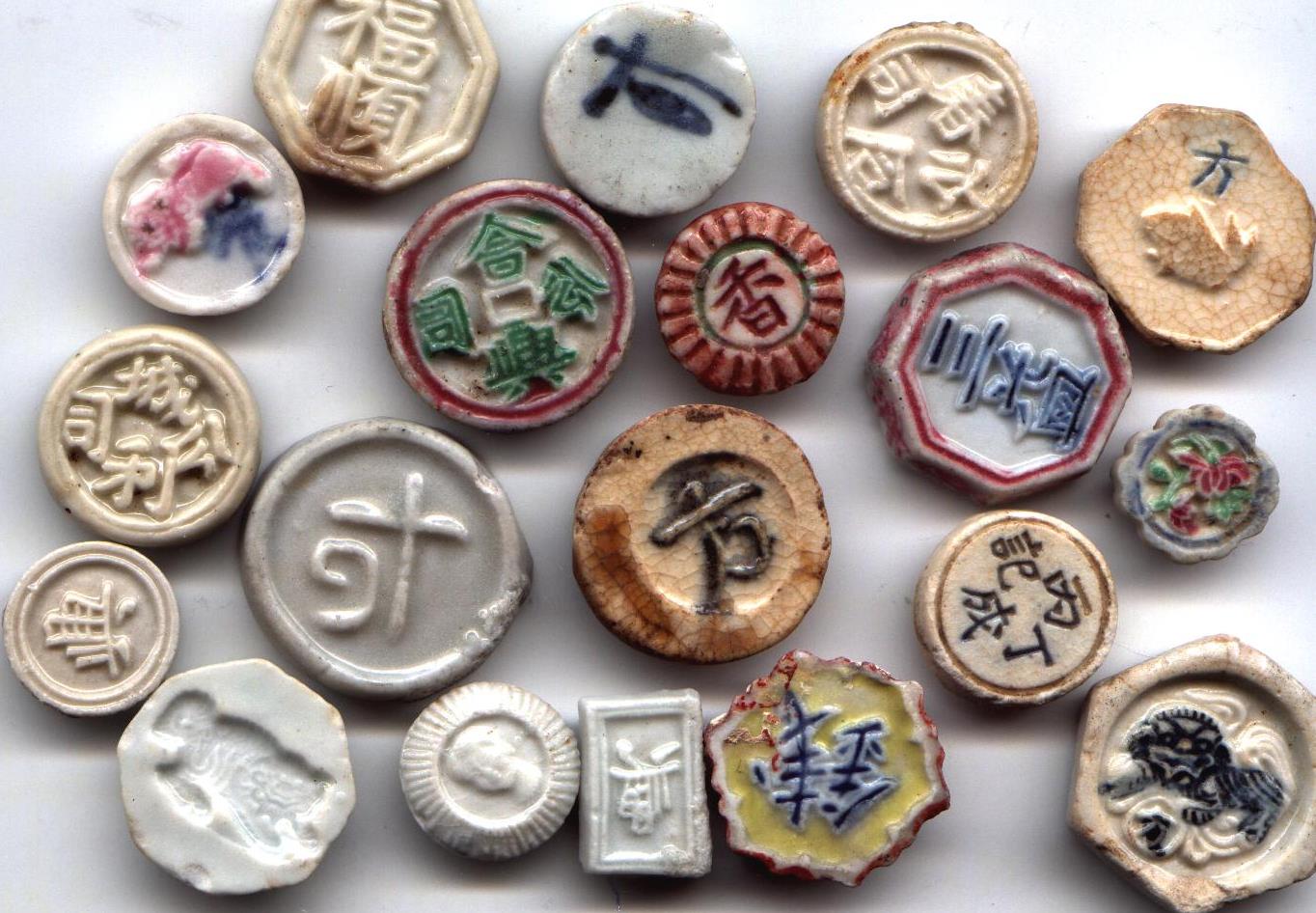
PORCELAIN MONEY

There
was often a shortage of small change in 19th century Siam. Porcelain
gaming tokens, known as Pees, were issued by Chinese owned gambling
houses were widely used as money in Siam during the 18th and 19th
century. After a period of time the gambling houses would recall the
tokens and they would be declared valueless, resulting in a substantial
profit to the issuer. This porcelain gambling token has the raised Chinese character "Xing", which

translates as "Prosperity increase". The other side has
denomination 2 Pai (1/16 Baht) incused in blue.
Item
TH-PORC SIAM 19th CENTURY PORCELAIN
MONEY VF
$9.00
AFRICAN
COINS
FEATURE TRADITIONAL AFRICAN MONEY 
Six member nations of the African Development Bank issued a
series of coins, each of which features a form of traditional money
used
in the member nation. Each coin bears the denomination of
1500
CFA Francs. The coins are 27mm nickel-plated steel and are dated
2005. One side features an
Elephant’s head and a map of Africa while the other features a form of
traditional
money. The Cameroon issue features a Mambila. Three pieces of
Spear
Money is shown on the coin of the Central African Republic. A
Manilla
is shown on the Chad issue. A Katanga Cross is on the coin
from
the
Congo Republic. A pair of Cowrie shells is on the Equatorial
Guinea
coin. The Gabon coin shows a piece of Throwing Knife
Money. Each coin has a mintage of only 2005 pieces!
Individually
they are interesting coins. As a
set they display the
wide range of items used for money in Africa prior to the introduction
of
coins and currency.
Item
CM-PRIM CAMEROON 1500 FRANCS 2005 Mambila
Br.X26 Unc. $9.50
Item
CF-PRIM CENTRAL AFRICAN REPUBLIC 1500 Francs
2005 Spear Money Br.X12
Unc. $9.50
Item
TD-PRIM CHAD 1500 Francs 2005
Manilla Br.X19
Unc.$17.50
Item
CG-PRIM CONGO REPUBLIC 1500 Francs 2005
Katanga Cross Br.X46 Unc.
$9.50
Item
GQ-PRIM EQUATORIAL GUINEA 1500 Francs 2005
Cowries Br.X124 Unc.
$9.50
Item
GA-PRIM GABON 1500 Francs 2005 Throwing knife
Money Br.X16
Unc. $9.50
Item
AFRICA-PRIM SET OF ABOVE 6 AFRICAN COINS
PICTURING PRIMITIVE MONEY Unc.
$59.00
<--
PREVIOUS PAGE
NEXT PAGE
-->