BI-METALLIC
2 EURO COINS





 Because
of its remoteness in Antarctica, most of Marie Byrd Land has not been
claimed by any sovereign nation, though it has been claimed by various
micro-nations. It was named by explorer Admiral Richard E. Byrd in 1929
after his wife. I am sure she deserved it for putting up with his
numerous explorations and adventures. In 2011 a trimetallic 10 Dollar
was issued for this remote area. One side of the 27mm coin pictures
Pope John Paul II and commemorates his beatification on May 1, 2011.
There is a
certain irony in
a coin being issued honoring the Pope for the only continent that
the Pope never visited. The other side shows a map of the territory
and a penguin.
 KNIGHT ON HORSEBACK ON
BI-METALLIC AUSTRIAN COIN
 Margrave
Heinrich I in armor on horseback is featured on the 1996 bi-metallic
Austrian 50 Schilling. The coin commemorates Austria's 1000th
Anniversary. Below is the word "Ostarrichi" as it first
appeared in 996 in a document issued by Emperor Otto III. The
name meant "Eastern Realm". It was the first written
reference to Austria. Heinrich I, also known as Henry the
Strong was the Margrave of Austria. He was of the House of Babenberg,
whose arms appear below the horse. The obverse of the 26.5mm
bi-metallic coin depicts the shields of the 9 Landers (states) of
modern Austria.DOVE OF PEACE ON
BOSNIA-HERZEGOVINA BI-METALLIC COIN
 The
dove of peace holding an olive branch in its beak is featured on this
bi-metallic 2 KM (Konvertible Marka or Convertible Mark) coin of
Bosnia-Herzegovina dated 2000. The design represents peace
between the country's major ethnic groups. The name of the
country in both the Latin and Cyrillic alphabet and the denomination is
on the obverse. Bosnia-Herzegovina was wracked by civil wars
between the Bosniaks, Serbs and Croatians after the breakup of
Yugoslavia, each of which used their own currency. In 1998,
as part of the process of uniting the nation a new currency was
introduced called the Konvertible Marka that was tied one to one to the
German Mark. Even though Germany ceased using the Mark when
it switched to the Euro in 2002, Bosnia-Herzegovina continues to use
the Konvertible Marka, though it is now tied to the Euro.
 BRAZIL RIO OLYMPIC COIN
SET


 This
unofficial bi-metallic 4500 Franc coin was issued for
Cameroons shortly after the ascension of
Pope Benedict XVI in 2005. The coin features a terrible,
toothy
portrait of Pope Benedict XVI. It makes the Pope
look like
a vampire. A map of Africa and an elephant's head
is on the
reverse.CANADA
CELEBRATES 50th ANNIVERSARY OF CN TOWER
 Canada
issued colored and uncolored versions of their 2026 bi-metallic
2 Dollar coin for the 50th Anniversary of the CN Tower in Toronto. The
color version glows in the dark to reveal the Toronto skyline at
night. Both versions have the same design, featuring the CN
Tower against the 2026 Toronto skyline, whose modern skyscrapers tower
above an outline of the city’s skyline as it appeared in
1976. Views of the 1976 skyline appears on the left side of
the outer ring. The 2026 skyline appears on the right
side. King Charles III is on the obverse. At a
height of 1815 feet (533 m) it was the tallest free standing structure
in the world from the time it opened in 1976 until 2007. The
name CN originally referred to the Canadian National Railway who built
the it on a former railyard as a communications and observation
tower. In 1995 it was transferred to the Canadian
government. At the time it was built Toronto's skyline was
growing rapidly. New, taller buildings would frequently
interfere with existing microwave links and broadcast
signals. The tower, being high above the Toronto skyline,
eliminated this problem.
 Canada
featured their Tomb of the Unknown Soldier on colored and uncolored 2
Dollar coins in 2025. The tomb, located in front of the
National War Museum in Ottawa holds the remains of an unidentified
Canadian soldier who died in France in World War I. The tomb
honors all Canadians who died in combat. Behind the tomb are
the silhouettes of four sentries representing all Canadians. In front
is a poppy. The poppy is red in the colored version of the
coin. King Charles III is on the obverse.
 Canada
commemorated the 100th anniversary of the birth of artist Jean-Paul
Riopelle with 2023 colored and non-colored 2 Dollar coins.
The reverses of the coins depict elements from panel 29 of his 132 foot
long (40.39m) 1992 work L’Hommage
a Rosa Luxemburg. The spray-paint and
acrylic work was done as a tribute to American painter Joan Mitchell,
which whom he had a close relationship. Rosa Luxemburg was a
communist who was executed in 1919 after attempting to overthrow the
German government.
Canada has not yet approved a portrait of
Charles III so the Susanna Blunt portrait of Queen Elizabeth along with
the dates 2023 1952 + 2022 is on the obverse.
 Canada
issued both color and non-colored circulating bi-metallic 2 Dollar
coins in 2022 to commemorate the 50th anniversary of their victory in
the Summit Series ice hockey games against the Soviet Union held in
September 1972. Both nations considered themselves to be the
best in the world. The Summit Series was set to prove it. It
was a series of eight games, the first four held in Canada and the last
four in the Soviet Union. This was during the Cold War. Both
fans and players had intense feelings of nationalism. Canada
went into the series confident they would sweep the series, but it was
not to be. The Soviets were a lot better than they
expected. Going into the final game of the series the games
were evenly split, with three wins and a tie. The Soviets led
in the number of goals scored. An estimated 15 out of 22
million Canadians tuned into the final game. It was a tense
and dramatic game, with Team Canada overcoming a two-goal Soviet lead
after two periods. Canada scored the final game winning goal with just
34 seconds left to play. The coin depicts two Team Canada
players in their distinctive red and white uniforms. The
coaches’ initials and the players’ jersey numbers surround the inner
core. The Royal Canadian Mint pledged that the net
proceeds from the sale of the coins will be donated to the Ukraine
Humanitarian Appeal.
 Canada
issued two circulating bi-metallic two-dollar coins in 2021 to
commemorate the 100th anniversary of the discovery of
insulin. The collaboration of Canadian scientist Frederick
Banting, Charles Best, James Collip and John Macleod led to the
isolation and purification of insulin, which offered a life-saving
treatment to those with diabetes. The designs of the coins include an
insulin monomer, scientific instruments used in the early formulation
of insulin (vial, mortar and pestle, and Erlenmeyer flask) overlaid on
a maple leaf, as well as red blood cells, glucose, and insulin
molecules. Two versions of the coin were issued,
one with the insulin monomer in blue, the color used to raise diabetes
awareness, the other without color. The obverse features the
Susanna Blunt portrait of Queen Elizabeth II.
 Canada
commemorated the 75th anniversary of the end of World War II
with this multi-color 2020 2 Dollar coin.
The coins have similar reverse designs which were adapted from Canada's World War II era Victory 5 cent
coins. The designs feature a torch and a large "V"
in the center. On the outer ring is the inscription "WE WIN WHEN WE
WORK WILLINGLY" in Morse code and the words Victory and
Remember are in
English and French. At the top are two shifting images of a
maple leaf within the line pattern. The obverse depicts the
portrait of Queen Elizabeth II. Canada
commemorated the 100th anniversary of the birth of artist Jean-Paul
Riopelle with 2023 colored and non-colored 2 Dollar coins.
The reverses of the coins depict elements from panel 29 of his 132 foot
long (40.39m) 1992 work L’Hommage
a Rosa Luxemburg. The spray-paint and
acrylic work was done as a tribute to American painter Joan Mitchell,
which whom he had a close relationship. Rosa Luxembutrg was a
communist who was executed in 1919 after attempting to overthrow the
German government.
Canada has not yet approved a portrait of
Charles III so the Susanna Blunt portrait of Queen Elizabeth along with
the dates 2023 1952 + 2022 is on the obverse.
 Cape
Verde is a group of ten islands located 350 miles (570 km.) off the
coast of Western Africa. It gained independence from Portugal
in 1975. To celebrate the 40th anniversary of independence,
and the 40th anniversary of its central bank it issued this circulating
28.5mm bi-metallic 250 Escudos dated 2015. One side,
commemorating 40 years of development and features a school teacher,
windmills, a family and other images. The other side
commemorates the 40th anniversary of Banco de Cabo Verde. It
includes the national arms and various monetary and financial symbols
(looks like the designer had fun with the wingdings fonts).
 China
commemorated the Year of the Tiger with this attractive 27mm
bi-metallic 2022 dated 10 Yuan coin. The reverse depicts a traditional
artistic paper-cutting of a tiger, a palace lantern and tree
branches. The obverse features the denomination surrounded by
an intricate etched floral design. The large number 10 contains latent
images which change from "R M B" to "10 10 10" when the coin is moved.
The design also features micro-letters and other anti-counterfeiting
devices.
 China
commemorated the Northeast China Tiger and Leopard National Park on
this 2024 bi-metallic 10 Yuan coin. The park was launched in 2017. It
covers 5,642 square miles (14,612 sq.km.) bordering Russia and North
Korea. The coin depicts a tiger sitting in the foreground and
a
walking leopard in the background. The emblem of China and
the date
are on the obverse of the 27mm coin.CHINA 2025 YEAR OF THE SNAKE
COIN AND BANKNOTE

 China
released a 2025
dated bi-metallic 10 Yuan coin and a colorful 2024 20 Yuan polymer
banknote to commemorate the Year of the Snake. The 27mm coin
depicts a
traditional artistic paper cutting of a snake, a palace lantern, and
plants the reverse. The denomination surrounded by an
intricate etched
design is on the obverse. The large number 10 contains latent images,
which change from Western to Chinese characters as the coin is
moved.
The 20 Yuan note features a stylized snake, the denomination in SPARK
optical and a clear window on the front. The back features
three
children hanging a Spring Festival banner in front of Shanxi residents
and legends in Chinese, Mongolian, Tibetan, Uyghur and Zhang.AUSTRALIA 2025 YEAR OF THE SNAKE SILVER DOLLARCHINA
2026 YEAR OF THE HORSE COIN AND BANKNOTE

 China
released a 2026 dated bi-metallic 10 Yuan coin and a colorful 2026 20
Yuan polymer banknote to commemorate the Year of the Horse.
The 27mm coin depicts a traditional artistic depiction of a prancing
horse, a palace lantern, and plants the reverse. The
denomination surrounded by an intricate etched design is on the
obverse. The large number 10 contains latent images, which change from
Western to Chinese characters as the coin is moved. The 20
Yuan note features a stylized prancing horse, the denomination in SPARK
optical and a clear window on the front. The back features
three children playing musical instruments and legends in Chinese,
Mongolian, Tibetan, Uyghur and Zhang. The polymer note is 70
x 145mm, COSTA
RICA CELEBRATES ANNEXATION OF PARTIDO DE NICOYA WITH BI-METALLIC
 In
1824, the residents of Partido de Nicoya voted to become part of Costa
Rica rather than join Nicaragua. The event significantly expanded Costa
Rican territory and enriched the nation culturally. The event
is celebrated annually in Costa Rica.In 2024 a bi-metallic 500 Colones
was issued to commemorate the event. The obverse includes a
partial map of Costa Rica with the region shaded. Next to the
map is a Guanacaste tree, which grows extensively in the region and is
Costa Rica's national tree. Below is a woman in a traditional
dress. The reverse includes a latent image that changes from
"BCCR" (initials of the Central Bank) to "500" as the coin is tilted.
 Egypt
recently released a number of circulating commemorative coins in an
effort to bolster support of the government. The coins have a
common obverse which includes the name of the country in Arabic, the
denomination in Arabic and English and both the AD and AH
dates. The 1 Pound coins are 25mm bi-metallic with a
brass-plated steel center in a nickel-plated steel ring. The
50 Piastres are 23mm brass-plated steel coins.
 The 69th anniversary of National Police Day
is commemorated on a 2021 1 Pound coin. Police Day is in
remembrance of the 50 police officers of the Ismaila Police Station
that were killed or wounded when the British attacked the police
station with tanks on January 25, 1952 after the police refused abandon
the station and hand over their weapons. January 25 was
declared a national holiday in 2009 by Egyptian President Hosni Mubarak
to recognize the efforts of Egyptian police to maintain security and
stability. On Police Day in 2011 widespread protests against police
brutality and corruption led to a revolution which overthrew President
Mubarak. The bi-metallic coin features a winged eagle emblem and the
Arabic numbers 69.
 Egyptian
Medical Teams are honored on 50 Piastre and 1 Pound
coins. The coins feature four doctors. In order to
avoid offending conservative Muslims, the doctors have no facial
features. The coin is triple dated, bearing the date 2020
beneath the doctors, and AD 2021 and AH 1442 on the obverse.
 "Decent
Life" is an initiative of
Egyptian President Abdel Fattah El-Sisi's improve rural areas of
Egypt. The multi-year project, started in 2019, aims to
improve sewer, water, electricity, natural gas and internet access in
villages, improve housing, as well as health and education
projects. The Decent Life 50 Piastre and 1 Pound coins both
feature a female farmer, wheat ears, and the Decent Life emblem, which
looks like a smile in a box. The coins are dated 2021.
 Gough Island is an isolated island in
the South Atlantic.
Though located some 250 miles (400km.) south-east of Tristan da Cunha,
it is a dependency of Tristan da Cunha. It has only about six
inhabitants who operate a weather station and conduct
research. The island is a major bird sanctuary, though in
recent years many of the bird species have been endangered by mice
eating their eggs. In 2009 Tristan da Cunha released a 26mm
bi-metallic 25 Pence for Gough Island. The coine features an
owl on the reverse and Queen
Elizabeth on the obverse.
 For
over a year, Belgium has
not been able to create a national government because of
disagreements between the French speaking portions and the Dutch
speaking portions of the country. Despite the lack
of a
national government (or maybe because of a lack of a national
government), Belgium is doing better economically than most of
Europe. A number Belgians have advocated breaking the country
into two separate nations. Flanders is the Dutch speaking part of
Belgium. This 2010 1 Euro coin was created for the
Flemish Republic, which does not yet exist. One side has a
map of Flanders with the legend Vlaams €uro (Flemish Euro).
The other side features a Flemish lion.
 Hungary introduced this new
bimetallic 200 Forint coin in 2009 in order to replace the 200 Forint
banknote in circulation. The banknote will cease to be legal
tender. The coin pictures the famed Széchenyi Chain Bridge
one one side and has the date and denomination on the other.
The chain suspension bridge, completed in 1849, was the first
permanent bridge across the Danube to join Buda with Pest. In
1873 the two cities were united to form the Hungarian capital of
Budapest. At the time the bridge was built, its center span
of 202 meters (663 feet) was one of the largest in the world and was
considered by some to be a "Wonder of the World".
 Hungary
issued this circulating 2023 bi-metallic 100 Forint to commemorate the
175th anniversary of their Defense Forces. The Defense Forces
were first organized by Lajos Kossuth during the unsuccessful 1848
Hungarian Revolution. The obverse of the 23.8mm coin features
the emblem of the Hungarian Defiance Forces: a Turul, a mythical bird
of prey, holding the sword of Stephen I of Hungary in its claws, and
the shield of the Hungarian Defense Forces. The
denomination is on the reverse.

 India
recently released this 2016 dated bi-metallic 10 Rupee coin to
commemorate the 125th anniversary of its national archives. The
archives were founded in 1891 as the Imperial Records
Department. The coin depicts the National Archives
building in New Delhi on the reverse. The obverse of the 27mm
coin features the Lion Pillar of Ashoka and the denomination. The coin
is Uncirculated, but like most modern Indian coins, is poorly struck.
 This
attractive bi-metallic 250 Rials of the Islamic Republic of Iran
features a stylized Grenadine blossom on one side. The other side
includes the denomination and date is Arabic. The coin is
28.3mm in diameter. When first minted, it was the highest
denomination issued by the Islamic Republic of Iran. Due to ongoing
inflation, it soon became virtually worthless and was
demonetized. The coins dated between 1373 and 1375 in the
Solar Hijri calendar
which corresponds to 1994 to 1996AD.


 MACAU BI-METALLIC COIN DEPICTS
HISTORIC CHURCH
 This bi-metallic 1997 Macau 10 Pataca
coin was one of the last coins issued for Macao while it was under
Portuguese rule. China took control of Macau in 1999. At the
top of the obverse is a small bat. In Chinese lore bats bring
the five blessings: life, wealth, health, virtue and death after
achieving one's destiny. The reverse pictures St.
Dominic's Church. The church was built in 1587 by Spanish
missionaries and reconstructed in the early 17th century. The
church closed down in 1834. In 1997 it was renovated,
reopened and a museum added alongside the church.
 Moldova
started an annual series of circulating bi-metallic 10 Lei coins in
2018. The 2018 issue commemorates the 25th anniversary of the
national currency - the Leu, which translates as lion. The
coin features a lion, the Moldova national arms and the emblem of the
national bank. The 2019 issue commemorates the 30th
Anniversary of the adoption of the Latin alphabet (as opposed the
Cyrillic alphabet used in Russia) and the state language
laws. The obverse depicts the emblem of the national language
that features the mythological Charmed Bird. The reverse
includes the Latin alphabet in lower case letters. The 2020
issue commemorates the 30th anniversary of the adoption of the State
flag. The 2021 issue commemorates the 30th anniversary of the
National Bank. The design includes the national arms, the national bank
emblem and the number '30'. The reverses of all the coins
bear the denomination. At the top is a latent image that
changes from R to M (for "Republica Moldova") as the coin is
shifted. "BNM", the initials of the national bank, is
micro-engraved on the surface of the "1".
 The
Oratorio San Felipe Neri (San Felipe Neri Oratory) was built in 1688
for the Congregation of Oratorian Fathers in Panama. The church is
named for Philip Neri, who founded the Oratorians in 1575. It
is one of the oldest churches in Panama City. It is featured
on this 2019 dated 26.5mm bi-metallic 1 Balboa of Panama. The
other side of the coin depicts the arms of Panama.
 Panama
celebrated World Youth Day with regular and colored bi-metallic 1
Balboa coins. The 2019 World Youth Day was held in Panama
City in January 2019. The event was organized by the Catholic
Church and featured a visit by Pope Francis. It drew
thousands of young people from around the world.
Both coins feature the logo of the event on one side and the Panamanian
arms on the other. The logo was designed by a 20-year-old
college student. The logo, which is rich in Catholic symbolism. It
incorporates a silhouette of the Panamanian Isthmus and the Panama
Canal, a Pilgrim Cross, silhouette of the Virgin Mary, the five points
of the crown of Mary, also symbolizing the five continents.
The logo has both the shape of a heart and the letter 'M'.

 Poland
recently introduced a series of circulating bi-metallic 5
Zlotych coins with the theme "Discover Poland". Each coin
features historic, but often not well known places.
The 24.5mm coins have a
copper-nickel ring around an aluminum-bronze
center. The arms of Poland are on the obverse.
Poland honored the Poznan Town Hall (Ratusz) on this 2015 bi-metallic 5
Zlotych. The mannerist style
building was completed in 1560 and served as the seat of local
government until 1939. Today it houses a museum.
Each day at noon two mechanical goats come out from the clock tower and
butt heads. The coin depicts the town
hall. The two goats can be seen in the shaded are next to the
town hall. The 2016 5 Zlotych features The Priest's Mill
(KSIĘŻY MŁYN) in Lodz. The mill is a vast housing and
industrial complex built in the 1870's on land which originally
belonged to the Rector of the Parish of Lodz. The almost completely
preserved complex includes a spinning mill, factory buildings, shops,
two hospitals, a school, workers housing and owners and directors
estates covering over 1200 acres (500 ha). Today it
is a monument to 19th century industrial designs and company
towns.
SCREW-HORNED GOAT ON LAST
BI-METALLIC 5 RUBLE OF THE USSR
 A
screw-horned goat, also known as a Makhor, is featured on this 1991
bi-metallic Soviet 5 Ruble coin. It was minted during the
brief period in late 1991 after the Soviet Union stopped using the
hammer and sickle on coins, but before the Soviet Union was dissolved
in December 1991. It one of the last coins issued by the Soviet Union.
It is also one of the first two coins in the Russian Red Book series
featuring rare and endangered wildlife.
 A
Black Sea Dolphin (Black Sea Aphalina) leaping from the water is
depicted on this 1993 bi-metallic Russian 50 Roubles. The double-headed
Russian eagle is on the obverse. The 25mm coin has an
aluminum-bronze center and copper-nickel ring. The coin was
struck at the Saint Petersburg mint and has a mintage of only 300,000,
which is why it commands a $30 catalog value. The
Russian war with Ukraine has caused the death of thousands of the
dolphins.


 BI-METALLIC RWANDA 100 FRANC COIN
 Rwanda
released this bi-metallic 100 Franc
(Amafaranga) coin UB 2996,. It is the highest denomination released
into
circulation. The coin features a copper center surrounded by a
copper-nickel ring. The design is simple, with the
denomination
on one side and the national arms on the other.
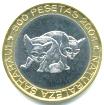

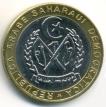 The
Saharawi Arab Democratic Republic, also known as Saharaui, is what used
to be the Spanish Sahara or Western Sahara. In 2004 Saharawi
issued
two bi-metallic 500 Peseta coins. One coin features a cute
pair
of
Fennecs, a long eared desert fox that is native to Saharawi. The other
commemorates the 28th anniversary of nation’s independence (though in
reality it is largely controlled by Morocco) and features a map of the
country. The obverse of both coins features the arms of
Saharawi,
which includes a pair of rifles. The coins are 26mm in
diameter
and
have a mintage of only 5000 pieces each.
 This
2010 dated bi-metal 500 Peseta coin of the Saharawi Arab Democratic
Republic honors Arab culture. The coin was issued in
conjunction with the Namur Expo in 2010. One side depicts
the national arms which feature a pair of crossed rifles
holding flags. The other depicts traditional Arab
hospitality, with one man preparing tea over a small fire while the
other plays a flute. Saharawi, formerly known as Spanish
Sahara, declared independence in 1976, however Morocco controls most of
its territory. The 26mm coin has a mintage of only 2500
pieces and is Uncirculated.


 This scarce unofficial bi-metallic 6000 Francs coin of Togo features a
topless Guin woman. The Guin are one of the major tribes in
Togo. The reverse features the head of an elephant and a map
of northern Africa. From the 16th to 18th Centuries Togo was
a major slave trading center, thus earning the name "Slave
Coast". It was claimed by Germany in 1884, transferred to
France after World War I, and became independent in 1960. The 2003
dated coin is 28mm in diameter, has a mintage of only 1,200 pieces and
a catalog value of $35.00
 This
unofficial bi-metallic 100 Ruble coin picturing Pope John Paul II was
issued for The Moldavian Republic of Dniestr, also known as
Transniestria or Transdniestra. The national arm featuring a hammer and
sickle and a star is on the back of the 2011 dated coin. The
small, communist state bordering the Dniester river declared
independence from Moldova in 1990. Though its independence is
not
widely recognized, it operates as a sovereign nation. The
26mm
coin has a mintage of only 2500 pieces and is Uncirculated.
 Turkey
issued the bi-metallic 1 Lira coin in 2020 to commemorate the
conversion of Hagai Sophia into the Grand Hagai Sophia
Mosque. The Hagai Sophia was built between 532 and 537 when
Constantinople was the capital of the Byzantine Empire. It was the
architectural marvel of its age. For almost 1000 years it was
the world's largest cathedral.. It converted to a Mosque
after the fall of Constantinople to the Ottomans in 1453. In
1935 Turkey converted it to a museum and it became Turkey's most
visited tourist attraction. In 2020 the Islamic government of
Turkey converted it back to a mosque despite opposition of many
international organizations and many Turkish citizens. The
coin depicts the mosque on one side and the denomination and date on
the other.

 Turkey commemorated the recently completed "1915 Canakkale
Bridge" that spans the Dardanelle on this 2022 bi-metallic 1 Lira
coin.
1915 is part of the official name of the bridge and refers to an
important Ottoman naval victory against the navies of the United
Kingdom and France during World War I. The bridge
is
depicted on the obverse of the coin. It iis the
longest suspension bridge in the world with a main span of 1.257 miles
(2.023 km). The coin is 26.15mm in diameter and
has the
standard
Turkish 1 Lira reverse.
RARE BLACK RHINO ON BIMETALLIC
ZIMBABWE COIN
 The
critically endangered Black Rhinoceros is featured on this bi-metallic
Zimbabwe 5 Dollar coin. Zimbabwe hosts one of the few remaining
significant populations of the Black Rhino. Though it is
referred to as black, its color varies from brown to gray.
The obverse depicts the Zimbabwe stone bird, which is the country's
national emblem. It has appeared on coins and banknotes of
Southern Rhodesia, Rhodesia and Zimbabwe since
1932. The original soapstone sculptures were found
in the ruins of the city of Great Zimbabwe and date from the 11th to
the 14th century. The 27.4mm coin has nickel-plated steel
center surrounded by a brass ring and is dated 2001 or 2002.ANDAMAN & NICOBAR
ISLANDS COIN SETSTRANGE PYGMY COINS FROM
CAMEROONSBI-METALLIC COIN FROM CLIPPERTON IS. BI-METALLIC
2 EURO COINSTIGERS ON INDIA BANK
COMMEMORATIVES2012 5 RUPEE &
BIMETAL 10 RUPEE CELEBRATE 60 YEARS OF INDIA'S PARLIAMENTTRI-METALLIC COIN OF
MARIE BYRD LAND HONORS POPE JOHN PAUL II MICRONESIA COIN SET
HONORS INCLUDES BI-METALLICS 2006
COINS FROM
NIGERIA INCLUDES BI-METALLICS BIMETALLIC
COINS FEATURE HISTORIC
RUSSIAN
CITIESBI-METALLIC
RUSSIAN COINS CELEBRATE REGIONSSAUDI
ARABIAN
BI-METALLIC COINVATICAN 2013 RIO WORLD
YOUTH DAY 2 EUROSBI-METALLIC COINS FROM WALLIS AND FUTUNA
ISLANDS
TABLE OF
CONTENTS FOR THE INTERESTING STUFF CATALOG
ALPHABETICAL LISTING OF
COINS AND BANKNOTES IN THE INTERESTING STUFF CATALOGWEB SITE MAP & SEARCH
ENGINESECURE ON-LINE CREDIT CARD ORDER PAGE
ORDERING INFORMATION