THE MIDDLE EAST
Coins and currency from this region that is so
frequently in
the
news.
For other coins
of this region, also check out
the following pages:
 AFGHANISTAN
COIN & CURRENCY PAGE
IRAQ COINS
& CURRENCY
AFGHANISTAN
COIN & CURRENCY PAGE
IRAQ COINS
& CURRENCY
BEAUTIFUL ANCIENT
SILVER COIN OF
THE HIMYARITE KINGS OF ARABIA

The
Himyarite Kingdoms was centered in what is now
Yemen. It
grew wealthy exporting frankincense and myrrh and trading ivory, which
they exported from Africa and sold to the Roman Empire. About
380AD the kingdom converted from polytheism to Judaism. These
15mm convex silver half denarius depict a male's head facing right,
with a monogram and a trident behind. The reverse features a
smaller head, an ornamented scepter and inscriptions. The
coins minted from about 100 to 200AD. Though struck in high
relief, the coins show only minimal wear. It is a scarce and
attractive coin from a little-known ancient kingdom.
Item
HIMYARITE HIMYARITE KINGS OF ARABIA SILVER
1/2 DENARIUS ca.100-200AD XF
$135.00
GREAT
SPHINX ON 1954 EGYPTIAN 1 MILLIEME

The
Great Sphinx at Giza is featured on the front of this Egyptian 1
Millieme. The back includes the denomination and date in
Arabic. The coin is double dated with both the AH date of
1354 and the AD date of 1954. It was one of the
first coins struck by the Republic of Egypt after the overthrow of King
Farouk in 1952. The aluminum-bronze coin is 16mm.
Item
EG-1M54 EGYPT 1 MILLIEME 1954AD - AH1354
KM375 UNC.
$5.00
Item
EG-1M54x5 5 of the above EGYPT 1 MILLIEME
1954AD - AH1354 KM375 UNC.
$15.00
2021 EGYPTIAN
CIRCULATING COMMEMORATIVE COINS
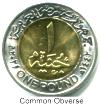
Egypt
recently released a number of circulating commemorative coins in an
effort to bolster support of the government. The coins have a
common obverse which includes the name of the country in Arabic, the
denomination in Arabic and English and both the AD and AH
dates. The 1 Pound coins are 25mm bi-metallic with a
brass-plated steel center in a nickel-plated steel ring. The
50 Piastres are 23mm brass-plated steel coins.
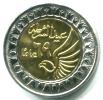
The 69th anniversary of
National Police Day
is commemorated on a 2021 1 Pound coin. Police Day is in
remembrance of the 50 police officers of the Ismaila Police Station
that were killed or wounded when the British attacked the police
station with tanks on January 25, 1952 after the police refused abandon
the station and hand over their weapons. January 25 was
declared a national holiday in 2009 by Egyptian President Hosni Mubarak
to recognize the efforts of Egyptian police to maintain security and
stability. On Police Day in 2011 widespread protests against police
brutality and corruption led to a revolution which overthrew President
Mubarak. The bi-metallic coin features a winged eagle emblem and the
Arabic numbers 69.
Item
EG-POLICE EGYPT 1 POUND 2021 POLICE DAY UNC.
$4.00
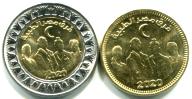 Egyptian
Medical Teams
Egyptian
Medical Teams are honored on 50 Piastre and 1 Pound
coins. The coins feature four doctors. In order to
avoid offending conservative Muslims, the doctors have no facial
features. The coin is triple dated, bearing the date 2020
beneath the doctors, and AD 2021 and AH 1442 on the obverse.
Item
EG-MED EGYPT 50 PIASTRE & 1 POUND
2020/2021 MEDICAL TEAMS UNC. $5.00
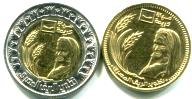
"
Decent
Life" is an initiative of
Egyptian President Abdel Fattah El-Sisi's improve rural areas of
Egypt. The multi-year project, started in 2019, aims to
improve sewer, water, electricity, natural gas and internet access in
villages, improve housing, as well as health and education
projects. The Decent Life 50 Piastre and 1 Pound coins both
feature a female farmer, wheat ears, and the Decent Life emblem, which
looks like a smile in a box. The coins are dated 2021.
Item
EG-DECENT EGYPT 50 PIASTRE & 1 POUND
2021 DECENT LIFE UNC. $5.00
GAZA COIN
FEATURES PALESTINIAN WITH ASSAULT WEAPON

A
Palestinian with a high-powered assault weapon is featured on this
unofficial 2019
rectangular 5 Pound coin issued for the Gaza Strip. The emblem of
Palestine is on the obverse. The Gaza Strip is about a
territory about
25 miles (41km) long and 4 to 8 miles (6 to 12 km.) wide that borders
Israel and Egypt and is the home of some 1.9 million
Palestinians.
Since 2007 Gaza has been a de-facto self-governing entity ruled by
Hamas, a fundamentalist Islamic organization. It recently
attacked
Israel, and Israel retaliated bringing destruction to much of this
small territory. The 40mm x 25mm rectangular silver plated Proof coin
has a mintage of only 200 pieces.
Item
GAZA GAZA STRIP 5 POUNDS 2019 PROOF $24.00
Also see:
BRITISH PALESTINE 1 MIL COINS
PALESTINE PATTERN COIN SET FEATURES NATIVE
WILDLIFE & BI-METALLICS
SCARCE
FANTASY COIN
OF HEJAZ

This
scarce fantasy silver Hejaz 10 Piastres or 1/2 Riyal was made
to
appear to be an early coin of Hejaz. It is dated AH1334, Year
8 (1923) and bears the legends that was struck in Mecca (“Makka
al-Mukarrama”). In reality it was struck some years ago in
the United States. The coins is technically Uncirculated,
however was given an “antiqued” finish. The 27.8mm coin has a
reeded edge. It is a scarce coin and given the popularity of
Saudi Arabian related coins, is sure to be in demand.
Item
HEJAZ10P HEJAZ 10 PIASTRES FANTASY COIN
Br.X2
ANTIQUED UNC.
$55.00
ANCIENT
PERSIAN SILVER SIGLOS

The
ancient Persian Empire stretched through the Fertile Crescent, covering
much of modern-day Iran, Iraq and Turkey. The Persian silver
Siglos was first introduced about 546BC, during the reign of Cyrus the
Great. The silver Siglos continued to be issued during the
reigns of Darius and Xerxes. It was practically the only coin
of issued by the Persian Empire until the it was conquered by Alexander
the Great in 330BC. The coins show the king kneeling holding a bow and
carrying a spear or a dagger. The reverse side has
a crude incuse punch mark that was formed when the coin was
struck. It is an important historic coin that was used in
much of the ancient world.
Item
SIGLOS PERSIA SILVER SIGLOS 546-330BC
VG-F-crude
$149.00
CONTROVERSIAL
FIRST COIN OF THE
ISLAMIC
REPUBLIC OF IRAN 
Shortly after coming into power in 1979, the revolutionary Islamic
government of Iran issued circulating commemorative coins which
caused a bit of a stir in some diplomatic circles. The 20mm
aluminum-bronze clad steel
1 Rial coin
commemorates World Jerusalem Day (Quds Day). The day was
initiated in 1979 by the Islamic Republic 1979 to express solidarity
with Palestine and oppose Zionism and Israel’s control of
Jerusalem. The coin pictures the Dome of the Rock - which is
located in Jerusalem,
Israel.
The Dome of the Rock or Qubbet
el-Sakhra is one of the holiest sites to Jews, Muslims and
Christians. It is the site of the original Jewish Temple,
where Jesus preached. The Foundation Stone or Rock
at the center of the dome was where many Jews believe that Abraham
offered to sacrifice his son Isaac. Muslims believe that it is the spot
where the Prophet Muhammad ascended to heaven. The coin is
dated SH1359 (AD1980). The reverses of all the
coins have the denomination within a wreath.
Item
IR-1R-DOME IRAN
1 RIAL 1980 DOME OF THE ROCK
KM1245 UNC. $5.00
IRAN
COMMEMORATES END OF IRAN-IRAQ WAR

Iran
commemorated the conclusion of the Iran-Iraq war with this
copper-nickel 20 Rials. The coin is dated SH1368, which
corresponds to 1989. The war which lasted from eight years,
from 1980 until 1988, resulted in an estimated 1 to 2 million
casualties, ended in a stalemate with no significant territorial
changes. The coin commemorates "eight years of sacred
defense".
Item
IR-20R-WAR
IRAN 20 RIALS SH1368=1989AD IRAN-IRAQ WAR
KM1254 UNC. $4.00
ISLAMIC
REPUBLIC OF IRAN BI-METALLIC 250 RIALS

This
attractive bi-metallic 250 Rials of the Islamic Republic of Iran
features a stylized Grenadine blossom on one side. The other side
includes the denomination and date is Arabic. The coin is
28.3mm in diameter. When first minted, it was the highest
denomination issued by the Islamic Republic of Iran. Due to ongoing
inflation, it soon became virtually worthless and was
demonetized. The coins dated between 1373 and 1375 in the
Solar Hijri calendar
which corresponds to 1994 to 1996AD.
Item
IR-250R
IRAN 250 RIALS 1994-1996AD KM1262 UNC.
$4.00
BANKNOTE OF THE
ISLAMIC REPUBLIC
OF IRAN
The 100 Rial note of the Islamic Republic of Iran was released in
1985. Within a few years inflation made it virtually
worthless. The front depicts Ayatollah Sayyid Hassan
Modarres, an Iranian cleric and politician who died in prison in 1937
after opposing the Shah. The Islamic Consultative Assembly
building is on the back. The note has a watermark of the emblem of
Islamic Iran, which consists of four crescents and a sword.
Item PM-IR-100R IRAN 100 RIALS BANKNOTE
(1985) P140 UNC. $4.00
SADDAM
HUSSAIN BANKNOTES FROM IRAQ
These five banknotes all picture Iraqi dictator Saddam Husain on the
front. The first banknote to bear Saddam's portrait is the
multi-colored 1986 25 Dinar Note. He is pictured with charging medieval
horsemen in an attempt to link himself with great military victories of
past centuries. The back shows the ancient gate of Babylon at the left,
below it is a lion frieze. In the center is the Martyr’s
Monument (al-Shaheed) in Baghdad. When issued the note had an
exchange
rate of approximately $80 and was the largest denomination in
circulation. The blue 1994 100 Dinar note depicts Saddam and
the medieval Al-Ukhaidir Fortress on the front and the modern Bagdad
Clock
tower on the back. The 1995 250 Dinars pictures Saddam and
the Haditha Dam on the Euphrates on the front. The back shows
the
frieze from the Liberty Monument in Baghdad. At the time it was issued
it was the highest denomination in circulation with an official
exchange rate of over $750, but would buy only a few dollars of goods
on the streets. The green 2001 25 Dinar features Ishtar
Gate. The original gate was built about 569 BC by order of
King Nebuchadnezzar II. It was excavated in the early 20th
century
and most of it was hauled off to Germany. Saddam built a
reproduction of the
gate which opened in 1987. The purple 2002 250 Dinars depicts the Dome
of
the Rock on Temple Mount in Jerusalem. It was one of the last notes
issued before Saddam was overthrown in the Second Gulf War in
2003. The 1986 25 Dinar grades Very Fine. The other
notes are Uncirculated. Notes may be purchased individually
for $3
each or as a set.
Item
PM-IQ-SET5 5 DIFFERENT IRAQ SADDAM HUSSAIN
NOTES 1986-2003 $10.00
Single Notes from the above set:
Item
PM-IQ-25D-86 IRAQ 25 DINAR NOTE, 1986 SADDAM
P73
XF $3.00
Item
PM-IQ-100D-94 IRAQ 100 DINAR NOTE, 1994
SADDAM
P84 UNC. $3.00
Item
PM-IQ-250D-95 IRAQ 250 DINAR NOTE, 1995
SADDAM
P85 UNC. $3.00
Item
PM-IQ-25D-01 IRAQ 25 DINAR NOTE, 2001
SADDAM
P86 UNC. $3.00
Item
PM-IQ-250D-02 IRAQ 250 DINAR NOTE, 2002
SADDAM
P88 UNC. $3.00
SADDAM
GULF WAR NOTE
This 1992 5 Dinars note of Iraq was issued after Iraq's defeat in
the First Gulf War. The country was under a United Nations
embargo so was unable to utilize its regular bank note printers.
Instead it utilized a Chinese printer that was willing to
break the embargo. The quality of the notes left much to be
desired, however they filled the need and were pressed into service.
The red note features a portrait of Saddam Hussein with an
underprint of an ancient temple. The back features Iraq's
Tomb of the Unknown Soldier and a small vignette of an ancient carving
of Hammurabi in conversation with the sun god Shamash. As an
anti-conterfeiting measure, the note contains threads that fluoresce
blue and orange under Ultra-Violet light. The note is
Uncirculated.
Item
PM-IQ-5D IRAQ 5 DINARS NOTE 1992 P80
UNC. $3.00
Item
PM-IQ-5Dx10 TEN of the above IRAQ 5
DINARS NOTES 1992 P80
UNC. $17.00
OPERATION
DESERT STORM PROPAGANDA LEAFLETS
These
propaganda leaflets were prepared by the US Armed Forces and
air-dropped on Iraqi soldiers during the First Gulf War in
1991. They
were part of a PSYOP psychological warfare program to encourage the
Iraqis not to fight. They must have been effective, as almost
half of
the Iraqi soldiers defected, deserted or surrendered. This
set
includes 7 different genuine propaganda leaflets, including both color
and black and white issues. Included in the set is a popular
leaflet
printed to look like an Iraq 25 Dinar note picturing Saddam. What
better way to have a piece of propaganda picked
up than to make it look like real money!
Click here for a
list of the leaflets provided
and their translations.
Item
IQ-PROP
SET OF 7 IRAQ WAR PROPAGANDA LEAFLETS, UNC.
$19.50
IRAQ POST
INVASION COIN SET

Iraq
released three 2004 dated
coins: a 25, 50 and 100 Dinar. They are the first coins
issued
since for circulation since the First Gulf War in 1990 and were issued
as part of America’s plan to bring stability to the country.
Since then no additional coins have been issued for circulation. The
coins have a very simple design. One side shows a map of
Iraq,
showing the Tigris and Euphrates rivers and the date in both the AH and
AD Calendar. The other side shows the denomination and
inscriptions in Arabic. The 25 Dinars is copper plated-steel,
the
50 Dinars is brass plated steel and the 100 Dinar is nickel-plated
steel.
Item
IQ-SET3 IRAQ 25, 50 & 100
DINAR 2004 KM175-177 UNC. $6.00
 BRILLIANT
UNCIRCULATED, OLD ISRAELI COIN WITH AN ANCIENT DESIGN
BRILLIANT
UNCIRCULATED, OLD ISRAELI COIN WITH AN ANCIENT DESIGN

This Brilliant Uncirculated aluminum 10
Pruta was one of the last coins issued by Israel before they revalued
their monetary system in 1960. The update replaced the 10
Pruta coin with the 1 Agorot coin. It is dated 5717 in the
Hebrew era, which is equivalent to 1957. The obverse design
is based on a silver coin minted during the second year of the Bar
Kokhba Revolt (133-134AD) depicting a single handled ceremonial jug.
"Israel" is in both Hebrew and Arabic. The reverse includes
the denomination and date within two stylized olive branches. The coin
is Brilliant Uncirculated, and is remarkably inexpensive considering it
is almost 70 years old.
Item
IL-10P57 ISRAEL 10 PRUTA HE2517 (1957AD)
KM20 BU $4.00
NORTH AFRICAN
HANUKKAH LAMP ON ISRAELI COIN
The Israel 1963 Hanukkah 1 Lira displays an 18th century North African
Hanukkah lamp. It has a mintage of 9928 pieces in Unc. and just 5412
in Proof. The Proof issues have the tiny Hebrew character
"mem" below the date. The coins are all 32mm
copper-nickel.
They are attractive and historic coins at a very reasonable price
considering their limited mintage.
Item
IL-AFRICA-U
ISRAEL 1 LIRA 1963 NORTH
AFRICAN HANUKKAH LAMP KM42 UNC
$12.00
Item
IL-AFRICA-PF
ISRAEL 1 LIRA 1963 NORTH
AFRICAN HANUKKAH LAMP KM42 PROOF
$15.00
JERUSALEM HANUKKA
LAMP ON ISRAELI COINS
For many years Israel’s annual Hanukka coins were popular gift items
and popular with collectors. The 1977 Hanukka coin was the last
commemorative 10 Lirot coin issued by Israel. The 34mm
copper-nickel coin features the Jerusalem Hanukka Lamp. The
lamp dates from the early 20th century and is now in the Ethnographic
and Folklore Museum in Ramat Aviv. The coin has a mintage of
46,106 in Brilliant Uncirculated and 29,516 Proof. Two versions of the
Proof coin were issued, one with an "open" Mem, the other with a
"closed" Mem. The Proof versions have
the Hebrew character "mem" in place of the mintmark and have a reeded
edged.
Item
IL-10L-77BU
ISRAEL 10 LIROT 1977 JERUSALEM HANUKKA LAMP KM91.1
BU $5.00
Item
IL-10L-77PF-O
ISRAEL 10 LIROT 1977 JERUSALEM HANUKKA KM91.2 OPEN MEM PROOF out
Item
IL-10L-77PF-C
ISRAEL 10 LIROT 1977 JERUSALEM HANUKKA KM91.3 CLOSED MEM PROOF out
ISRAEL TELEPHONE
TOKEN

For many years, Israel required tokens
to operate their public telephones. The tokens made it easy
to raise prices and helped cut down on slugs beings. This
Israeli telephone token, called an Asimon, was issued by the Israel
Post. One side is dated 1966 in Hebrew and has the world
“telephone” in Hebrew and Arabic. A deep slot and a center
hole is incorporated into the token to prevent regular coins or slugs
from being used in the telephone. The other side features a
telephone dial.
Item
IL-PHONE
ISRAEL TELEPHONE TOKEN 1966 VF $3.00
FOR MORE ISRAEL COINS SEE:
ISRAEL MINT AND PROOF SETS
MODERN
COIN OF KURDISTAN
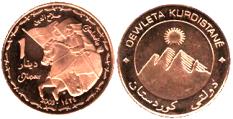
The Kurds are an
ethnic group divided between Iraq, Turkey and Syria.
Their attempts to establish a Kurdish nation have been repeatedly
thwarted by outside powers. In 2003, after the fall of Saddam Hussein
in Iraq, overseas Kurdish groups authorized the issuance of coins for
what they expected would be their new independent nation.
Because of objections from neighboring Turkey, the United States did
not allow the establishment of Kurdistan. Though the Kurds greatly
assisted the United States by providing ground forces to fight ISIS in
Syria and Iraq, in 2019 the United States again betrayed by withdrawing
United States troops and abandoning them to Turkish and Russian
forces.
The 2003 1 Dinar depicts the
most famous Kurd of all time: Saladin. He is depicted on
horseback carrying a modern Kurdish flag. Saladin founded the powerful
Ayyubid Dynasty in 1169. His diplomatic skills, backed by
well-disciplined army enabled him to gain control of Egypt, Palestine
and Syria from Islamic as well as Christian opponents. Even
his opponents admired him for his chivalry, justice and piety. The
27.4mm coin is struck in bronze-plated zinc..
The reverse depicts a
Kurdish emblem featuring the sun rising over three
mountains.
Item
KURD1 KURDISTAN
1 DINAR 2003 Br.X1.2 UNC.
$7.50
RARE
KURDISTAN 2006 1000
DINAR COIN

This
Kurdistan 2006 dated 1000 Dinar pictures Mustafa Barzani, a
charismatic Kurdish nationalist leader. He spent almost his entire life
fighting for Kurdish indpendence. When he was only three
years old he and his family were imprisoned by the Ottomans for an
insurrection by his tribe. Much of his family was later executed.
After the British gained control of Iraq following World War
I he engaged in attacks against both British and
Iraqi authorities. In 1946, he was chosen as the leader of the
Kurdistan Democratic Party (KDP) to lead the Kurdish revolt against the
Kingdom of Iraq. He died in 1979 in the United States while
undergoing treatment for lung cancer. The reverse of the coin
features the Kurdish mountain emblem, representing the Kurds of Iraq,
Turkey and Syria. The unofficial 27mm coin is struck in
brass-plated zinc and has a mintage of 8,500 pieces.
Item
KURD1000 KURDISTAN 1000 DINARS 2006 Br.X12
UNC.
$5.00
LEBANON
BANKNOTE & COIN SETS
Lebanon was once one of the most prosperous nations in the Middle
East. In recent years entrenched politicians, caring more for
their political party than their nation, drove the country to
ruin. In 2020 a massive ex-plosion caused by improperly
stored am-monium nitrate killed over 200, left over 300,000 homeless
and destroyed major portions of Beirut.
Due to inflation Lebanon introduced new notes in 2014. The 3
note set includes the
1000, 5000 and 10,000 Livres dating from 2014 to
2016. The 3-coin set from Lebanon includes the 2002
25
Livres, the eight-sided 1996 50 Livres and the 2009 100
Livres. The 25 and 50 Livres were struck only a single year.
The coins all feature a Lebanese Cedar. Lebanon was under
French control from the end of World War I until after World War II so
the notes and coins have legends in Arabic on the front and in French
on the back. Also available is the full set of all six notes
currently in circulation: 1000, 5000, 10,000, 20,000, 50,000 and
100,000 Livres dated from 2016 to 2022 in Uncirculated condition.
At the official exchange rates the notes are worth well over
$100. We obtained these at
black
market rates so can offer them for far less than their
official face value.
Item
PM-LB-SET3
LEBANON 3 NOTE SET 1000-10,000 LIVRES 2014-16
UNC. $7.50
Item
S-LB-SET3
LEBANON 3 COIN SET 25, 50 & 100
LIVRES 1996-2009 UNC.
$3.50
Item
PM-LB-NEW6
LEBANON CURRENT 6 NOTE SET 1000-100,000
LIVRES
2016-22
UNC. $39.50
SILVER
COINS OF THE
SLAVE KINGS OF THE HOLY LAND
The Bahri Mamluks ruled Egypt, Syria and the Holy Land from 1250 to
1382. The Mamluks were slaves purchased as boys from Russia,
converted to Islam and trained to be warriors. In 1250 Mamluk
slaves overthrew their masters, the Ayyubids, and established the Bahri
Mamluk dynasty with its capital in Cairo. They continued to
import Mamluk slaves to serve in their military. The Sultan
was supposed to be selected from the ranks of the Mamluk slaves, so the
Sultan would also have been slave! Thus, the Mamluks are
known as the "Slave-Kings". Mamluks were not supposed to be
able to inherit wealth or power, but many attempted to do so, resulting
in brutal and bloody quests for power among various factions competing
for supremacy. Mamluk Sultans rarely died a natural
death.
Baybars was a brilliant military leader. He helped defeat the
Seventh Crusade under Louis IX of France in 1250, then in 1260 he gave
the Mongol armies their first substantial defeat and turned back the
Mongol conquests of the Middle East. Shortly after that the
Mamluk Sultan was assassinated and Baybars proclaimed himself Sultan.
As sultan, he engaged in a combination of military action and
diplomacy, greatly expand the Mamluk empire. He died in 1277,
possibly from accidentally drinking a poisoned alcoholic beverage he
intended for a rival. These silver Dirhams of Baybars, like
most Mamluk coins, is crude, often with large weakly struck areas. In
addition to inscriptions, most have a crude depiction of a lion at the
bottom of the obverse.
Mamluk power and culture reached its zenith under Al-Nasir Muhammad I.
He served three reigns as Sultan. He was the son of a Mamluk
Sultan, rather than a Mamluk slave. He was first made Sultan
in 1293. He was only 8 years old, so was controlled by
others. He was deposed the following year in a palace
revolt. In 1299 the reigning sultan was murdered and Muhammad
was again placed on the throne, again under the control of
others. He fled the palace in 1309 rather than continue to
submit to authority of others. After the population of Cairo
forced his unpopular successor to flee, he reclaimed his
throne. He ruthlessly cracked down on corruption and those he
infringed on his power. He also engaged in major public works
projects including rebuilding an ancient canal connecting Alexandria
with the Nile and building or rebuilding many mosques, schools and
public baths. We have factional silver Dirhams struck during
Muhammad's third reign from 1310 to 1341. The small, irregularly shaped
coins were struck using dies for the much larger 1 Dirham coin, so most
of the design is off the flan.
In the year following the death of Muhammed in June 1341 there were
three Mamuk sultans, two of which were murdered and the third deposed
as various factions vied for control. In June 1342 As-Salih Isma'il, a
son of Muhammad and one of his concubines became Sultan. He
was a pious ruler that brought some political stability to the Mamluk
empire before he died of an illness in 1345. The Silver Dirhams of
Isma'il, like other Mamluk Dirhams, have Arabic inscriptions on both
sides and are weakly struck.
Item
MAM-BAYB MAMLUK DIRHAM, BAYBARS I, 1260-1277
A-883
G-VG-crude
$15.00
Item
MAM-MUH MAMLUK FRACTIONAL DIRHAM, MUHAMMED I
1310-41 A-921
VG-crude
$15.00
Item
MAM-ISM MAMLUK DIRHAM, ISMA'IL 1342-45,
G-VG-crude out
NEW
COINS FROM OMAN

Oman
released a series of four new coins dated 2020. Included were
the stainless steel 50 and 25 Baisa and copper-clad steel 10 and 5
Baisa. All four coins have similar designs. One
side features the denomination, AD and AH date. The other
side depicts the national emblem of Oman which consists of a dagger in
a sheath and two crossed swords joined together with a waist
belt. The coins were struck by the British Royal Mint.
Item
OM-SET20 OMAN 5, 10, 25 and 50 BAISA 2020
KM199-KM202 UNC. 7.50
FIRST COINS OF
PALESTINE

This
set includes the first coins issued by the British Mandate of Palestine
in Uncirculated condition.
Great
Britain gained control of Palestine from the
Ottoman Empire after
World War I. It issued
its first coins for Palestine in 1927, including these 1 and 2 Mils
coins. Both coins are bronze and have similar designs. In
order to satisfy the Jews and Arabs in the territory, as well as their
British rulers, the coins have their legends in three different
languages, Arabic, English and Hebrew and the date in both the AD and
AH calendar. An olive branch, representing peace, is on the
reverses of both coins. In 1948 the Mandate was dissolved
with most of the territory going to the newly declared
State of Israel.
The 1
Mil is 21mm and the 2 Mils is 28mm. Both coins still retain
most of their original bright mint luster.
Item
PS-SET2U PALESTINE 1 & 2 MILS 1927 KM1
&
2 AU-UNC.
$45.00
TRI-LINGUAL
COIN OF BRITISH
PALESTINE
 Great
Britain
Great
Britain gained control of Palestine from the
Ottoman Empire after
World
War I. It did not issue its first coins
for
Palestine until
1927. In order to satisfy the Jews and Arabs in the
territory, as well as their British rulers, the bronze 1 Mil coins have
their legends in three different languages, Arabic, English and Hebrew
and the date in both the AD and AH calendar. An olive branch,
representing peace, is on the reverse. In 1948 the British
Mandate of Palestine was dissolved and most of the territory became the
newly declared State of Israel. Britain only sporadically
minted the 1 Mil coin for Palestine: 1927, 1935, 1937, 1939, 1940
(rare), 1941, 1942, 1943, 1944, 1946 and 1947 (very rare - all but 5
melted).
Item
PS-1M-27 PALESTINE 1 MIL 1927 KM1 VF-XF
$4.00
Item
PS-1M-37 PALESTINE 1 MIL 1937 KM1 VF-XF
$4.00
Item
PS-1M-39 PALESTINE 1 MIL 1939 KM1 VF-XF
$4.00
Item
PS-1M-42 PALESTINE 1 MIL 1942 KM1 VF-XF
$4.00
PALESTINE
PATTERN
SET FEATURES NATIVE WILDLIFE & BI-METALLICS
This attractive set of 8 unofficial
Palestine pattern coins
features native wildlife and two bimetallic coins. The Bimetallic 2
Dinars features a pair of sand cats. An Argali, a type of mountain
goat, is on the bi-metallic 1 Dinar. The seven-sided brass 50 Qirsh
(Piastre) pictures a leopard. A White Stork is on the seven-sided
brass 25 Qirsh. The Barbary Falcon appears on the nickel-plated
steel 10 Qirsh. The nickel-plated steel 5 Qirsh features a White
Pelican in flight. A Marsh Sandpiper is on the nickel-plated steel
2 1/2 Qirsh. A Fattail Scorpion is on the copper-plated steel 1
Qirsh. All coins are dated 2010 and feature the arms of Palestine
on the obverse. Only 10,000 sets were minted.
Item
PS-SET8
PALESTINE 8 COIN WILDLIFE
SET, 1 QIRSH - 2 DINARS
2010 UNC. $29.50
SCARCE
SAUDI HALALA

In
1963 Saudi Arabia introduced a new denomination; the 1 Halala, as part
of a monetary
reform. Because the new coin had no direct equivalent in the
previous monetary system and had minimal value, it was poorly
accepted.
The obverse of the 19mm bronze coin features a palm tree and crossed
swords. The reverse has the denomination and date in
Arabic.
Item
SA-1H SAUDI ARABIA 1 HALALA AH1383=AD1963
KM44,
AU-UNC. $3.00
SCARCE SAUDI ARABIAN
COIN

The
British Royal Mint struck a small quantity of copper-nickel 100 Halala
coins for Saudi Arabia dated AD1977 and AH 1397 as samples. Actual
production of the coins commenced the following year, with the coins
dated AD 1978 and AH1398. A few of the sample coins somehow
escaped into circulation. The coins were to be part of the
United Nations Food and Agriculture Organization coin program. The
program encourages farmers to grow more food and helps raise money for
Agricultural projects through the sale of the coins.
Item
SA-100H-77
SAUDI ARABIA 100 HALALA 1977 KM59 UNC. $45.00
SAUDI
ARABIAN BI-METALLIC
COINS

Saudi
Arabia issued two
bi-metallic 100 Halala coins in 1999 (AH1419). The regular
issue
features a palm tree and a pair of crossed swords. The
commemorative issue honors the 100th anniversary of the Saudi
Kingdom. Saudi Arabia dates it's founding to a night in 1902
when
Abdul Aziz ibn Saud and 40 of his followers did a daring midnight raid,
capturing the Ottoman fort at Riyadh. With the support of the
conservative Islamic Wahhabi clergy, Abdul Aziz declared a
Jihad,
or holy war against the Ottomans and other rulers who controlled the
Arabian Peninsula. After the defeat of the
Ottoman's in
World War I by Allied forces, Abdul Aziz conquered neighboring Hejaz,
and consolidated his kingdom into what is today Saudi Arabia. The
design of the coin features extensive calligraphy as well as a stylized
representation of a palm tree, and the
fort. The 100
years from 1902 to 1999 is based on the lunar Hegira calendar, which
has
slightly shorter years than a solar calendar.
Item
SA-66 SAUDI ARABIA
100 HALALA REGULAR ISSUE, KM66 UNC.
$5.00
Item
SA-67 SAUDI
ARABIA
100 HALALA 100TH ANNIVERSARY, KM67 UNC. OUT
SYRIA
COIN SET DEPICTS DAMAGED HISTORIC SITES

This
attractive set includes the most recent issues of all six denominations
minted for Syria from 1996 to 2018, from 1 to 50 Pounds. The obverses
of all the coins include the AD and AH
dates in Arabic and the Syrian coat of arms which features the hawk of
Quraish with two stars on the shield. The reverse of the 2018
nickel-plated steel
50 Pounds depicts the Tomb of the Unknown Soldier in
Damascus. It is the last coin that has been issued by Syria.
It is virtually the same size and has a similar obverse
design as
the 1996 1 Pound coin. The 2003 bi-metallic 25 Pounds depicts
the
Central
Bank of Syria (CBS) building and a latent image that changes from "25"
to "CBS" as the coin is shifted. The 2003 nickel-brass 10
Pounds depicts the ancient colonnade and monumental arch in
Palmyra. There is a latent image within the arch.
The arch was destroyed during the recent civil war. The 2003
nickel-clad steel 5 Pounds depicts the Citadel of Aleppo within a
pentagram. The Citadel is one of the oldest and largest castles in the
world, having been in use since the 3rd millennium BC. It too
was damaged during the recent civil war. The coin has a latent image
that
changes from "5" to "CBS". The 1996 nickel-clad steel 2
Pounds features the Roman Theatre at Bosra. The stainless
steel 1996 1 Pound features the denomination within traditional Syrian
ornamentation. It is an historic set depicting historic sites
from a war-torn nation.
Item
S-SY-SET6
SYRIA 6 COIN SET 1-50 POUNDS 1996-2018 UNC.
$14.00
SYRIAN
BANKNOTE BARGAIN
The front of the 1998 Syrian 500
Pound note a portrait of Queen Zenobia who ruled Palmyrene Empire from
267 to 272AD. Also pictured are Hadrian's Gate and theater in
Palmyra and an ancient brooch. The back depicts the Tabqua Dam on the
Euphrates River, a tractor and produce. The watermark depicts
a horse head.
The 500 Pound catalogs for $25. With the collapse of the Syrian
economy, we are able to offer the notes for MUCH less.
Item
PM-SY-500P SYRIA 500 POUNDS BANKNOTE 1998
P110c UNC. $6.00
FATHER AND SON
DICTATORS OF SYRIA


The Assad family brutally ruled Syria from 1970 until
December
2024. Hafez al-Assad came to power in a coup d'etat in
1970. He consolidated power, gaining absolute control over
the Syrian government and created a personality cult centered on
himself and his family. He opened prison death camps and
ruthlessly crushed any opposition. After his first son and
expected successor Bassel died in an automobile crash in 1994, his
second son, Bashar became his designated successor.
Previously Bashar was considered somewhat of a geek, showing little
interest in politics and was training in London to be an
ophthalmologist. Bashar succeeded his father after his death in
2000. Many were hoping that with a British education, Bashar
would be a reformist, but instead he was even more
repressive. There was extensive secret police surveillance,
heavy censorship and numerous summary executions. Perceived
opponents were jailed and tortured. He was considered one of
the most repressive regimes in modern times. In 2011 a
multi-sided civil war broke out which continued until his fall in 2024.
During the civil war Bashar engaged in chemical warfare, war crimes. In
December 2024 his regime rapidly collapsed and Bashar fled to Russia
during a major offensive by opposition groups.
Hafez al-Assad is depicted on the front
of the 1997 Syrian 1000 Pound note along with the Great Mosque of
Damascus, an ancient cuneiform tablet and an Umayyad gold Dinar. The
back includes images of the oil industry, a cargo ship and a combine
harvester. Bashar al-Asad is on the front of the 2021 2000
Pound note along with the Umayyad Mosque in Damascus. The
denomination is micro-perforated at the right. The back shows
the interior of the Parliament building. It is an attractive pair of
notes depicting a ruthless but short dynasty.
Item
PM-SY-1000P SYRIA 1000 POUNDS BANKNOTE 1997
P111c UNC. out
Item
PM-SY-2000P SYRIA 2000 POUNDS BANKNOTE 2021
P117d UNC. $6.00
BEAUTIFUL
RECENT
BANKNOTES FROM WAR-TORN SYRIA

Syria is again in the news with the sudden overthrow of the President
Bashar al-Assad on December 8, 2024. The Assad family had
brutally ruled Syria since 1971. Despite a chaotic 13 year multi-sided
civil war leading up to his overthrow, Syria introduced three
remarkably beautiful banknotes in 2021 that highlighted the nation’s
long history. The 50 Pound note features ancient clay cuneiform tablets
on the front. On the back is the Hafez al-Assad library and
his statue. Hafez al-Assad was ruthlessly ruled Syria from 1971 until
his death in 2000 and was the father of Bashar. The 100
Pounds shows the ancient Roman archway and theater at Bosra on the
front. The back depicts an ancient Roman silver Antoninianus
of Philip II, headquarters of the Central Bank and the Dome of the
Treasury at Umayyad Mosque in Damascus. The 200 Pounds
depicts the historic Baz al-Kilaniyya waterwheel of Hama on the front
and the ceiling of Temple of Bel (Baal) in Palmyra. ISIS
destroyed much of the ancient temple in 2015. The notes have Arabic
legends on the front and have English on the back. They have
a horse head watermark and were printed in Russia.
Item
PM-SY-SET3 SYRIA 50, 100 & 200 POUND
NOTES 2021 UNC. $4.00
HIGH GRADE
ABBASID PROVINCIAL
SILVER 1/2 DIRHAM
OF TABARISTAN

Tabaristan
is a region on the southern coast of the Caspian Sea in what is now
Iran. It was one of the last parts of Persia to fall to the
Muslim conquest due to natural barriers including high mountains,
numerous rivers, swamps and dense forests as well resistive
population. Even after it fell to the Abbasid Caliphate it
was virtually independent and had its own distinctive, non-Muslim style
coinage until about 793AD. The coins were silver 1/2 Dirhams based on
the Sassanian Dirham. The obverse featured a crowned
Sassanian style bust. The reverse features a Zoroastrian fire
altar flanked by two attendants. The coins are about 23mm in
diameter, are well struck, and have little or no wear. It is
an unusual transitional coin struck by the Muslim Abbasids but
retaining the design of the earlier Zoroastrian Sassanian coinage.
Item
TABARISTAN TABARISTAN 1/2 DIRHAM,
8th CENTURY
AD, XF
$49.50
SILVER
COINS OF THE OTTOMAN EMPIRE
The Ottoman Empire was a vast, rich, powerful empire that at its peak
spanned three continents, including much of southern Europe, western
Asia and north Africa. It was founded at the end of the 13th century in
what is now Turkey, and lasted until 1922. Its early coinage consisted
primarily of small, poorly struck silver coins. We are
pleased to offer some of the coins of some of the Ottoman's most
important early Sultans. Because the coins were produced in large
quantities and have not been widely
collected, they are still quite reasonably priced.
 Suleiman the Magnificent
(Suleyman I) ruled the Ottoman Empire from 1520 to 1566.
During his long reign he greatly expanded his empire, conquering much
of the Middle East, North Africa, most of Hungary and laid siege to
Vienna twice. He instituted major reforms in education,
taxation and criminal law. He was an accomplished poet,
goldsmith and patron of the arts. This
silver Medini (3 Akces) of Suleiman was struck at the Amid mint, in
what is now Diyabakir in Turkey. Diyabakir, located on the Tigris River
is considered the "un-proclaimed capital of so-called Turkish
Kurdistan". The silver coin is approximately 13mm in diameter
and is dated AH926 (1520AD). It is an historic coin of an
historic monarch.
Item
TR-SUL OTTOMAN, SULEIMAN THE MAGNIFICENT
SILVER MEDINI
AH926=1520AD, AMID MINT VG-crude
$6.00
 Mahmud II
 ruled the
Ottoman Empire from 1808 until 1839. In 1808 Mahmud II's
predecessor and half-brother, Ottoman Sultan Mustafa IV ordered his
execution along with his cousin, the deposed Sultan Selim
III. Selim III was killed, but Mahmud was safely hidden by
his mother and was placed on the throne of the Ottoman Empire after
rebels deposed Mustafa IV. Mahmud carried out many reforms to modernize
his country, including abolishing the elite Janissary corps, reforming
the justice system to prevent governors from arbitrarily sentencing
people to death, modernized the taxation system to prevent abuses by
tax collectors, made sweeping reforms of the bureaucracy in order to
reestablish royal authority and raised salaries in an attempt to limit
bribery. He was less successful militarily,
loosing the Greek war of Independence, losing Algeria to the French and
losing territory in two wars against Russia. This small, thin
Para of Mahmud II was struck in Constantinople between 1832 and
1838. The coin is struck in .170 fine silver.
Though the coin shows little wear, it is weakly struck and is so thin
that the design on one side shows through to the other side of the
coin. It is remarkably inexpensive for an historic silver
coin that is almost 200 years old.
Item
TR-MAHM2 OTTOMAN EMPIRE, MAHMUD II 1
PARA 1832-38 KM594 VF-XF-CRUDE
$4.00
Item
TR-MAHM2x10 10 of the above OTTOMAN MAHMUD II
1 PARA 1832-38 KM594 VF-XF-CRUDE
$25.00
Item
TR-MAHM2x100 100 of the above OTTOMAN MAHMUD
II 1 PARA 1832-38 KM594 VF-XF-CRUDE
$125.00
TURKEY
CONVERTS MUSEUM INTO A MOSQUE

Turkey
issued the bi-metallic 1 Lira coin in 2020 to commemorate the
conversion of Hagai Sophia into the Grand Hagai Sophia
Mosque. The Hagai Sophia was built between 532 and 537 when
Constantinople was the capital of the Byzantine Empire. It was the
architectural marvel of its age. For almost 1000 years it was
the world's largest cathedral.. It converted to a Mosque
after the fall of Constantinople to the Ottomans in 1453. In
1935 Turkey converted it to a museum and it became Turkey's most
visited tourist attraction. In 2020 the Islamic government of
Turkey converted it back to a mosque despite opposition of many
international organizations and many Turkish citizens. The
coin depicts the mosque on one side and the denomination and date on
the other.
Item
TR-SOPHIA TURKEY 1 LIRA 2020 GRAND HAGAI
SOPHIA MOSQUE UNC.
$3.00
2022 BI-METALLIC
FROM TURKEY COMMEMORATES NEW BRIDGE


Turkey commemorated the recently completed "1915 Canakkale
Bridge" that spans the Dardanelle on this 2022 bi-metallic 1 Lira
coin.
1915 is part of the official name of the bridge and refers to an
important Ottoman naval victory against the navies of the United
Kingdom and France during World War I. The bridge
is
depicted on the obverse of the coin. It iis the
longest suspension bridge in the world with a main span of 1.257 miles
(2.023 km). The coin is 26.15mm in diameter and
has the
standard
Turkish 1 Lira reverse.
Item
TR-1L-BRIDGE TURKEY 1 LIRA 2022 BRIDGE
KM1548
UNC. $2.50
I LOVE UAE

The
United Arab Emirates (UAE) is a federation of seven emirates that
was formed in 1971. It has undergone rapid development and
now a major commercial and transportation hub. It is host to the
tallest building in the world: the Burj Khalifa. Over 80% of
its inhabitants are citizens of other countries. The “I Love
UAE” program was started to promote a stronger national unity among the
diverse population. The program included this circulating
commemorative 1 Dirham that was released in 2009. The reverse
features a heart shaped ribbon surrounding a map of the United Arab
Emirates with the legend “I LOVE UAE” in Arabic and English.
The standard 1 Dirham obverse is on the other side. The 23.8mm coin is
struck in copper-nickel. The coin is undated (must mean it is dateless
love).
Item
UAE-LOVE
UNITED ARAB EMIRATES 1 DIRHAM "I
LOVE UAE" KM99 BU
$4.00
UNITED ARAB REPUBLIC
COIN SET

In 1958
Egypt and
Syria
united to form the United Arab Republic, hoping it would form
the basis of a larger pan-Arabic union. It was not to
be. Syria withdrew in 1961 over resentment of Egyptian
dominance and control the union. Egypt continued to call
themselves United Arab Republic until 1971. This four coin United Arab
Republic set includes the aluminum-bronze 1, 2, 5 and 10 Milliemes
struck by Egypt and dating from 1960 to 1962. The coins
feature the Eagle of Saladin with two stars on the shield representing
Egypt and Syria. The back has the denomination and AH and AD dates, all
in Arabic.
Item
UAR-SET4 UNITED ARAB REPUBLIC (Egypt) 1, 2,
5 & 10 Milliemes 1960-1962 UNC. $5.00
SCARCE
SILVER
COIN OF THE KATHIRI STATE OF SEIYUN AND TARIM

The
Kathiri Sultans controlled the towns of Seiyun and Tarim in what is
now
Yemen. After losing much
of their territory to rival tribes they
agreed to become a British Protectorate. Seiyun was the capital, and
Tarim is a major center of Islamic learning. In 1897 they had
this silver 12 Khumsi coins struck at the Heaton Mint for their
territory. The coin is all in Arabic, except for the Heaton
mintmark and are dated AH1315. 12 Khumsi was
equivalent to
1/10 Riyal. The coin is 18mm in diameter. It is a rarely seen coin from
a now forgotten nation.
Item
SEIYUN-12K
KATHIRI STATE OF SEIYUN & TARIM 12
KHUMSI AH1315=1897AD KM216 F-VF
$45.00
LOBSTER ON COIN
OF SHORT-LIVED
PEOPLE'S DEMOCRATIC REPUBLIC OF YEMEN

The
People's Democratic Republic of Yemen, also known as South Yemen or
Democratic Yemen, gained independence from
Great
Britain after the
withdrawal of the British and the collapse of the Federation of South
Arabia in 1967. Over the years its relations with the
Yemen Arab
Republic, or North Yemen fluctuated between war and
peace.
The two nations fought a war in 1972, but were peacefully united in
1990 after Democratic Yemen lost support from communist nations due to
the collapse of the
Soviet
Union. Peace was not lasting however, a
civil war between factions from the north and south broke out again
in
1994. Peace was temporarily achieved with an election in
1999, however the country continued to suffer from instability as
various tribal factions fought for contol. Since 2012 Yemen
has been engaged in another
ongoing civil war, with factions in the South supported by
Saudi
Arabia
and factions in the north supported by I
ran.
This 23mm
aluminum 5 Fils coin of Democratic Yemen features a spiny
Lobster. The coins is dated in Arabic numerals 1984AD and
AH1404.
Item
YEMDR-5F YEMEN DEMOCRATIC REPUBLIC 5 FILS
1984 KM4
LOBSTER UNC.
$3.00
Item
YEMDR-5Fx10 10 of the above YEMEN DEMOCRATIC
REPUBLIC 5 FILS
1984 KM4
LOBSTER UNC.
$15.00
CONTROVERSIAL NEW
YEMEN
BANKNOTE WITH UNUSUAL SECURITY FEATURE

Yemen is in the midst of a long civil war. In July 2025 the
Houthi led government in Sana’a issued this 200 Rials banknote in the
name of the Central Bank of Yemen. The internationally
recognized Central Bank of Yemen in Aden immediately denounced the
issue unauthorized and a "serious escalation" by the Houthis”. It
warned that warned that anyone found possessing, using, or trading the
new banknotes would face penalties. The front of the note has
a holographic stripe, and depicts the Al Janid Mosque in
Ta'izz. The mosque is the oldest in Yemen dating back to the
earliest days of Islam. The back depicts ships in Al Ma'alla
port in Aden. The port is not currently controlled by the
Houthis who issued the note. The blue water in the harbor
scene shows an unusual pattern. The denomination is in
braille to assist the blind. An unusual security feature is
the denomination in Arabic is micro-perforated into the note between
the mosque and the watermark. It is only visible when the
note is held up to light.
Item
PM-YE-200R YEMEN 200 RIALS NOTE 2025 UNC. $5.00
FOR OTHER COINS OF THIS REGION, PLEASE
CHECK
OUT:
1800 YEARS OF IRAQ COINS & CURRENCY
AFGHANISTAN COIN & CURRENCY PAGE
<--PREVIOUS
PAGE NEXT PAGE-->
 The
Himyarite Kingdoms was centered in what is now Yemen. It
grew wealthy exporting frankincense and myrrh and trading ivory, which
they exported from Africa and sold to the Roman Empire. About
380AD the kingdom converted from polytheism to Judaism. These
15mm convex silver half denarius depict a male's head facing right,
with a monogram and a trident behind. The reverse features a
smaller head, an ornamented scepter and inscriptions. The
coins minted from about 100 to 200AD. Though struck in high
relief, the coins show only minimal wear. It is a scarce and
attractive coin from a little-known ancient kingdom.
The
Himyarite Kingdoms was centered in what is now Yemen. It
grew wealthy exporting frankincense and myrrh and trading ivory, which
they exported from Africa and sold to the Roman Empire. About
380AD the kingdom converted from polytheism to Judaism. These
15mm convex silver half denarius depict a male's head facing right,
with a monogram and a trident behind. The reverse features a
smaller head, an ornamented scepter and inscriptions. The
coins minted from about 100 to 200AD. Though struck in high
relief, the coins show only minimal wear. It is a scarce and
attractive coin from a little-known ancient kingdom.  The
Great Sphinx at Giza is featured on the front of this Egyptian 1
Millieme. The back includes the denomination and date in
Arabic. The coin is double dated with both the AH date of
1354 and the AD date of 1954. It was one of the
first coins struck by the Republic of Egypt after the overthrow of King
Farouk in 1952. The aluminum-bronze coin is 16mm.
The
Great Sphinx at Giza is featured on the front of this Egyptian 1
Millieme. The back includes the denomination and date in
Arabic. The coin is double dated with both the AH date of
1354 and the AD date of 1954. It was one of the
first coins struck by the Republic of Egypt after the overthrow of King
Farouk in 1952. The aluminum-bronze coin is 16mm. Egypt
recently released a number of circulating commemorative coins in an
effort to bolster support of the government. The coins have a
common obverse which includes the name of the country in Arabic, the
denomination in Arabic and English and both the AD and AH
dates. The 1 Pound coins are 25mm bi-metallic with a
brass-plated steel center in a nickel-plated steel ring. The
50 Piastres are 23mm brass-plated steel coins.
Egypt
recently released a number of circulating commemorative coins in an
effort to bolster support of the government. The coins have a
common obverse which includes the name of the country in Arabic, the
denomination in Arabic and English and both the AD and AH
dates. The 1 Pound coins are 25mm bi-metallic with a
brass-plated steel center in a nickel-plated steel ring. The
50 Piastres are 23mm brass-plated steel coins.  The 69th anniversary of National Police Day
is commemorated on a 2021 1 Pound coin. Police Day is in
remembrance of the 50 police officers of the Ismaila Police Station
that were killed or wounded when the British attacked the police
station with tanks on January 25, 1952 after the police refused abandon
the station and hand over their weapons. January 25 was
declared a national holiday in 2009 by Egyptian President Hosni Mubarak
to recognize the efforts of Egyptian police to maintain security and
stability. On Police Day in 2011 widespread protests against police
brutality and corruption led to a revolution which overthrew President
Mubarak. The bi-metallic coin features a winged eagle emblem and the
Arabic numbers 69.
The 69th anniversary of National Police Day
is commemorated on a 2021 1 Pound coin. Police Day is in
remembrance of the 50 police officers of the Ismaila Police Station
that were killed or wounded when the British attacked the police
station with tanks on January 25, 1952 after the police refused abandon
the station and hand over their weapons. January 25 was
declared a national holiday in 2009 by Egyptian President Hosni Mubarak
to recognize the efforts of Egyptian police to maintain security and
stability. On Police Day in 2011 widespread protests against police
brutality and corruption led to a revolution which overthrew President
Mubarak. The bi-metallic coin features a winged eagle emblem and the
Arabic numbers 69.  Egyptian
Medical Teams are honored on 50 Piastre and 1 Pound
coins. The coins feature four doctors. In order to
avoid offending conservative Muslims, the doctors have no facial
features. The coin is triple dated, bearing the date 2020
beneath the doctors, and AD 2021 and AH 1442 on the obverse.
Egyptian
Medical Teams are honored on 50 Piastre and 1 Pound
coins. The coins feature four doctors. In order to
avoid offending conservative Muslims, the doctors have no facial
features. The coin is triple dated, bearing the date 2020
beneath the doctors, and AD 2021 and AH 1442 on the obverse. "Decent
Life" is an initiative of
Egyptian President Abdel Fattah El-Sisi's improve rural areas of
Egypt. The multi-year project, started in 2019, aims to
improve sewer, water, electricity, natural gas and internet access in
villages, improve housing, as well as health and education
projects. The Decent Life 50 Piastre and 1 Pound coins both
feature a female farmer, wheat ears, and the Decent Life emblem, which
looks like a smile in a box. The coins are dated 2021.
"Decent
Life" is an initiative of
Egyptian President Abdel Fattah El-Sisi's improve rural areas of
Egypt. The multi-year project, started in 2019, aims to
improve sewer, water, electricity, natural gas and internet access in
villages, improve housing, as well as health and education
projects. The Decent Life 50 Piastre and 1 Pound coins both
feature a female farmer, wheat ears, and the Decent Life emblem, which
looks like a smile in a box. The coins are dated 2021.  A
Palestinian with a high-powered assault weapon is featured on this
unofficial 2019
rectangular 5 Pound coin issued for the Gaza Strip. The emblem of
Palestine is on the obverse. The Gaza Strip is about a
territory about
25 miles (41km) long and 4 to 8 miles (6 to 12 km.) wide that borders
Israel and Egypt and is the home of some 1.9 million
Palestinians.
Since 2007 Gaza has been a de-facto self-governing entity ruled by
Hamas, a fundamentalist Islamic organization. It recently
attacked
Israel, and Israel retaliated bringing destruction to much of this
small territory. The 40mm x 25mm rectangular silver plated Proof coin
has a mintage of only 200 pieces.
A
Palestinian with a high-powered assault weapon is featured on this
unofficial 2019
rectangular 5 Pound coin issued for the Gaza Strip. The emblem of
Palestine is on the obverse. The Gaza Strip is about a
territory about
25 miles (41km) long and 4 to 8 miles (6 to 12 km.) wide that borders
Israel and Egypt and is the home of some 1.9 million
Palestinians.
Since 2007 Gaza has been a de-facto self-governing entity ruled by
Hamas, a fundamentalist Islamic organization. It recently
attacked
Israel, and Israel retaliated bringing destruction to much of this
small territory. The 40mm x 25mm rectangular silver plated Proof coin
has a mintage of only 200 pieces. This
scarce fantasy silver Hejaz 10 Piastres or 1/2 Riyal was made
to
appear to be an early coin of Hejaz. It is dated AH1334, Year
8 (1923) and bears the legends that was struck in Mecca (“Makka
al-Mukarrama”). In reality it was struck some years ago in
the United States. The coins is technically Uncirculated,
however was given an “antiqued” finish. The 27.8mm coin has a
reeded edge. It is a scarce coin and given the popularity of
Saudi Arabian related coins, is sure to be in demand.
This
scarce fantasy silver Hejaz 10 Piastres or 1/2 Riyal was made
to
appear to be an early coin of Hejaz. It is dated AH1334, Year
8 (1923) and bears the legends that was struck in Mecca (“Makka
al-Mukarrama”). In reality it was struck some years ago in
the United States. The coins is technically Uncirculated,
however was given an “antiqued” finish. The 27.8mm coin has a
reeded edge. It is a scarce coin and given the popularity of
Saudi Arabian related coins, is sure to be in demand. The
ancient Persian Empire stretched through the Fertile Crescent, covering
much of modern-day Iran, Iraq and Turkey. The Persian silver
Siglos was first introduced about 546BC, during the reign of Cyrus the
Great. The silver Siglos continued to be issued during the
reigns of Darius and Xerxes. It was practically the only coin
of issued by the Persian Empire until the it was conquered by Alexander
the Great in 330BC. The coins show the king kneeling holding a bow and
carrying a spear or a dagger. The reverse side has
a crude incuse punch mark that was formed when the coin was
struck. It is an important historic coin that was used in
much of the ancient world.
The
ancient Persian Empire stretched through the Fertile Crescent, covering
much of modern-day Iran, Iraq and Turkey. The Persian silver
Siglos was first introduced about 546BC, during the reign of Cyrus the
Great. The silver Siglos continued to be issued during the
reigns of Darius and Xerxes. It was practically the only coin
of issued by the Persian Empire until the it was conquered by Alexander
the Great in 330BC. The coins show the king kneeling holding a bow and
carrying a spear or a dagger. The reverse side has
a crude incuse punch mark that was formed when the coin was
struck. It is an important historic coin that was used in
much of the ancient world. 
 Iran
commemorated the conclusion of the Iran-Iraq war with this
copper-nickel 20 Rials. The coin is dated SH1368, which
corresponds to 1989. The war which lasted from eight years,
from 1980 until 1988, resulted in an estimated 1 to 2 million
casualties, ended in a stalemate with no significant territorial
changes. The coin commemorates "eight years of sacred
defense".
Iran
commemorated the conclusion of the Iran-Iraq war with this
copper-nickel 20 Rials. The coin is dated SH1368, which
corresponds to 1989. The war which lasted from eight years,
from 1980 until 1988, resulted in an estimated 1 to 2 million
casualties, ended in a stalemate with no significant territorial
changes. The coin commemorates "eight years of sacred
defense".  This
attractive bi-metallic 250 Rials of the Islamic Republic of Iran
features a stylized Grenadine blossom on one side. The other side
includes the denomination and date is Arabic. The coin is
28.3mm in diameter. When first minted, it was the highest
denomination issued by the Islamic Republic of Iran. Due to ongoing
inflation, it soon became virtually worthless and was
demonetized. The coins dated between 1373 and 1375 in the
Solar Hijri calendar
which corresponds to 1994 to 1996AD.
This
attractive bi-metallic 250 Rials of the Islamic Republic of Iran
features a stylized Grenadine blossom on one side. The other side
includes the denomination and date is Arabic. The coin is
28.3mm in diameter. When first minted, it was the highest
denomination issued by the Islamic Republic of Iran. Due to ongoing
inflation, it soon became virtually worthless and was
demonetized. The coins dated between 1373 and 1375 in the
Solar Hijri calendar
which corresponds to 1994 to 1996AD.


 Iraq
released three 2004 dated
coins: a 25, 50 and 100 Dinar. They are the first coins
issued
since for circulation since the First Gulf War in 1990 and were issued
as part of America’s plan to bring stability to the country.
Since then no additional coins have been issued for circulation. The
coins have a very simple design. One side shows a map of
Iraq,
showing the Tigris and Euphrates rivers and the date in both the AH and
AD Calendar. The other side shows the denomination and
inscriptions in Arabic. The 25 Dinars is copper plated-steel,
the
50 Dinars is brass plated steel and the 100 Dinar is nickel-plated
steel.
Iraq
released three 2004 dated
coins: a 25, 50 and 100 Dinar. They are the first coins
issued
since for circulation since the First Gulf War in 1990 and were issued
as part of America’s plan to bring stability to the country.
Since then no additional coins have been issued for circulation. The
coins have a very simple design. One side shows a map of
Iraq,
showing the Tigris and Euphrates rivers and the date in both the AH and
AD Calendar. The other side shows the denomination and
inscriptions in Arabic. The 25 Dinars is copper plated-steel,
the
50 Dinars is brass plated steel and the 100 Dinar is nickel-plated
steel. This Brilliant Uncirculated aluminum 10
Pruta was one of the last coins issued by Israel before they revalued
their monetary system in 1960. The update replaced the 10
Pruta coin with the 1 Agorot coin. It is dated 5717 in the
Hebrew era, which is equivalent to 1957. The obverse design
is based on a silver coin minted during the second year of the Bar
Kokhba Revolt (133-134AD) depicting a single handled ceremonial jug.
"Israel" is in both Hebrew and Arabic. The reverse includes
the denomination and date within two stylized olive branches. The coin
is Brilliant Uncirculated, and is remarkably inexpensive considering it
is almost 70 years old.
This Brilliant Uncirculated aluminum 10
Pruta was one of the last coins issued by Israel before they revalued
their monetary system in 1960. The update replaced the 10
Pruta coin with the 1 Agorot coin. It is dated 5717 in the
Hebrew era, which is equivalent to 1957. The obverse design
is based on a silver coin minted during the second year of the Bar
Kokhba Revolt (133-134AD) depicting a single handled ceremonial jug.
"Israel" is in both Hebrew and Arabic. The reverse includes
the denomination and date within two stylized olive branches. The coin
is Brilliant Uncirculated, and is remarkably inexpensive considering it
is almost 70 years old.


 For many years, Israel required tokens
to operate their public telephones. The tokens made it easy
to raise prices and helped cut down on slugs beings. This
Israeli telephone token, called an Asimon, was issued by the Israel
Post. One side is dated 1966 in Hebrew and has the world
“telephone” in Hebrew and Arabic. A deep slot and a center
hole is incorporated into the token to prevent regular coins or slugs
from being used in the telephone. The other side features a
telephone dial.
For many years, Israel required tokens
to operate their public telephones. The tokens made it easy
to raise prices and helped cut down on slugs beings. This
Israeli telephone token, called an Asimon, was issued by the Israel
Post. One side is dated 1966 in Hebrew and has the world
“telephone” in Hebrew and Arabic. A deep slot and a center
hole is incorporated into the token to prevent regular coins or slugs
from being used in the telephone. The other side features a
telephone dial.
 The Kurds are an
ethnic group divided between Iraq, Turkey and Syria.
Their attempts to establish a Kurdish nation have been repeatedly
thwarted by outside powers. In 2003, after the fall of Saddam Hussein
in Iraq, overseas Kurdish groups authorized the issuance of coins for
what they expected would be their new independent nation.
Because of objections from neighboring Turkey, the United States did
not allow the establishment of Kurdistan. Though the Kurds greatly
assisted the United States by providing ground forces to fight ISIS in
Syria and Iraq, in 2019 the United States again betrayed by withdrawing
United States troops and abandoning them to Turkish and Russian
forces.
The Kurds are an
ethnic group divided between Iraq, Turkey and Syria.
Their attempts to establish a Kurdish nation have been repeatedly
thwarted by outside powers. In 2003, after the fall of Saddam Hussein
in Iraq, overseas Kurdish groups authorized the issuance of coins for
what they expected would be their new independent nation.
Because of objections from neighboring Turkey, the United States did
not allow the establishment of Kurdistan. Though the Kurds greatly
assisted the United States by providing ground forces to fight ISIS in
Syria and Iraq, in 2019 the United States again betrayed by withdrawing
United States troops and abandoning them to Turkish and Russian
forces.  This
Kurdistan 2006 dated 1000 Dinar pictures Mustafa Barzani, a
charismatic Kurdish nationalist leader. He spent almost his entire life
fighting for Kurdish indpendence. When he was only three
years old he and his family were imprisoned by the Ottomans for an
insurrection by his tribe. Much of his family was later executed.
After the British gained control of Iraq following World War
I he engaged in attacks against both British and
Iraqi authorities. In 1946, he was chosen as the leader of the
Kurdistan Democratic Party (KDP) to lead the Kurdish revolt against the
Kingdom of Iraq. He died in 1979 in the United States while
undergoing treatment for lung cancer. The reverse of the coin
features the Kurdish mountain emblem, representing the Kurds of Iraq,
Turkey and Syria. The unofficial 27mm coin is struck in
brass-plated zinc and has a mintage of 8,500 pieces.
This
Kurdistan 2006 dated 1000 Dinar pictures Mustafa Barzani, a
charismatic Kurdish nationalist leader. He spent almost his entire life
fighting for Kurdish indpendence. When he was only three
years old he and his family were imprisoned by the Ottomans for an
insurrection by his tribe. Much of his family was later executed.
After the British gained control of Iraq following World War
I he engaged in attacks against both British and
Iraqi authorities. In 1946, he was chosen as the leader of the
Kurdistan Democratic Party (KDP) to lead the Kurdish revolt against the
Kingdom of Iraq. He died in 1979 in the United States while
undergoing treatment for lung cancer. The reverse of the coin
features the Kurdish mountain emblem, representing the Kurds of Iraq,
Turkey and Syria. The unofficial 27mm coin is struck in
brass-plated zinc and has a mintage of 8,500 pieces. 


 Oman
released a series of four new coins dated 2020. Included were
the stainless steel 50 and 25 Baisa and copper-clad steel 10 and 5
Baisa. All four coins have similar designs. One
side features the denomination, AD and AH date. The other
side depicts the national emblem of Oman which consists of a dagger in
a sheath and two crossed swords joined together with a waist
belt. The coins were struck by the British Royal Mint.
Oman
released a series of four new coins dated 2020. Included were
the stainless steel 50 and 25 Baisa and copper-clad steel 10 and 5
Baisa. All four coins have similar designs. One
side features the denomination, AD and AH date. The other
side depicts the national emblem of Oman which consists of a dagger in
a sheath and two crossed swords joined together with a waist
belt. The coins were struck by the British Royal Mint. This
set includes the first coins issued by the British Mandate of Palestine
in Uncirculated condition. Great
Britain gained control of Palestine from the Ottoman Empire after World War I. It issued
its first coins for Palestine in 1927, including these 1 and 2 Mils
coins. Both coins are bronze and have similar designs. In
order to satisfy the Jews and Arabs in the territory, as well as their
British rulers, the coins have their legends in three different
languages, Arabic, English and Hebrew and the date in both the AD and
AH calendar. An olive branch, representing peace, is on the
reverses of both coins. In 1948 the Mandate was dissolved
with most of the territory going to the newly declared State of Israel.
The 1
Mil is 21mm and the 2 Mils is 28mm. Both coins still retain
most of their original bright mint luster.
This
set includes the first coins issued by the British Mandate of Palestine
in Uncirculated condition. Great
Britain gained control of Palestine from the Ottoman Empire after World War I. It issued
its first coins for Palestine in 1927, including these 1 and 2 Mils
coins. Both coins are bronze and have similar designs. In
order to satisfy the Jews and Arabs in the territory, as well as their
British rulers, the coins have their legends in three different
languages, Arabic, English and Hebrew and the date in both the AD and
AH calendar. An olive branch, representing peace, is on the
reverses of both coins. In 1948 the Mandate was dissolved
with most of the territory going to the newly declared State of Israel.
The 1
Mil is 21mm and the 2 Mils is 28mm. Both coins still retain
most of their original bright mint luster. Great
Britain gained control of Palestine from the Ottoman Empire after World
War I. It did not issue its first coins
for
Palestine until
1927. In order to satisfy the Jews and Arabs in the
territory, as well as their British rulers, the bronze 1 Mil coins have
their legends in three different languages, Arabic, English and Hebrew
and the date in both the AD and AH calendar. An olive branch,
representing peace, is on the reverse. In 1948 the British
Mandate of Palestine was dissolved and most of the territory became the
newly declared State of Israel. Britain only sporadically
minted the 1 Mil coin for Palestine: 1927, 1935, 1937, 1939, 1940
(rare), 1941, 1942, 1943, 1944, 1946 and 1947 (very rare - all but 5
melted).
Great
Britain gained control of Palestine from the Ottoman Empire after World
War I. It did not issue its first coins
for
Palestine until
1927. In order to satisfy the Jews and Arabs in the
territory, as well as their British rulers, the bronze 1 Mil coins have
their legends in three different languages, Arabic, English and Hebrew
and the date in both the AD and AH calendar. An olive branch,
representing peace, is on the reverse. In 1948 the British
Mandate of Palestine was dissolved and most of the territory became the
newly declared State of Israel. Britain only sporadically
minted the 1 Mil coin for Palestine: 1927, 1935, 1937, 1939, 1940
(rare), 1941, 1942, 1943, 1944, 1946 and 1947 (very rare - all but 5
melted). 
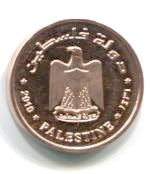
 In
1963 Saudi Arabia introduced a new denomination; the 1 Halala, as part
of a monetary
reform. Because the new coin had no direct equivalent in the
previous monetary system and had minimal value, it was poorly
accepted.
The obverse of the 19mm bronze coin features a palm tree and crossed
swords. The reverse has the denomination and date in
Arabic.
In
1963 Saudi Arabia introduced a new denomination; the 1 Halala, as part
of a monetary
reform. Because the new coin had no direct equivalent in the
previous monetary system and had minimal value, it was poorly
accepted.
The obverse of the 19mm bronze coin features a palm tree and crossed
swords. The reverse has the denomination and date in
Arabic. 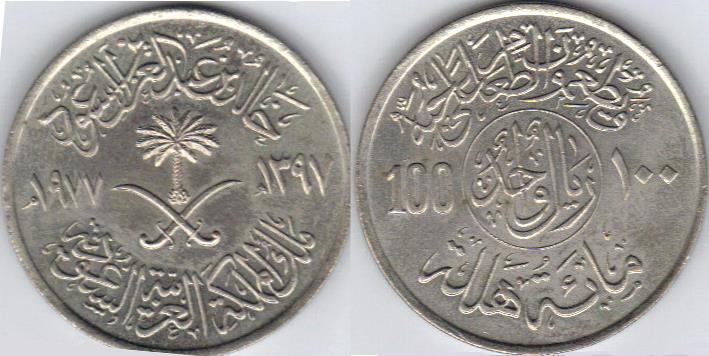 The
British Royal Mint struck a small quantity of copper-nickel 100 Halala
coins for Saudi Arabia dated AD1977 and AH 1397 as samples. Actual
production of the coins commenced the following year, with the coins
dated AD 1978 and AH1398. A few of the sample coins somehow
escaped into circulation. The coins were to be part of the
United Nations Food and Agriculture Organization coin program. The
program encourages farmers to grow more food and helps raise money for
Agricultural projects through the sale of the coins.
The
British Royal Mint struck a small quantity of copper-nickel 100 Halala
coins for Saudi Arabia dated AD1977 and AH 1397 as samples. Actual
production of the coins commenced the following year, with the coins
dated AD 1978 and AH1398. A few of the sample coins somehow
escaped into circulation. The coins were to be part of the
United Nations Food and Agriculture Organization coin program. The
program encourages farmers to grow more food and helps raise money for
Agricultural projects through the sale of the coins.
 This
attractive set includes the most recent issues of all six denominations
minted for Syria from 1996 to 2018, from 1 to 50 Pounds. The obverses
of all the coins include the AD and AH
dates in Arabic and the Syrian coat of arms which features the hawk of
Quraish with two stars on the shield. The reverse of the 2018
nickel-plated steel
50 Pounds depicts the Tomb of the Unknown Soldier in
Damascus. It is the last coin that has been issued by Syria.
It is virtually the same size and has a similar obverse
design as
the 1996 1 Pound coin. The 2003 bi-metallic 25 Pounds depicts
the
Central
Bank of Syria (CBS) building and a latent image that changes from "25"
to "CBS" as the coin is shifted. The 2003 nickel-brass 10
Pounds depicts the ancient colonnade and monumental arch in
Palmyra. There is a latent image within the arch.
The arch was destroyed during the recent civil war. The 2003
nickel-clad steel 5 Pounds depicts the Citadel of Aleppo within a
pentagram. The Citadel is one of the oldest and largest castles in the
world, having been in use since the 3rd millennium BC. It too
was damaged during the recent civil war. The coin has a latent image
that
changes from "5" to "CBS". The 1996 nickel-clad steel 2
Pounds features the Roman Theatre at Bosra. The stainless
steel 1996 1 Pound features the denomination within traditional Syrian
ornamentation. It is an historic set depicting historic sites
from a war-torn nation.
This
attractive set includes the most recent issues of all six denominations
minted for Syria from 1996 to 2018, from 1 to 50 Pounds. The obverses
of all the coins include the AD and AH
dates in Arabic and the Syrian coat of arms which features the hawk of
Quraish with two stars on the shield. The reverse of the 2018
nickel-plated steel
50 Pounds depicts the Tomb of the Unknown Soldier in
Damascus. It is the last coin that has been issued by Syria.
It is virtually the same size and has a similar obverse
design as
the 1996 1 Pound coin. The 2003 bi-metallic 25 Pounds depicts
the
Central
Bank of Syria (CBS) building and a latent image that changes from "25"
to "CBS" as the coin is shifted. The 2003 nickel-brass 10
Pounds depicts the ancient colonnade and monumental arch in
Palmyra. There is a latent image within the arch.
The arch was destroyed during the recent civil war. The 2003
nickel-clad steel 5 Pounds depicts the Citadel of Aleppo within a
pentagram. The Citadel is one of the oldest and largest castles in the
world, having been in use since the 3rd millennium BC. It too
was damaged during the recent civil war. The coin has a latent image
that
changes from "5" to "CBS". The 1996 nickel-clad steel 2
Pounds features the Roman Theatre at Bosra. The stainless
steel 1996 1 Pound features the denomination within traditional Syrian
ornamentation. It is an historic set depicting historic sites
from a war-torn nation.


 Tabaristan
is a region on the southern coast of the Caspian Sea in what is now
Iran. It was one of the last parts of Persia to fall to the
Muslim conquest due to natural barriers including high mountains,
numerous rivers, swamps and dense forests as well resistive
population. Even after it fell to the Abbasid Caliphate it
was virtually independent and had its own distinctive, non-Muslim style
coinage until about 793AD. The coins were silver 1/2 Dirhams based on
the Sassanian Dirham. The obverse featured a crowned
Sassanian style bust. The reverse features a Zoroastrian fire
altar flanked by two attendants. The coins are about 23mm in
diameter, are well struck, and have little or no wear. It is
an unusual transitional coin struck by the Muslim Abbasids but
retaining the design of the earlier Zoroastrian Sassanian coinage.
Tabaristan
is a region on the southern coast of the Caspian Sea in what is now
Iran. It was one of the last parts of Persia to fall to the
Muslim conquest due to natural barriers including high mountains,
numerous rivers, swamps and dense forests as well resistive
population. Even after it fell to the Abbasid Caliphate it
was virtually independent and had its own distinctive, non-Muslim style
coinage until about 793AD. The coins were silver 1/2 Dirhams based on
the Sassanian Dirham. The obverse featured a crowned
Sassanian style bust. The reverse features a Zoroastrian fire
altar flanked by two attendants. The coins are about 23mm in
diameter, are well struck, and have little or no wear. It is
an unusual transitional coin struck by the Muslim Abbasids but
retaining the design of the earlier Zoroastrian Sassanian coinage. Suleiman the Magnificent
(Suleyman I) ruled the Ottoman Empire from 1520 to 1566.
During his long reign he greatly expanded his empire, conquering much
of the Middle East, North Africa, most of Hungary and laid siege to
Vienna twice. He instituted major reforms in education,
taxation and criminal law. He was an accomplished poet,
goldsmith and patron of the arts. This
silver Medini (3 Akces) of Suleiman was struck at the Amid mint, in
what is now Diyabakir in Turkey. Diyabakir, located on the Tigris River
is considered the "un-proclaimed capital of so-called Turkish
Kurdistan". The silver coin is approximately 13mm in diameter
and is dated AH926 (1520AD). It is an historic coin of an
historic monarch.
Suleiman the Magnificent
(Suleyman I) ruled the Ottoman Empire from 1520 to 1566.
During his long reign he greatly expanded his empire, conquering much
of the Middle East, North Africa, most of Hungary and laid siege to
Vienna twice. He instituted major reforms in education,
taxation and criminal law. He was an accomplished poet,
goldsmith and patron of the arts. This
silver Medini (3 Akces) of Suleiman was struck at the Amid mint, in
what is now Diyabakir in Turkey. Diyabakir, located on the Tigris River
is considered the "un-proclaimed capital of so-called Turkish
Kurdistan". The silver coin is approximately 13mm in diameter
and is dated AH926 (1520AD). It is an historic coin of an
historic monarch.
 Mahmud II ruled the
Ottoman Empire from 1808 until 1839. In 1808 Mahmud II's
predecessor and half-brother, Ottoman Sultan Mustafa IV ordered his
execution along with his cousin, the deposed Sultan Selim
III. Selim III was killed, but Mahmud was safely hidden by
his mother and was placed on the throne of the Ottoman Empire after
rebels deposed Mustafa IV. Mahmud carried out many reforms to modernize
his country, including abolishing the elite Janissary corps, reforming
the justice system to prevent governors from arbitrarily sentencing
people to death, modernized the taxation system to prevent abuses by
tax collectors, made sweeping reforms of the bureaucracy in order to
reestablish royal authority and raised salaries in an attempt to limit
bribery. He was less successful militarily,
loosing the Greek war of Independence, losing Algeria to the French and
losing territory in two wars against Russia. This small, thin
Para of Mahmud II was struck in Constantinople between 1832 and
1838. The coin is struck in .170 fine silver.
Though the coin shows little wear, it is weakly struck and is so thin
that the design on one side shows through to the other side of the
coin. It is remarkably inexpensive for an historic silver
coin that is almost 200 years old.
Mahmud II ruled the
Ottoman Empire from 1808 until 1839. In 1808 Mahmud II's
predecessor and half-brother, Ottoman Sultan Mustafa IV ordered his
execution along with his cousin, the deposed Sultan Selim
III. Selim III was killed, but Mahmud was safely hidden by
his mother and was placed on the throne of the Ottoman Empire after
rebels deposed Mustafa IV. Mahmud carried out many reforms to modernize
his country, including abolishing the elite Janissary corps, reforming
the justice system to prevent governors from arbitrarily sentencing
people to death, modernized the taxation system to prevent abuses by
tax collectors, made sweeping reforms of the bureaucracy in order to
reestablish royal authority and raised salaries in an attempt to limit
bribery. He was less successful militarily,
loosing the Greek war of Independence, losing Algeria to the French and
losing territory in two wars against Russia. This small, thin
Para of Mahmud II was struck in Constantinople between 1832 and
1838. The coin is struck in .170 fine silver.
Though the coin shows little wear, it is weakly struck and is so thin
that the design on one side shows through to the other side of the
coin. It is remarkably inexpensive for an historic silver
coin that is almost 200 years old. Turkey
issued the bi-metallic 1 Lira coin in 2020 to commemorate the
conversion of Hagai Sophia into the Grand Hagai Sophia
Mosque. The Hagai Sophia was built between 532 and 537 when
Constantinople was the capital of the Byzantine Empire. It was the
architectural marvel of its age. For almost 1000 years it was
the world's largest cathedral.. It converted to a Mosque
after the fall of Constantinople to the Ottomans in 1453. In
1935 Turkey converted it to a museum and it became Turkey's most
visited tourist attraction. In 2020 the Islamic government of
Turkey converted it back to a mosque despite opposition of many
international organizations and many Turkish citizens. The
coin depicts the mosque on one side and the denomination and date on
the other.
Turkey
issued the bi-metallic 1 Lira coin in 2020 to commemorate the
conversion of Hagai Sophia into the Grand Hagai Sophia
Mosque. The Hagai Sophia was built between 532 and 537 when
Constantinople was the capital of the Byzantine Empire. It was the
architectural marvel of its age. For almost 1000 years it was
the world's largest cathedral.. It converted to a Mosque
after the fall of Constantinople to the Ottomans in 1453. In
1935 Turkey converted it to a museum and it became Turkey's most
visited tourist attraction. In 2020 the Islamic government of
Turkey converted it back to a mosque despite opposition of many
international organizations and many Turkish citizens. The
coin depicts the mosque on one side and the denomination and date on
the other.
 Turkey commemorated the recently completed "1915 Canakkale
Bridge" that spans the Dardanelle on this 2022 bi-metallic 1 Lira
coin.
1915 is part of the official name of the bridge and refers to an
important Ottoman naval victory against the navies of the United
Kingdom and France during World War I. The bridge
is
depicted on the obverse of the coin. It iis the
longest suspension bridge in the world with a main span of 1.257 miles
(2.023 km). The coin is 26.15mm in diameter and
has the
standard
Turkish 1 Lira reverse.
Turkey commemorated the recently completed "1915 Canakkale
Bridge" that spans the Dardanelle on this 2022 bi-metallic 1 Lira
coin.
1915 is part of the official name of the bridge and refers to an
important Ottoman naval victory against the navies of the United
Kingdom and France during World War I. The bridge
is
depicted on the obverse of the coin. It iis the
longest suspension bridge in the world with a main span of 1.257 miles
(2.023 km). The coin is 26.15mm in diameter and
has the
standard
Turkish 1 Lira reverse.
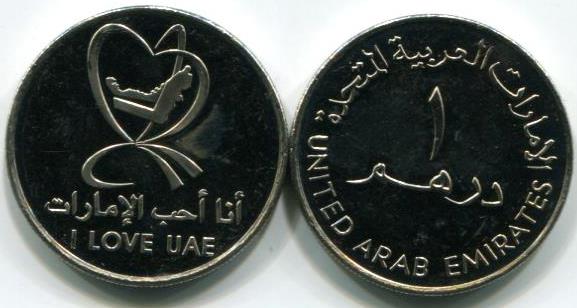 The
United Arab Emirates (UAE) is a federation of seven emirates that
was formed in 1971. It has undergone rapid development and
now a major commercial and transportation hub. It is host to the
tallest building in the world: the Burj Khalifa. Over 80% of
its inhabitants are citizens of other countries. The “I Love
UAE” program was started to promote a stronger national unity among the
diverse population. The program included this circulating
commemorative 1 Dirham that was released in 2009. The reverse
features a heart shaped ribbon surrounding a map of the United Arab
Emirates with the legend “I LOVE UAE” in Arabic and English.
The standard 1 Dirham obverse is on the other side. The 23.8mm coin is
struck in copper-nickel. The coin is undated (must mean it is dateless
love).
The
United Arab Emirates (UAE) is a federation of seven emirates that
was formed in 1971. It has undergone rapid development and
now a major commercial and transportation hub. It is host to the
tallest building in the world: the Burj Khalifa. Over 80% of
its inhabitants are citizens of other countries. The “I Love
UAE” program was started to promote a stronger national unity among the
diverse population. The program included this circulating
commemorative 1 Dirham that was released in 2009. The reverse
features a heart shaped ribbon surrounding a map of the United Arab
Emirates with the legend “I LOVE UAE” in Arabic and English.
The standard 1 Dirham obverse is on the other side. The 23.8mm coin is
struck in copper-nickel. The coin is undated (must mean it is dateless
love).
 In 1958
Egypt and Syria
united to form the United Arab Republic, hoping it would form
the basis of a larger pan-Arabic union. It was not to
be. Syria withdrew in 1961 over resentment of Egyptian
dominance and control the union. Egypt continued to call
themselves United Arab Republic until 1971. This four coin United Arab
Republic set includes the aluminum-bronze 1, 2, 5 and 10 Milliemes
struck by Egypt and dating from 1960 to 1962. The coins
feature the Eagle of Saladin with two stars on the shield representing
Egypt and Syria. The back has the denomination and AH and AD dates, all
in Arabic.
In 1958
Egypt and Syria
united to form the United Arab Republic, hoping it would form
the basis of a larger pan-Arabic union. It was not to
be. Syria withdrew in 1961 over resentment of Egyptian
dominance and control the union. Egypt continued to call
themselves United Arab Republic until 1971. This four coin United Arab
Republic set includes the aluminum-bronze 1, 2, 5 and 10 Milliemes
struck by Egypt and dating from 1960 to 1962. The coins
feature the Eagle of Saladin with two stars on the shield representing
Egypt and Syria. The back has the denomination and AH and AD dates, all
in Arabic. The
Kathiri Sultans controlled the towns of Seiyun and Tarim in what is
now Yemen. After losing much
of their territory to rival tribes they
agreed to become a British Protectorate. Seiyun was the capital, and
Tarim is a major center of Islamic learning. In 1897 they had
this silver 12 Khumsi coins struck at the Heaton Mint for their
territory. The coin is all in Arabic, except for the Heaton
mintmark and are dated AH1315. 12 Khumsi was
equivalent to
1/10 Riyal. The coin is 18mm in diameter. It is a rarely seen coin from
a now forgotten nation.
The
Kathiri Sultans controlled the towns of Seiyun and Tarim in what is
now Yemen. After losing much
of their territory to rival tribes they
agreed to become a British Protectorate. Seiyun was the capital, and
Tarim is a major center of Islamic learning. In 1897 they had
this silver 12 Khumsi coins struck at the Heaton Mint for their
territory. The coin is all in Arabic, except for the Heaton
mintmark and are dated AH1315. 12 Khumsi was
equivalent to
1/10 Riyal. The coin is 18mm in diameter. It is a rarely seen coin from
a now forgotten nation. The
People's Democratic Republic of Yemen, also known as South Yemen or
Democratic Yemen, gained independence from Great
Britain after the
withdrawal of the British and the collapse of the Federation of South
Arabia in 1967. Over the years its relations with the Yemen Arab
Republic, or North Yemen fluctuated between war and
peace.
The two nations fought a war in 1972, but were peacefully united in
1990 after Democratic Yemen lost support from communist nations due to
the collapse of the Soviet
Union. Peace was not lasting however, a
civil war between factions from the north and south broke out again
in
1994. Peace was temporarily achieved with an election in
1999, however the country continued to suffer from instability as
various tribal factions fought for contol. Since 2012 Yemen
has been engaged in another
ongoing civil war, with factions in the South supported by Saudi
Arabia
and factions in the north supported by Iran.
This 23mm
aluminum 5 Fils coin of Democratic Yemen features a spiny
Lobster. The coins is dated in Arabic numerals 1984AD and
AH1404.
The
People's Democratic Republic of Yemen, also known as South Yemen or
Democratic Yemen, gained independence from Great
Britain after the
withdrawal of the British and the collapse of the Federation of South
Arabia in 1967. Over the years its relations with the Yemen Arab
Republic, or North Yemen fluctuated between war and
peace.
The two nations fought a war in 1972, but were peacefully united in
1990 after Democratic Yemen lost support from communist nations due to
the collapse of the Soviet
Union. Peace was not lasting however, a
civil war between factions from the north and south broke out again
in
1994. Peace was temporarily achieved with an election in
1999, however the country continued to suffer from instability as
various tribal factions fought for contol. Since 2012 Yemen
has been engaged in another
ongoing civil war, with factions in the South supported by Saudi
Arabia
and factions in the north supported by Iran.
This 23mm
aluminum 5 Fils coin of Democratic Yemen features a spiny
Lobster. The coins is dated in Arabic numerals 1984AD and
AH1404.