GERMAN COINS AND CURRENCY
Including coins and notes of the
German Empire, Weimar Republic Inflationary period, Third Reich and
East Germany
BAVARIA
SILVER 5 MARK COMMEMORATES 90th BIRTHDAY
OF PRINCE REGENT LUITPOLD

Bavaria
commemorated the 90th birthday of Prince Regent Luitpold with this
silver 1911 5 Mark coin. . The bust of Luitpold is on the
obverse and the standard crowned German Imperial Eagle is on the
reverse. The 38mm coin is struck in .900 fine silver contains
.8037 troy ounces of silver and has a lettered edge "
GOTT MIT UNS" (God
with us).
Luitpold was the regent for
Bavarian King Otto. King Otto who was the younger brother of
"The Mad"
King Ludwig II. On June 10, 1886 the Bavarian cabinet
declared Ludwig unable to rule and appointed his uncle Luitpold as
Regent. Three days later Ludwig died under mysterious
circumstances and Otto became king. King Otto was never able
to rule as he was immediately declared "melancholic" and Luitpold
continued as regent. It is unclear if Otto's problem was
Post-Traumatic Stress Disorder from his service in the Franco-Prussian
War, the ravages of Syphilis, an inherited disorder or if Luitpold and
others just wanted him out of the way. The King was kept
locked up and there was no apparent effort to treat him. In 1912
Luitpold died and his son succeeded him as regent.
Item
BAV-5M-LUITPOLD BAVARIA 5 MARK 1911 LUITPOLD
90th BIRTHDAY, KM999 UNC
$150.00
FRIEDRICH THE
IRONTOOTH OF
BRANDENBURG

This
silver Bracteate Hohlpfennig was issued by
Friedrich II (Frederick II) who was the
Prince-Elector of the
Margravate of Brandenburg from
1440 to 1470. It is believed that he was nicknamed "The Irontooth" or
"The
Iron" due to his great strength and power. Friedrich
strengthened Brandenburg forming the basis of what was to become
Prussia and the German Empire. The rights of the towns and
nobility were curtailed and he regained Neumark (East Brandenburg) from
the Teutonic Knights. The citizens of Berlin revolted when he
attempted to build a palace on Colin island in the Spree
river. Friedrich prevailed, built the castle that became the
Stadtschloss (Berlin Palace), and the rights of the city were greatly
curtailed. The Stadtschloss was torn down by East Germany in the 1950's
and is now being rebuilt. The silver Bracteate Hohlpfennig is
an extremely thin and single sided coin wtih a raised rim.
The
design is
embossed from the reverse. This coin is approximately 16mm in
diameter and features an eagle with outstretched wings.
Because the coins are so thin and fragile, few survive today.
Item
BRAND BRANDENBURG SILVER HOHLPFENNIG,
FRIEDRICH II 1440-1470, Saurma 4675 F-VF
$39.00
MEDIEVAL CITY
COINS OF THE
MARGARVIATE OF BRANDENBURG


These medieval city Hohlpfennigs were issued during the reign of
Friedrich II Irontooth, who was Prince-elector of the Margraviate of
Brandenburg from 1440 to 1470. A Hohlpfennig is a thin silver
coin, about 16mm in diameter with a raised rim. The coin design is
embossed on one side and incuse on the other. They were widely used in
Northern Germany in the late Middle Ages. The coins depict
the arms of the city in which they were struck. The coin from Stendal
depicts half an eagle on the left and four diamonds on the
right. Stendal is located about 78 miles (125km) west of
Berlin. It the joined Hanseatic League in 1358 and purchased the
privilege of minting from the Brandenburg margraves in 1369.
In 1456 Friedrich II founded a convent for Augustinian nuns in the
city, which today is a museum. The Hohlpfennig from Frankfurt
an der Oder features a plumed knight's helmet. Frankfurt (Oder) is
located about 50 miles (80km.) east of Berlin on the Oder river on what
is now the German-Polish border. It was founded as a Polish
town. In 1249 it became part of the Margraviate of
Brandenburg, The knight's helmet design makes this one of the
more interesting Hohlpfennigs.
Item
STENDAL STENDAL SILVER HOHLPFENNIG, FRIEDRICH
II 1440-70, Bahrfeldt 19 VF-crude
$29.50
Item
FRANK-O FRANKFURT (ODER) SILVER HOHLPFENNIG,
FRIEDRICH
II 1440-70, Bahrfeldt 16 VF-crude
$33.50
 EINBECK
- HOME OF BOCK BEER
EINBECK
- HOME OF BOCK BEER

Einbeck
is a town in Lower Saxony Germany, gained fame in the fourteenth
century for its distinctive dark beer. As a member of the Hanseatic
League it sold its beer from Antwerp in the west to Riga in the east
and from Stockholm in the north to Munich in the south.
Brewers in Munich copied the style of the popular beer in the 17th
century. They mispronounced "Einbeck" as "ein Bock" (a billy goat), and
thus the beer became known as "bock". Einbeck struck its own
coinage sporadically from 1498 to 1717. This undated Einbeck
1 Pfennig was struck from 1647 until 1717. The crude 15mm
copper coin has the denomination on one side and the name of the town
around an emblem on the other. It is one of the most
affordable coins of this small town.
Item
EINBECK EINBECK 1 PFENNIG (1647-1717) KM40
F-VF
$20.00
UNHAPPY ROYAL
WEDDING COIN OF
SAXE-WEIMAR-EISENACH

The
Grand Duchy of Saxe-Weimar-Eisenach consisted of over a dozen
non-contiguous territories in central Germany. After the
unification of Germany it issued few coins. This 1910 3 Mark of
Saxe-Weimar-Eisenach commemorates the wedding of Grand Duke Wilhelm
Ernest to Princess Fedora. It was the Duke's second
marriage. The Duke's first wife died after 18 months,
probably by suicide. His marriage to Fedora was not a happy
one. Though Fedora was popular with the people, the Duke was not. The
Duke was known to be a sadist and was widely hated. He was
called "the most unpopular prince in all of Germany". His court was
considered to be one of the most stifling and etiquette-driven in
Germany, and Weimar was considered to be "the dreariest capital in
Europe". The 33mm silver coin depicts the busts of Wilhelm
Ernest and Fedora on the obverse. The imperial German Eagle
is on the reverse. The coin has a lettered edge. It
has a mintage of only 133,000 and was struck in Berlin. It is
an attractive coin from an unpopular monarch.
Item
WEIMAR-3M SAXE-WEIMAR-EISENACH 3 MARK 1910
WEDDING KM22 AU
$120.00
MAGNIFICENT 1910
IMPERIAL
GERMAN BATTLESHIP BANKNOTE 
This beautiful, large, old
1910 German 100 Mark pictures a seated figure of Germania holding a
sword and shield under an oak tree. In the background three
battle ships steam by. At her feet are symbols of industry,
farming and commerce. The front features the heads of Mercury
and Ceres and the German imperial crown. The over-sized note
is 207mm x 102 mm (8.25” x 4”) and includes a watermark of German
Emperor Wilhelm I. It is an impressive old note at a moderate
price.
Item
PM-DE-100M-10 GERMANY 100 MARK 1910
BATTLESHIP BANKNOTE VG-FINE
$7.00
GERMAN EMPIRE
COIN
& CURRENCY SETS


In 1871 Otto Von Bismarck united the 26 independent German States
under Prussian King Wilhelm I, forming the Second Reich, also known as
the German Empire. During its 47 years of existence, the German Empire
became the industrial, technological, and scientific giant of Europe
and the world's third largest economy. It created a colonial
empire and possessed the world strongest army. The Empire
disintegrated as a result of Germany's defeat in World War I.
This
six-coin set includes the silver 1 Mark, which was minted from 1873
until 1916; the silver 1/2 Mark, minted from 1905 to 1919; the
copper-nickel 5 and 10 Pfennig and the copper 1 and 2 Pfennig, which
were minted from 1874 to 1916. All six coins feature the
Imperial
German Eagle on the reverse and the denomination on the
obverse. The
coins grade Fine or Extra
Fine.
The set of 3 banknotes consist of the 20 Mark, 100 Mark and 1000 Mark
notes dated between 1908 and 1914. The blue 20 Mark featured a crowned
imperial German Eagle at the upper right and measures
136x90mm.
The blue 100 Mark includes a large crowned imperial German Eagle on the
front. The back features two women holding a large medallion
depicting a woman's head. The large note measures 160 x105mm (6.3" x
4.1"). The brown 1000 Mark note features two allegorical women
representing seafaring and agriculture flanking the imperial German
arms. The over-sized note is 187mm x 110mm (7.3” x 4.3”). It is printed
on special ridged hemp paper containing blue silk threads.
When
first issued the three notes could be redeemed for over 12 ounces of
gold on demand! After the start of World War I
Germany
halted the redemption of banknotes for gold - but kept on printing
banknotes. By 1922 the notes were virtually worthless due to
inflation. It is an impressive and historic currency set.
Item
DE-EMP-SET6 GERMAN EMPIRE 6 COIN SET 1
PFENNIG - 1 MARK 1874-1918 F-XF
$22.00
Item
PM-DE-SET3 GERMAN EMPIRE 20, 100
& 1000 MARK BANKNOTES 1908-1914 F-VF
$6.00
Item
PM-DE-SET3x10 10 OF THE ABOVE GERMAN
EMPIRE 3 NOTE SETS
$39.00
Item
PM-DE-SET3x100 100 OF THE ABOVE
GERMAN
EMPIRE 3 NOTE SETS
$195.00
GERMAN WORLD
WAR I
ERA
COIN SET

Because
of the difficulty in obtaining nickel and copper needed for coins due
to World War I, Germany made a number of changes in their
coinage. In 1917 the copper 1 Pfennig was switched to
aluminum and shrunk in size. It was discontinued shortly
after that. The copper 2 Pfennig was discontinued due to the
war. The copper-nickel 5 Pfennig was changed to iron in 1915
and continued to be produced until 1922. The
copper-nickel 10 Pfennig was produced in two metals: iron, starting in
1916, and zinc starting in 1917. Both continued to be struck
until 1922. All the coins had the denomination on one side
and the imperial German Eagle on the other. This
World War I era four coin set includes the aluminum 1 Pfennig, iron 5
Pfennig and both the iron and zinc 10 Pfennig in Very Fine of better
condition.
Item
DE-WWISET GERMANY 4 COIN SET 1 - 10
PFENNIG, 1915-1922
VF
$7.50
GERMAN WORLD WAR I
SILVER COINS
After the start of World War I in 1914, Germans hoarded their silver
coins. Because of this the World War I German coins are
available in top grade at very reasonable prices (especially when
compared to United States coins of that era). Both the 1/2 Mark was
struck in .900 fine silver (the same as U.S. silver coins).
They feature the Imperial German Eagle on one side and the denomination
and date on the other.
Item
DE-WWI-1/2M GERMANY 1/2 MARK KM17: 1914,
1915, 1916 or 1918 AU-UNC.
$12.00
EMERGENCY WORLD WAR
I 50 PFENNIG NOTE OF KIEL, GERMANY

Kiel
is an important seaport located at the mouth of the Kiel Canal
which connects the Baltic Sea to the North Sea. It was also a
major base for the German Imperial Navy. By the
beginning of 1918 the war effort was not going well for
Germany. Though the German government continued to mint
silver 1/2 Mark coins, they were hoarded almost as soon as they were
minted, resulting in a serious coin shortage. To
help alleviate the shortage and allow merchants and citizens to carry
on commercial transactions the city of Kiel issued this emergency 50
Pfennig note dated January 1, 1918. The front features the denomination
and date in words and has a green under-printing depicting ships on the
ocean. The back features the Kiel city hall.
Item
PM-KIEL-50P KIEL, GERMANY 50 PFENNIG NOTE,
JANUARY 1, 1918
UNC.
$3.00
Item
PM-KIEL-50Px5 5 of the above KIEL, GERMANY 50
PFENNIG NOTE,
JANUARY 1, 1918
UNC.
$9.95
LAST BANKNOTE OF
THE
GERMAN EMPIRE

This attractive 50 Mark note is the
last note of the German Empire. It
is dated June 23, 1919, some seven months after Germany's defeat in
World War I and less than 7 weeks before the signing of the new
constitution in Weimar which formally ended the German Empire and
ushered in the weak and chaotic Weimar Republic. The large, green note
measures 153x102mm and features an allegorical figure of a woman
against a starry background.
Item
PM-DE-50M-19 GERMANY 50 MARK NOTE 1919
P66 Fine $3.00
HIGH-GRADE WEIMAR
GERMAN BANKNOTE
These 1 and 2 Mark notes dated March 1, 1920 were some of the first
notes issued by Germany's Weimar government after World War I. They
were needed to help relieve the serious coin shortage that developed in
Germany during and after World War I. The notes were
technically were not legal tender but a non-interest-bearing loan to
the government. that did not stop people from accepting them as the low
denomination notes were needed to purchase essential goods.
When first issued the 1 Mark note could buy about a pound of flour or
half a
dozen eggs. The notes include an embossed seal and are
printed on watermarked paper. They are quite reasonably priced for
historic high-grade notes that are a century old.
Item
PM-DE-1+2M GERMANY 1 & 2 MARK NOTES
1920 P58 & P59& UNC.
$5.00
GERMAN WEIMAR
REPUBLIC
100 MARK BANKNOTE

The Weimar Republic was formed after
the defeat of the German Empire in
World War I. Its early years were a tumultuous period of
uprisings, riots and massive inflation. It is named after the
city where the new German constitution was written and adopted in
August, 1919, and lasted until the rise of the Nazis in
1933. The 100 Mark note features two
images of the head of the “Bamberg Horseman”. The horseman is
an impressive 13th century sculpture in the Bamberg
Cathedral. The Bamberg
Horsman depicts a famous king, however which king it is is a matter of
debate. The note is dated November 1, 1920, measures
162x108mm and includes
the red Weimar Republic crest.
Item
PM-DE-100M-20-C GERMANY-WEIMAR 100 MARK NOTE,
1920 P69 Fine $3.00
Item
PM-DE-100M-20x10 10 OF THE ABOVE GERMAN 100
MARK NOTES, 1920 P69 VG-F $15.00
Item
PM-DE-100M-20x100 PACK OF 100 OF THE ABOVE
GERMAN 100
MARK NOTES, 1920 P69 VG-F $85.00
Item
PM-DE-100M-20-U GERMANY-WEIMAR 100 MARK NOTE,
1920
P69b AU-UNC. $10.00
EMERGENCY
BANKNOTE
FROM THE CITY OF GOTHA
 Reduced
size image
Reduced
size image
Because of the severe inflation that followed World War I, prices were
rising faster than the German government could print money.
Many towns and companies resorted to printing their own
currency. This 100 Mark note was issued by the City of Gotha,
Germany. It is dated September 30, 1922. It is a
simple, uniface note that pictures a bishop from the town’s
arms.
Item
PM-GOTHA GOTHA, GERMANY 100 MARK NOTE, 1922
VF $3.00
GERMAN NOTGELD (EMERGENCY) COINS AND CURRENCY
Notgeld means "emergency money" in German, and generally refers to an
extensive series of locally issued coins and currency produced during
and following World War I. Notgeld was issued in paper, metal
and even porcelain and other materials. Below is a selection
of this fascinating but little known collectible.
METAL
GERMAN NOTGELD COINS

Notgeld
coins were struck for over 600 communities and companies in Germany
between 1916 and 1922, though many are not dated. Most are in
denominated from 5 to 50 Pfennig. Typically the city arms or landmark
is on one side and the denomination is on the other. They
were usually struck in zinc or iron, both of which corrode easily, so
the
coins may be spotted or rusted.
Item DE-METNOTx1 1
GERMAN METAL NOTGELD COIN, F-VF
$3.50
Item DE-METNOTx10 10
DIFFERENT GERMAN METAL NOTGELD COINS, F-VF $35.00
SCHLESWIG
PLEBISCITE NOTE FROM
FLENSBURG

After
World War I, control of the Schleswig-Holstein region was disputed
between Denmark and Germany. Historically, control of various
portions of the region had alternated between Denmark and Germany over
the centuries. It was decided to hold two plebiscites and let
the inhabitants of the regions decide which country they wished to
join. The first plebiscite held in the northern portion
elected to become part of Denmark. The southern portion elected to join
Germany. The town of Flensburg is at the northern end of the
southern portion and a vast majority of its population was of German
ancestry. Shortly after the plebiscite, Flensburg issued this
25 Pfennig note showing the Danes having lost a tug-of-war with the
Germans and the Germans welcoming them. The date of the
plebiscite, March 14, 1920 appears above the Danes. The
reverse consists of text. It is an unusual note reflecting a
vote.
Item
PM-FLENS-25PF FLENSBURG 25 PFENNIG
NOTE 1920 UNC. $4.00
LOW
AND HIGH DENOMINATION GERMAN MUNICIPAL NOTES
Germany’s hyperinflation is clearly demonstrated in these municipal
emergency banknotes. The low denomination notes issued around
the end of World War I were needed because of a shortage of small
change. The second issue, done just a few years later in 1923 was
needed because inflation was so bad that cities printed their own money
to pay their workers. From the City of Frankfurt is a 25
Pfennig dated November 1, 1919. It would buy about 1 loaf of
bread. A view of the city is on the back. The
Frankfurt 100 million Mark note is dated September 28, 1923.
It would buy about 2 loaves of bread. The back of the note
depicts the Imperial Cathedral of Saint Bartholomew on the left and St.
Paul’s Church on the right. Both were severely damaged in
World War II. From the City of Marburg is a 50 Pfennig note
dated between 1918 and 1921, shortly before the end of World War
I. It
depicts the Town Hall and St. George’s Column (now a fountain) on the
front and the city emblem on the back. The Marburg 20 Milliarden Mark
(20 Billion Mark) note is dated October 27, 1923. It pictures
St. Elizabeth’s Church and a monument on the front and is blank on the
back. They are fascinating historical symbols of Germany’s
hyperinflation.
Item
PM-FRANK-25PF FRANKFURT, GERMANY 25 PFENNIG
NOTE 1919 XF $3.00
Item
PM-FRANK100MM FRANKFURT, GERMANY 100 MILLION
MARK NOTE 1923 VF-XF out
Item
PM-MARB-50PF MARBURG, GERMANY 50 PFENIG NOTE
1918-1921 AU-UNC $3.00
Item
PM-MARB-20BM MARBURG, GERMANY 20 MILLARDEN
(BILLION) MARK 1923 VF $8.00
ST.
MARTIN'S EVE FEAST NOTE FROM NORDHAUSEN

St.
Martin's Day, also called Old Halloween, takes place November
11. It marked the end of the harvest season and beginning of
winter. In Germany it was celebrated with feasting, bonfires,
processions and small gifts for children. The back of this 1921 dated
25 Pfennig note from the German city of Nordhausen depicts three men
drinking and feasting on a traditional St. Martin's Goose along with
two St. Martin candles, a cooked goose and fish on platters. Below is a
poem which roughly translates as "
With
a sip of Korn (a strong liquor
produced in Nordhausen),
A
slice of meat, That’s the way the Nordhauser
people celebrate with a St. Martin's goose feast".
The front
of the note features the Nordhausen coat of arms. The
colorful note is 84x55mm.
Item
PM-NORHAUSEN NORDHAUSEN, GERMANY 25 PFNNIG
NOTE 1921 UNC. $3.00
ATTRACTIVE
AND COLORFUL GERMAN NOTGELD NOTES
These attractive, colorful small (most less than 4 inches - 90cm long)
were issued by communities throughout Germany during and after World
War I. They quickly became a popular with collectors and by
1921 many
thousand different types were produced. They have a wide
variety of
themes, including fairy tales, local history, monuments, and political
satire. Every lot is different, however there may be
duplication between lots. They are a fun and fascinating
collectible and
remarkably inexpensive considering they are over 100 years old!
Item
PM-DE-NOTx10 10 DIFFERENT
GERMAN NOTGELD NOTE UNC. $10.00
Item
PM-DE-NOTx25 25
DIFFERENT GERMAN NOTGELD
NOTES, UNC. $22.50
Item
PM-DE-NOTx100 100
DIFFERENT GERMAN NOTGELD
NOTES, MOST UNC.
$89.50
Item
PM-DE-NOTx200 200
MOSTLY DIFFERENT GERMAN NOTGELD
NOTES, MOST UNC.
$179.00
OLD GERMAN COINS
BLOWOUT
LOT
Nice mix of German Empire, WWI and Weimar Republic coins datubg from
the late 19th century to about 1936. Good mix of dates, mints
and types. Many coins are over 100 years old. Every lot is
different.
Item
DE-LOT50 LOT OF 50 MIXED GERMAN COINS
including Empire, WWI & Weimar coins $25.00
WEIMAR
REPUBLIC COIN
SETS
The Weimar Republic was a turbulent period for Germany between the
collapse of the German Empire in World War I in 1918 and the Nazis
coming to power in 1933. We are pleased to offer the three
series of coins issued by the Weimar Republic. The Inflation
Era Set includes the following 4 coins. The aluminum 50 Pfennig minted
from 1919 until 1922 features a wheatsheaf and a proverb which
translates as "hard work pays off". The aluminum 3
Mark was minted only in 1922 and features the heraldic German
eagle. It commemorates the third anniversary of the Weimar
constitution. In 1923 aluminum 200 and 500 Mark coins were
released. Both coins feature the Germanic eagle. At the
beginning of 1923 the two coins (700 Mark) could buy a loaf of
bread. By November bread cost over 80 Billion Mark per
loaf! In November 1923 Germany did a 1 trillion to 1
revaluation of their currency and introduced the Rentenmark.
The Rentenmark was backed by mortgages on German industrial and
agricultural property. The set of 4 Rentenmark coins includes
the 1, 2, 5 and 10 Rentenpfennig. The bronze 1 and 2
Rentenpfennig feature a wheatsheaf, which was the emblem of the
Rentenbank. The aluminum-bronze 5 and 10 Rentenpfennig feature ears of
grain. Rentenpfennig coins were struck for circulation only
two years: 1923 and 1924. In 1924 the Reichsmark was
introduced. It was backed by gold and was equal to a
Rentenmark. The 5-coin Reichsmark set includes the 1, 2, 5,
10 and 50 Reichpfennig. The 1, 2, 5 and 10 Reichpfennig coins
utilized the same designs as the Rentenpfennig coins except the legend
was changed from Rentenpfennig to Reichpfennig. The coins
were struck from 1924 until 1936. In 1927 the nickel 50
Reichspfennig coin featuring the Germanic eagle was
introduced. It continued to be struck until 1938.
All of these Weimar coins feature the denomination in large numerals on
the obverse.
Item
DE-INFLAT SET OF 4 GERMAN INFLATION COINS: 50
PFENNIG - 500 MARK 1919-1923 VF-AU $10.00
Item
DE-RENTEN SET OF 4 GERMAN RENTENPFENNIG
COINS: 1 - 10 RENTENPFENNIG 1923-1924 VF $5.00
Item
DE-REICH SET OF 5
GERMAN REICHSPFENNIG COINS:
1 - 50 REICHSPFENNIG 1924-1936 VF $7.50
COINS OF
GERMANY'S
HYPERINFLATION
In 1919, after the collapse of the establishment of the Weimar Republic
and the fall in the value of the Mark, Germany replaced the silver 1/2
Mark with an aluminum 50 Pfennig. One side features a sheaf
of wheat with the proverb "hard work pays off" on one side and the
denomination and date on the other. The 23mm coin
is 1.5mm thick. It was struck until 1922. In 1923 Germany introduced a
200 Mark coin. It was also 23mm, but only 1mm thick. One side
has the Weimar Eagle with the inscription that translates "Unity and
Justice and Freedom". Because of continued Germany's
hyperinflation it was issued for only a few months before it became
virtually worthless. Later that year the city of Hamburg
introduced a 200,000 Mark coin that was virtually the same size as the
200 Mark. It is dated August 1923 and features the Hamburg
coat of arms.
Item
DE-50PF-22 GERMANY 50 PFENNIG 1919-1922 KM27
AU-UNC. $3.00
Item
DE-200M GERMANY 200 MARK 1923 KM37 XF-UNC. $4.00
Item
HAM-200K HAMBURG, GERMANY 200,000 MARK COIN
AUGUST
1923 AU-UNC. $12.00
WEIMAR REPUBLIC
COMMEMORATES 3rd
ANNIVERSARY WITH 3 MARK
In 1922 Germany issued a circulating 3 Mark coin commemorating
the 3rd Anniversary of the Weimar Constitution. The
denomination,
date and mintmark are on the obverse. A Germanic Eagle and
the
legend "
VERFASSUNGSTAG
11. AUGUST 1922"
(Constitution day, August 11, 1922) is on the other. The
aluminum
coin is 28mm. Inflation quickly took a toll on Germany. It
was an
inauspicious commemorative. Due to rampant inflation it
quickly
became virtually worthless. We have the coin in Uncirculated condition
from both the Berlin (A) and Karlsruhe (G) mints. The coins
catalog $30 each. Our price is MUCH less.
Item
DE-3M-A GERMANY 3 MARK 1922-A BERLIN MINT
KM29 BU
$5.00
Item
DE-3M-G GERMANY 3 MARK 1922-G KARLSRUHE MINT
KM29 BU
$5.00
Item
DE-3M-J GERMANY 3 MARK 1922-J HAMBURG MINT
KM29 BU
$8.00
Item
DE-3Mx10 10 pieces of GERMANY 3 MARK 1922
KM29, mixed A & G mints BU
$29.50
THE FAMOUS GERMAN
"VAMPIRE
NOTE"
This large ( 180 x 100mm - approx. 8” x 5”) 10,000 Mark note dated
January 19, 1922 is
often called the "Vampire Note" If you turn the note
sideways,
look carefully and have a good imagination you will see a vampire
on the neck of the German. The nose of the vampire is pointed
towards the neck of the man. This was an allusion to the
heavy reparations that Germany had to pay France following World War I.
It represented France sucking the lifeblood out of
Germany.
Item
PM-DE-VAMP-C
GERMANY 10,000 MARK "VAMPIRE NOTE" 1922 P72 VF $6.00
Item
PM-DE-VAMPx10
10 of the above GERMANY 10,000 MARK "VAMPIRE NOTE" 1922 P72 VF $39.00
Item
PM-DE-VAMPx100
100 of the above GERMANY 10,000 MARK "VAMPIRE NOTE" 1922 P72 VF $250.00
Also see:
 CANADIAN "DEVIL'S FACE" BANKNOTES:
$1 & $2 1954 P66 & P67
CANADIAN "DEVIL'S FACE" BANKNOTES:
$1 & $2 1954 P66 & P67
POPULAR GERMAN
100,000 MARK
INFLATION NOTE
This 100,000 Mark note dated February 1, 1923 is one of the most
popular of the German inflation notes. The large (190 x
115mm) note features a cut from Hans Holbein the Younger's portrait
"The Merchant Georg Gisze". At the time the painting was done
in 1532 Georg Gisze was a prominent Hanseatic merchant who
managed his family's trading office in London. Some sources indicate
the portrait was done for his betrothed who lived in Danzig (Gdansk),
as they probably had never met. German painter Han Holbein
the Younger had a successful career in London, with commissions from
Sir Thomas More, Thomas Cromwell, Anne Boleyn and as a court painter of
Henry VIII. The painting is now in the Gemäldegalerie in
Berlin. The back of the brown, black and lilac note features
the denomination within guilloche patterns. It is an historic
note from the beginning of the German hyperinflationary
period. We have the note in both circulated and Uncirculated condition
Item
PM-DE-100,000M-C
GERMANY 100,000 MARK NOTE,
1923 P83 VF-XF $4.00
Item
PM-DE-100,000M-Cx10
10 of the above GERMANY 100,000 MARK NOTE,
1923 P83 VF-XF $25.00
Item
PM-DE-100,000M-Cx100
100 of the above GERMANY 100,000 MARK NOTE,
1923 P83 VF-XF
$150.00
Item
PM-DE-100,000M-U
GERMANY 100,000 MARK NOTE,
1923 P83 UNC.
$8.00
SET OF 9 GERMAN
INFLATION ERA NOTES: 1 MARK - 2 MILLION MARK 1920-1923

This
set of nine banknotes issued by the German government vividly
illustrates the 1920-1923 hyperinflation. This set includes
the 1 and 2 Mark dated March 1, 1920. The notes were needed because all
silver 1 Mark coins had disappeared from circulation. The
large-size (162 x 108mm) 100 Mark note is dated November 1, 1920 and
depicts the head of the Bamberg Horseman. It was worth about
$1.50 when first issued. Also included is the 500 Mark dated
July 7, 1922; 1000 Mark dated September 15, 1922; 5000 Mark
dated December 2, 1922 and 20,000 Mark dated February 20, 1923. The
magnificent, large 100,000 Mark is dated February 1, 1923, features a
cut from Hans Holbein the Younger's portrait "The Merchant Georg
Gisze". The last note in the collection is the 2 Million Mark
note dated August 9, 1923. It was worth less than a dollar
when introduced and would be virtually worthless in less than a month.
The notes grade Fine to Almost Uncirculated. It is an
impressive and historic collection showing what happens when government
spending gets out of control.
Item
PM-DE-SET9
SET OF 9 DIFFERENT GERMAN NOTES 1 MARK - 2 MILLION MARK 1920-1923 F-AU $29.75
BULK GERMAN NOTE BARGAINS:
Item
PM-DE-LOT50
LOT OF OF 50 MIXED GERMAN NOTES 1 MARK - 50 MILION MARK+, 1907-1923
VG-AU
$69.75
Item
PM-DE-LOT100
LOT OF OF 100 MIXED GERMAN NOTES 1 MARK - 50 MILION MARK+, 1907-1923
VG-AU
$125.00
GERMAN
NATIONAL
RAILWAY
CURRENCY

In
1923, Germany experienced what was then the world’s worst inflation.
Prices increased hourly and the government could not print currency
fast enough to meet the demand. In order to pay employees and
suppliers, the Deutsche Reichsbahn (the German National Railways)
printed its own currency. Unlike most of the corporate or
municipal issues of the period, the Railway notes were accepted
throughout most of Germany. In order to pay workers and suppliers notes
were issued from the company headquarters in Berlin as well as regional
railway offices throughout the country. It is interesting to see how
the denominations increased from week to week. In German
Milliarden is 1 Billion in English. Many notes are printed only on one
side. These sell out quickly, alternates appreciated.
NOTES ISSUED FROM
DEUTSCHE REICHBAHN BERLIN HEADQUARTERS:
Item
PM-DERB-1MM DEUTSCHE REICHSBAHN 1 MILLION
MARK, August 12, 1923 PS1011 VF-XF
$6.00
Item
PM-DERB-2MM DEUTSCHE REICHSBAHN 2 MILLION
MARK August 20, 1923 PS1012 XF
$6.00
NOTE ISSUED BY THE
FRANKFURT AM MAIN REGIONAL RAILWAY OFFICE
Item
PM-RD-FRANK-20MM FRANKFURT 20 MILLION MARK
Sept. 1 1923 PS1219 AU-UNC.
$13.00
GERMANY
LOCAL INFLATION
NOTGELD NOTES

By
the summer of 1923 inflation roared totally out of control in
Germany. The federal government couldn't print money fast
enough,
so municipalities and companies printed their own money to pay workers
and buy supplies. Of course, only increased the money supply making
inflation even worse. These notes are known as inflation notgeld
(emergency money). In most cases the notes would
only be
accepted in the communities they were issued, and then, sometimes only
reluctantly. The notes clearly demonstrate what
happens
when governments print too much money to cover their
expenses.
Because they were issued only for use in the local area, they are much
scarcer than the national issues.
We offer selections of this
inflation notgeld. Most are denominated between 100,000 Mark
and
100 Milliarden (100 billion) Mark and most date between July and
November 1923. Most are full sized notes.
Some have
attractive designs, others have simple designs and are printed on one
side only reflecting the rush to produce the notes.
Every
lot is different, though there may be some duplication between lots.
Item
PM-DE-INFLNOTx1 1
GERMAN 1923 INFLATION NOTGELD NOTE VF-XF $3.00
Item
PM-DE-INFLNOTx10 10 DIFFERENT 1923 GERMAN
INFLATION
NOTGELD NOTES VG-XF $29.95
Item
PM-DE-INFLNOTx30 30 DIFFERENT 1923 GERMAN
INFLATION
NOTGELD NOTES VG-XF $89.95
Item
PM-DE-INFLNOTx100 100 MOSTLY DIFFERENT 1923
GERMAN
INFLATION
NOTGELD NOTES VG-XF $295.00
RARE 1923 GERMAN
GOLD MARK NOTE
During Germany’s spiraling 1923 hyperinflation some organizations
issued bank notes denominated in both gold and the United
States Dollar (which was tied to gold at $20.67 per troy
ounce). Thhis note was issued by the Association of the
South German Textile Employers based in Hof in an attempt to pay their
workers a fair wage at a time when money quickly became virtually
worthless. It is denominated at 42 Pfennig-Gold = 1/10
Dollar. It is dated November 26, 1923, shortly
after German introduced the Rentenmark in an effort to bring inflation
under control and Germany was still in the midst of monetary
chaos.
Item
PM-DE-42PFG SOUTH GERMAN TEXTLE EMPLOYERS 42
PFENNIG-GOLD – 1/10
DOLLAR NOTE 1923 XF-AU
$8.00
CLICK
HERE to see our exhibit on the coins and notes of the German
Hyperinflation
HISTORIC
1930 YOUNG PLAN BONDS ATTEMPT TO PAY GERMAN WAR
REPARATIONS
After its defeat in World War I, Germany was saddled with heavy war
reparations, the repayment of which contributed to the 1923 German
hyperinflation and helped bring Hitler to power. An attempt
was made in 1924 to restructure the payments, however that quickly
failed. A second attempt was made in 1929. The
proposal was known as the Young Plan. It was named after its
chairman, American industrialist Owen D. Young, who founded the Radio
Corporation of America (RCA) and was Chairman of General
Electric. The Young Plan reduced payments by about
20%, stretched payment out over 58 years, and created the Bank of
International Settlements to facilitate the reparation
payments. One third of the annual reparations were to be paid
by Germany from general revenue, however that payment could be
postponed. Two thirds of the annual payments were to be financed by a
consortium of American banks and were "unconditional". In
1930 bonds were issued various currencies to help implement the
plan. The plan however quickly failed. The stock
market crash of 1929, the start of the Great Depression and the
collapse of international trade made the plan infeasible. As might be
expected, the plan was unpopular with most Germans and Hitler made
repudiation of the war reparations a major element of his
campaigns. He repudiated the debt after becoming Chancellor
in 1933. After Germany's defeat in World War II the payments were again
restructured, and Germany finally paid off the last of its reparation
debt and interest in 2020, 92 years after its defeat in World War
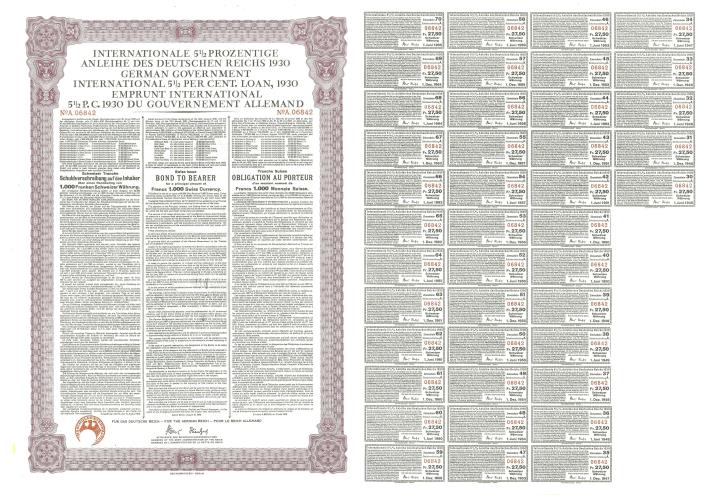
I. We offer ab historic `000 Swiss Francs 1930
Young Plan Bond. The bonds paid 5
1/2% interest. They have texts in German, English and
French. The large sized bonds measure
approximately 11.75" x 16.5" (300 x 420mm) and have been punch
canceled. The Swiss bonds
include a partial sheet of 41 coupons, dating from June 1, 1945 to June
1 1965. They are important but rarely seen financial
instruments.
Item
BND-YOUNG-SWISS 1000 SWISS FRANCS 1930 YOUNG
BOND
VF-cancelled
$7.00
WEIRD 4 PFENNIG
COIN
FROM GERMANY

In midst of the Great Depression German
chancellor Heinrich Brüning decided that a 4 Reichspfennig coin would
stimulate the failing economy. The coin was introduced in
1932 by an emergency decree. The 24mm copper coin featured
the German eagle on one side and the denomination and date on the
other. To encourage its use, all wages were supposed to be partially
paid with fifty of the new 4 Reichspfennig coins. As might be
expected the coin was not popular. A smaller and more
convenient 5 Reichspfennig had long been in use. People did not like
the coin and merchants and banks did not want them. It was issued only
a single year: 1932. In 1933 the new Nazi government promptly
did away with the coin. On October 1, 1933 it ceased to be
legal tender. Most were melted for scrap, making it scarce today.
Item
DE-4PF
GERMANY 4 REICHSPFENNIG 1932 KM75 VF-XF
$15.00
NAZI GERMAN 50
REICHSPFENNIG COINS PREPARE FOR WAR
Nazi Germany issued four types of 50 Reichspfennig coins. With World
War II about to begin, Nazi Germany instituted major changes to the 50
Reichspfennig coin in 1938 and 1939. The Nazis continued to
mint the 22mm nickel 50 Reichspfennig that had been introduced in 1927
during the Weimar regime until sometime in 1938. The coin features the
German eagle on one side and the denomination on the other. In 1938
they introduced a new version of the nickel 50 Reichspfennig which
featured the Eagle holding a swastika in an oak wreath. The
coin was struck only two years, 1938 and 1939. Few were ever
released into circulation, making it by far the rarest Nazi German
regular issue coin. In 1939 Germany decided it needed nickel
for its war effort. The nickel 50 Reichspfennig coins were quickly
recalled and were demonetized in 1940. To replace the nickel coins
Germany released 22mm aluminum 50 Reichspfennig coin dated 1935. The
coin was struck in 1935 but had not been issued into circulation at
that time. It features the German Eagle without a swastika. Also, in
1939 a new aluminum 50 Reichspfennig with the Eagle holding a swastika
was introduced. It continued to be struck until
1944.
Item
DE-49 GERMANY NICKEL 50 REICHSPFENNIG
1927-1938 KM49 VF-XF $3.00
Item
DE-95 NAZI GERMANY NICKEL 50 REICHSPFENNIG
1938-39 KM95
XF-AU $79.00
Item
DE-87 NAZI GERMANY ALUMINUM 50 REICHSPFENNIG
1935 KM87
VF $5.00
Item
DE-96 NAZI GERMANY ALUMINUM 50 REICHSPFENNIG
1939-1944 KM96 VF $5.00
FIRST NAZI GERMAN
COIN

This
nickel 1 Reichsmark was the first new coin introduced by the Nazi
government after they assumed power in 1933. The obverse has
the
date and denomination. The reverse features the German
imperial
eagle and the legend "
Gemeinnutz
vor Eigennutz" which translates as
"
Common Good Takes
Priority over Self-interest". The legend
was
the final point in the Nazi's 25-Point Program which gave the Reich
unlimited authority. The 23mm coin was struck in
nickel and
was minted
from 1933 until 1939. The coins were recalled and melted
after the start of World War II as the nickel was needed for the war
effort. Today it is one of the hardest to find of all the
regular issue Nazi German coins.
Item
DE-1RMK NAZI GERMANY NICKEL 1 REICHSMARK
1933-39 KM78 VF-XF $12.00
GERMANY CELEBRATES
1st ANNIVERSARY OF NAZI RULE
Nazi
Germany celebrated the first anniversary of Nazi rule with these silver
commemorative 2 and 5 Reichsmark coins dated 1934. Both coins
have the same design. The reverse portrays the Potsdam Garrison Church
and the date 21 March, 1933. It was at this church
that date that Hitler ceremonially opened the first Reichstag of the
Third Reich, officially ushering in Nazi control of Germany The obverse
depicts the German Eagle and two small swastikas. The 25mm 2 Reichsmark
coin is struck in .625 fine silver and contains .1607 troy oz. of
silver. The 29mm 5 Reichsmark coin is struck in .900 fine
silver and contains .4016 troy oz. of silver.
Item
DE-81 NAZI GERMANY SILVER 2 REICHSMARK 1934,
1st. ANNIVERSARY OF NAZI RULE KM81 VF out
Item
DE-82 NAZI GERMANY SILVER 5 REICHSMARK 1934,
1st. ANNIVERSARY OF NAZI RULE KM82 VF $40.00
NAZI
GERMANY SILVER COINS
NAZI
GERMANY SILVER 2 REICHSMARK

This
historic silver 2 Reichsmark was struck by Nazi Germany from 1936 until
production was halted by the start of World War II in 1939. One side
depicts a Nazi Eagle holding a swastika with the legend "
Deutsches Reich",
along with the date and denomination. The other side pictures Paul Von
Hindenburg, who turned Germany over to Hitler. Hitler honored him by
putting him on this coin. The coin is approximately the size of a
quarter and has an unusual lettered edge. The coin contains .1607 troy
ounces of silver and grades Very Fine or better. It is an historic coin
of the failed Third Reich.
Item DE-93 NAZI
GERMANY SILVER 2 REICHSMARK HINDENBURG/SWASTIKA 1936-39 KM93 VF $15.00
POTSDAM
GARRISON CHURCH ON NAZI SILVER 5 REICHSMARK

The
Potsdam Garrison Church, also known as the Potsdam Military Church, is
featured on this Nazi German silver 5 Reichsmark. It was at this church
that on March 21, 1933 Hitler ceremonially opened the first Reichstag
of the Third Reich, officially ushering in Nazi control of Germany. To
honor the event, the Church was featured on this silver 5 Reichsmark.
The obverse depicts a Germanic Eagle, two small swastikas and the
legend
"Deutsches Reich".
The church was built by Prussian King Friedrich Wilhelm I between 1730
and 1735, and was destroyed by fire on April 14, 1945. Two weeks later
Hitler committed suicide. The coin is approximately the size of a Half
Dollar and has an unusual lettered edge. It is struck in .900 fine
silver, which was the same as was used for United States coins. It
contains .4016 troy ounces of silver. It was struck only 2 years, 1934
and 1935, before being replaced in 1935 with a new design featuring
Paul von Hindenburg.
Item DE-83 NAZI
GERMANY SILVER 5
REICHSMARK MILITARY CHURCH 1934-35 KM83 VF $27.00
Item DE-83x5 5 of the
NAZI
GERMANY SILVER 5
REICHSMARK MILITARY CHURCH 1934-35 KM83 VF $125.00
HINDENBURG
& EAGLE ON NAZI GERMANY SILVER 5 REICHSMARK

German
President Paul von Hindenburg appointed Hitler as Chancellor of
Germany, putting Germany under Nazi rule. Hindenburg died the following
year in August 1934. Hitler honored him by putting him on this silver 5
Reichsmark coin. Hitler himself never appeared on any official German
coins or currency. The obverse depicts the head of Hindenburg. The
reverse side features a Germanic Eagle, the date, denomination and the
legend
"Deutsches Reich".
The coin was struck for only about a year starting in mid 1936. In
mid-1936 the reverse was changed to a new design. The coin is
approximately the size of a Half Dollar and has an unusual lettered
edge. It is struck in .900 fine silver, which was the same as was used
for United States coins. It contains .4016 troy ounces of silver. It is
a short-lived Nazi Germany coin.
Item DE-86 NAZI
GERMANY SILVER 5
REICHSMARK HINDENBURG/EAGLE 1935-36 KM86 VF $30.00
HINDENBURG
& SWASTIKA ON NAZI GERMANY SILVER 5
REICHSMARK

In
mid-1936 Nazi Germany revised the reverse of their 5 Reichsmark,
replacing the Germanic Eagle with a Nazi Eagle holding a Swastika. The
obverse, featuring the Paul von Hindenburg was left unchanged.
Thevsilver 2 Reichsmark coin
bearing the same design of Hindenburg and the Nazi Eagle holding the
Swastika was introduced at the same time. The coin continued to be
minted until 1939, when it was discontinued due to the war effort. The
coin is approximately the size of a Half Dollar and has an unusual
lettered edge. It is struck in .900 fine silver, which was the same as
was used for United States coins. It contains .4016 troy ounces of
silver. The coin serves as a reminder of the brief but destructive
"1000 Year Reich".
Item DE-94 NAZI
GERMANY SILVER 5 REICHSMARK HINDENBURG/SWASTIKA 1936-39 KM94 VF $39.00
 SPECIAL -
ALL 4 OF
THE ABOVE NAZI GERMAN SILVER COINS
SPECIAL -
ALL 4 OF
THE ABOVE NAZI GERMAN SILVER COINS
Buy
the set and save!
Item DE-SSET4 SET OF
ABOVE 4 NAZI GERMAN SILVER COINS
$105.00
NAZI
GERMAN 8 COIN SET
This set consists of the eight lower denominations of Nazi German coins
each showing the eagle and swastika. The 1937-1939 issues include the
1, 2, 5 and 10 Reichspfennig made from copper or aluminum-bronze
alloys. In 1939 an aluminum 50 Reichspfennig with the Eagle and
Swastika was introduced, and was
produced until 1944. In 1940 the 1, 5 and 10 Reichspfennig
were switched to zinc and the 2 Reichspfennig was discontinued due to
the war. All eight coins grade VF or better, though the zinc coins may
show some spots as zinc spots very easily. The coins all feature the
denomination on one side and an eagle holding a swastika on the other.
Item
DE-NAZISET8 NAZI GERMAN 8 COIN SET 1- 50
REICHSPFENNIG, 1937-1944 VF $23.00
Item
DE-NAZISET8x3 3 of the aobve NAZI GERMAN 8
COIN SETS 1- 50
REICHSPFENNIG, VF $59.00
NAZI
GERMAN 14 COIN
SET

This 14 coin set includes the regular issue coins of Nazi
Germany listed above. Included are the following coins: The bronze 1
and 2
Reichspfennig issued from 1936 to 1940 with an eagle and swastika. The
aluminum-bronze (brass) 5 and 10 Reichspfennig issued from 1936 to 1939
with an eagle and swastika. The aluminum 50 Reichspfennig
picturing an eagle, which was dated only one year, 1935. The nickel 1
Reichsmark with an eagle which was issued from 1933 to 1939. Because
nickel was a critical war material, most were melted during the
War. The silver 5 Reichmark issued in 1934 and 1935 pictures
the Potsdam Garrison Church where Hitler was sworn into office on one
side and an eagle and two small swastikas on the other. Paul
von Hindenburg and an Eagle are on the silver 5 Reichsmark dated 1935
and 1936. The silver 2 Reichsmark and 5 Reichsmark
dating from 1936 to 1939 pictures Hindenburg on one side and an eagle
holding a swastika during the other. Because of
World War II, the only coins issued after 1940 were the zinc 1, 5 and
10 Reichspfennig, which depict an eagle holding a swastika. The coins
grade Very Fine or better, though the zinc coins may have
some spots. Because of the difficulty in obtaining all 14 coins at one
time, I rarely am able to offer this historic set.
(Note: this set includes the coins from Nazi set of 4 silver
coins and the Nazi 8 coin set listed above, plus the aluminum 1935 50
Reichspfennig which was issued that single year, and the scarce nickel
1 Reichsmark)
Item
DE-NAZISET14 NAZI GERMAN 14 COIN SET 1
REICHSPFENNIG - 5 REICHSMARK 1934-44 VF $140.00
NAZI GERMAN
CURRENCY
The following notes were used in Nazi Germany throughout World War II
and remained legal tender until 1948. The notes bear two
dates: the date the note was first authorized, and the date the issuing
bank was authorized to issue currency. The Reichsbank was first
authorized to issue cufrrency on August 20, 1924. Unlike
coins, the date is not
the year the note was printed. These Reichsbank notes were
supposedly backed by gold, but could not be redeemed for gold.
NAZI
GERMAN 20 REICHSMARK NOTE
FEATURES AUSTRIAN MAIDEN
In 1939 a new 20
Reichsmark note was introduced, with a design adopted
from an unissued Austrian note. Austria had been forcibly
incorporated into the Third Reich the previous year. The
front depicts a young woman holding edelweiss. There is also
a small eagle and swastika and a large swastika underprint.
The back pictures the Dachstein Glacier on Lake Gosausee in Austria.
To the left is a man holding an ax. To the right is
a man sowing
seeds. The watermark depicts the young maiden.
Item
PM-DE-NAZI20RMK-39U GERMANY 20 REICHSMARK NOTE
1939
P185 AU-UNC. $55.00
 Reduced
size images
Reduced
size images
The
20 Reichsmark note
dated 1929 portrays Ernst Werner
Siemens, the 19th century
German industralist and inventor who founded the Siemens A.G. which has
expanded into a multi-national company producing a wide range products.
The back features
children holding tools and a worker carrying a
hammer. It has a watermark of Siemans at the left
and
an embosed seal near the lower left corner. The note
continued in circulation throughout World War II.
Item
PM-DE-NAZI20RMK-29C GERMANY 20 REICHSMARK NOTE
1929
P181 Fine-VF $3.00
NAZI
GERMAN 5
REICHSMARK
NOTE FEATURES HITLER YOUTH
Nazi Germany introduced
this 5 Reichsmark note in 1942 to replace
the silver 5 Reichsmark coins which were discontinued in
1939.
The front of the note features a German young man, along with a small
eagle and swastika. The back depicts a woman with a sickle and a man
with a wood plane, representing farming and
industry.
Between them is a vignette of the Brunswick Cathedral and the Brunswick
Lion statue. The Lion was commissioned by Henry the Lion
about
1166AD. The statue is the oldest, preserved large sculpture
from
the Middle Ages north of the Alps. The note measures 140x70mm and is
brown. The left side features a watermark of the numeral "5",
Item
PM-DE-NAZI5RMKC NAZI GERMANY 5 REICHSMARK
NOTE,
1942 P186 F-VF. $12.00
NAZI
GERMAN 1 & 2 RENTENMARK NOTES


In
1937 Nazi Germany introduced a 1 Rentenmark note, in order to
replace the
nickel 1
Reichsmark coin. The coin was to be withdrawn so that the
nickel could be used in the upcoming war efforts. The
Rentenmark was equivalent to the Reichsmark,
however it was issued by
the Rentenbank rather than the Reichsbank and the currency was
theoretically backed by land rather than by gold. The note has the
embossed seal of the Rentenbank at the lower right hand corner.
A 1937 2 Rentenmark with a similar design was also issued and
was widely used after the minting of
silver
2 Reichmark was discontinued after the start of
World War II in 1939.
Item
PM-DE-1RNTMK-C NAZI GERMANY 1 RENTENMARK
NOTE 1937 P173 F-VF $4.00
Item
PM-DE-2RNTMK NAZI GERMANY 2 RENTENMARK NOTE
1937
P174 AU-UNC. $9.00
EMERGENCY WWII REICHSBANK
NOTE
This German 20 Reichsmark note was issued by the German Reichsbank in
Sudetenland and Lower Silesia at the very end of World War
II. Sudetenland and Lower Silesia were areas of
Czechoslovakia and Poland had been forcibly incorporated into Germany
at the start of World War II. Because of the advancing allied armies,
shipments of regular Germany currency were no longer available from
Berlin. The note is dated April 28, 1945, less than two weeks
before German surrendered. The tan and brown note is 150 ×
80mm.
PM-DE-SUDET
SUDETENLAND 20 REICHSMARK NOTE,
1945, P187 UNC. $25.00
WORLD WAR II
GERMAN
MILITARY CURRENCY
Wehrmacht military currency was used by Nazi Germany to pay its troops
during the final months of World War II. The notes are dated
September 15, 1944. Soldiers were paid in military scrip while in
transit. When a soldier arrived at his post the notes could be
converted to the local currency or occupation notes. The notes all have
similar designs. The front includes a small Eagle holding a Swastika
and the inscription "
VERRECHNUNGSSEN
FUR DIE DEUTSCHE WEHRMACHT"
(Clearing notes for German Armed Forces) The back of the note includes
regulations and instructions on how to use the notes. They are
interesting and historic pieces of World War II military history.
Item
PM-DE-MILIT1M GERMAN MILITARY 1
REICHSMARK NOTE 1944
PM38 UNC. $12.00
Item
PM-DE-MILIT5M GERMAN MILITARY 5
REICHSMARK NOTE 1944
PM39 UNC. $29.00
CLICK HERE FOR OUR NAZI COIN LIST
CLICK HERE FOR WORLD WAR II COIN & CURRENCY PAGE
FIRST
COINS OF
EAST GERMANY


East Germany issued its first coins in 1948 while it was still under
the occupation of the Soviet Army. The coins consisted of the
aluminum 1, 5 and 10 Pfennig. The coins featured an ear of
grain and a cogwheel, which symbolized a communist "Workers' and
Farmers' state". The denomination was on the other
side.
In 1952 a new series of aluminum 1, 5 and 10 Pfennig
coins
was introduced. The obverse showing the denomination was
basically unchanged, however the new reverse designs featured a
compass, hammer and two ears of grain. The compass
represented the intelligentsia, who were supposed to be leading the
workers (hammer) and farmers (grain). Most of the workers and
farmers that I know do not like the idea of being led by a bunch
of intelligentsia who have little idea of what life is like
in
"the real world". Perhaps that is a clue as to why so many
wanted
to escape from East Germany and why it later
collapsed. The
new designs were
issued only
two years: 1952 and 1953. After the reunification of Germany,
the East German coins were withdrawn from circulation and melted.
Item
EGER-SET48 EAST GERMANY 3 COIN SET 1 - 10
PFENNIG 1948-50 KM1-3 VF
$4.00
Item
EGER-SET52 EAST GERMANY 3 COIN SET 1 - 10
PFENNIG 1952-53 KM5-7 VF-XF $3.00
EAST GERMANY'S
20th
ANNIVERSARY

East
Germany, also known as the German Democratic Republic or DDR, issued
this 5 Mark coin in 1969 to commemorate its 20th anniversary. It was
formed in 1949 from the Soviet occupied portion of Germany following
World War II. The design is simple, with legends "XX JAHRE
DDR", date and denomination on one side and the East German
emblem on the other. The coin is struck in a nickel-bronze
alloy.
Item
EGER-20ANNV EAST GERMAN 5 MARK 1969 20th
ANNIVERSARY XF $4.00
EAST GERMAN 5
MARK
COMMEMORATIVES

East
Germany issued an annual series of popular and well struck
non-circulating copper-nickel 5 Mark commemorative coins honoring
famous Germans and their achievements. The 29mm coin feature the emblem
of the German Democratic Republic on the obverse. The
denomination is repeated on the lettered edges of the coins.
The 125th anniversary of the birth of Wilhelm Conrad Rontgen
commemorated this 1970 issue which depicts his X-ray tube. He
was awarded the inaugural Nobel Prize in Physics in 1901 for his
discovery of X-rays. The 1971 issue marked the 400th
anniversary of the birth of Johannes Kepler. The design
reflects Kepler's theories regarding heliocentric planetary motions.
The 75th anniversary of the death of composer Johannes Brahms is the
theme of the 1972 issue. The design features musical
notes. The 100th anniversary of the death of physicist
Philipp Reis is honored on the 1974 issue. Reis invented a
telephone in 1861, pre-dating Alexander Graham Bell's telephone by more
than a decade. However, Reis's telephone was delicate, tricky
and produced inconsistent results. An image of his telephone
apparatus appears on the coin. The 200th Anniversary of the
birth of military officer Ferdinand von Schill is commemorated on the
1976 issue. In 1809 he led an unsuccessful revolt to liberate
the portions of Germany that were controlled by Napoleon. The
coin features his sword and military hat. The 125th
anniversary of the death of Friedrich Ludwig Jahn, the father of German
gymnastics, is on the 1977 issue. His portrait appears on the
coin.
Item
EGER-RONT70 EAST GERMAN 5 MARK 1970 RONTGEN
KM26 BU out
Item
EGER-KEPLER71 EAST GERMAN 5 MARK 1971 KEPLER
KM30 BU $20.00
Item
EGER-BRAHMS72 EAST GERMAN 5 MARK 1972
BRAHAMS KM36.1 BU $17.00
Item
EGER-REIS74 EAST GERMAN 5 MARK 1974 REIS
KM49 BU $15.00
Item
EGER-SCHILL76 EAST GERMAN 5 MARK 1976 VON
SCHILL KM60 BU $15.00
Item
EGER-JAHN77 EAST GERMAN 5 MARK 1977 JAHN
KM64 BU out
BETHEL
FOUNDATION CURRENCY FROM
GERMANY

The
Bethel Foundation (Bodelschwinghsche Stiftungen Bethel) was founded in
1867 in Prussia to care for epileptics. Its mission has
expanded to care for mentally ill and other challenged
people. It is headquartered in the Bethel district of
Bielefeld and has facilities in eight German states serving 200,000
people per year. It issued its first currency in
1908. After World War II it was the only private institution
in West
Germany authorized to issue its own currency. The notes are
accepted at Bethel facilities and selected
merchants. This four-note set of Bethel currency
includes the 50 Pfennig, 2, 5 and 20 Mark notes dated from 1957 to
1973. In 2002 the notes were replaced with Euro denominated
currency.
Item
PM-BETHEL BETHEL FOUNDATION, GERMANY: 4 NOTE
SET, 50 Pfennig - 20 Mark 1957-1973 UNC. $15.00
GERMAN POLYMER RING
5 EURO COINS


Item
DE-5E-18ST GERMANY 5 EURO 2018-G SUBTROPICAL
ZONE UNC. $12.50
Item
DE-5E-19TM GERMANY 5 EURO 2018-F TEMPERATE
ZONE UNC. $12.50
GERMAN 2
EUROS CELEBRATES THE FALL OF THE BERLIN WALL

Germany
commemorated the 30th anniversary of the fall of the
Berlin wall with this 2019 2 Euro coin. The opening of the Berlin wall
in November 1989 led to the collapse of
East Germany and the reunification of the nation. The design,
created by a French engraver, represents joyous people and doves
passing through an opening in the Berlin Wall. In the
background
is the Brandenburg Gate. The "graffiti" on the
wall reads "
30 JAHRE
MAUERFAL" (30 years fall of the Berlin
Wall). At the bottom right is a "D" for Deutschland
(Germany). The coins were struck at all five German mints
(A=Berlin, D=Munich,
F=Stuttgart, G=Karlsruhe, J=Hamburg). The mintmark is at the bottom
left of the design. It is small and hard to see. All the
coins
have the standard 2 Euro reverse featuring a map of Europe.
Item
DE-2E19WALL GERMANY 2 EUROS BERLIN WALL
2019 (Mint of our choice) UNC. $5.75
Item
DE-2E19WALL-ALL GERMANY ALL
5 MINTS (A, D, F, G, J) BERLIN WALL 2 EUROS UNC. $28.50
GERMANY HONORS
SAXONY-ANHALT
ON 2021 2 EURO

Germany
continued their annual series of 2 Euro coins honoring each of their
Bundesländer (states) with this 2021 issue for Saxony-Anhalt
(Sachsen-Anhalt). The coin depicts the Magdeburg
Cathedral. The
Cathedral is the oldest Gothic Cathedral in
Germany. Construnction
was started in 1209 on the site of an abbey. It was not
completed
until over 300 years later in 1520. The coins were struck at all five
German mints (A=Berlin, D=Munich, F=Stuttgart, G=Karlsruhe, J=Hamburg).
The mintmark is at the left of the cathedral.
Item
DE-2E21-SAX GERMANY 2 EURO 2021
SAXONY-ANHALT mint our
choice,UNC. $6.00
Item
DE-2E21-SAX-ALL5 ALL 5 MINTS (A,D,F,G,J)
SAXONY-ANHALT
2 EURO 2021, UNC.
$29.50
2023 GERMAN 2
EURO CELEBRATES
CHARLEMAGNE

Germany
celebrated the 1275th anniversary of the birth of Charlemagne with this
circulating 2023 2 Euro coin. Charlemagne is known as Karl the Great in
Germany. He unified central and western Europe for the first
time since the fall of the Roman Empire centuries earlier. He
was crowned King of the Franks, King of the Lombards and Emperor of the
Romans, and started what became known as the Holy Roman
Empire. He ruled from his capital in Aachen,
Germany. The coin depicts Charlemagne's monogram over the
octagon of Aachen Cathedral. At the lower right is the "D"
for Deutschland followed by the mintmark (A=Berlin, D=Munich,
F=Stuttgart, G=Karlsruhe, J=Hamburg). At the bottom are the
dates of his birth and death: "748-814".
Item
DE-2E23-KARL GERMANY 2 EURO 2023 CHARLEMAGNE
mint of Joel's choice UNC.
$6.00
Item
DE-2E23-KARLx5 GERMANY 2 EURO 2023
CHARLEMAGNE,
ALL 5 MINTS: A,D,F,G & J UNC. $29.50
GERMANY HONORS
MECKLENBURG-WEST POMERANIA WITH 2 EURO

Germany
honored the state of Mecklenburg-West Pomerania
(Mecklenburg-Vorpommern) on their 2024 2 Euro coin. The coin
depicts the iconic “Konigsstuhl” (King’s Chair) in the Jasmund National
Park on the island of Rugen.. It is a 387-foot (118m) chalk
cliff rising above the Baltic Sea. A person standing on the
beach gives an idea to the immense size of the cliffs. To the
left is the "D" for Deutschland. Above the cliff is the
mintmark (A=Berlin, D=Munich, F=Stuttgart, G=Karlsruhe, J=Hamburg).
Item
DE-2E24-KING GERMANY 2 EURO 2024
MECKLENBURG-WEST POMERANIA (Mint of our choice) UNC. $6.00
Item
DE-2E24-KINGx5 GERMANY 2 EURO 2024
MECKLENBURG-WEST POMERANIA, ALL 5 MINTS UNC. $29.50
GERMANY
COMMEMORATES ITS
FIRST CONSTITUTION

This
German 2024 2 Euro coin commemorates the 175th anniversary the St.
Paul's Church Constitution (Paulskirchenverfassung), also known as the
Frankfurt Constitution. It was an attempt to create
a unified German nation. It included a charter of fundamental
rights and a democratic government in the form of a constitutional
monarchy. The constitution failed due to the objections of
Prussia and some of the smaller states. The coin depicts the
St. Paul's Church memorial (the original church was destroyed by Allied
bombing in 1944). Behind it is a quill and a paper
representing the constitution. In the background are female
allegorical figures representing unity, justice and freedom and the
tri-color German flag. To the left of the church is the
letter "D" for Deutschland (Germany). The mintmark is to the right of
the church just below the quill.
Item
DE-2E24-CONST GERMANY 2 EURO 2024
FRANKFURT CONSTITUTION (Mint of our choice) UNC. $6.00
Item
DE-2E24-CONSTx5 GERMANY 2 EURO 2024
FRANKFURT CONSTITUTION, ALL 5 MINTS UNC. $29.50
SAARLAND HONORED
ON 2025 GERMAN
2 EURO

Germany
continued their annual series honoring each of their states with this
2025 dated 2 Euro for Saarland. Saarland is located on the
border of Germany, France and Luxembourg. It has long been
contested between France and Germany. It gained importance in
the 19th century due to its rich coal deposits and heavy
industrialization. France tried to establish it as an
independent entity after both World War I and World War II, and both
times Saarland voted overwhelmingly to become part of
Germany. The coin features a birds eye view of the
Saarschleife, which is a big bend in the Saar river. It is a
major tourist attraction. At the bottom is a "D" for Deutschland and
the date. The mintmark is on the middle right side of the
coin.
Item
DE-2E25-SAAR GERMANY 2 EURO 2025 SAARLAND,
mint
of our choice, UNC.
$6.00
Item
DE-2E25-SAARx5 ALL 5 MINTS OF THE GERMAN 2
EURO
2025 SAARLAND, UNC.
$29.50
COMPLETE
SET OF SCARCE SAARLAND COINS: 10-100 FRANKEN
1954-55 KM1-4
WORLD WAR I GERMAN EAST
AFRICA
EMERGENCY COIN

German East Africa encompassed what is
today the nations of Rwanda, Burundi, most of Tanzania as well as small
portions of Mozambique, Kenya and Uganda. With the outbreak of World
War I in July 1914, German East Africa soon found itself isolated due
to a British naval blockade. The one German warship in the
region, the light cruiser SMS Konigsberg led British Royal Navy on a
merry chase, sinking both military and merchant ships, before being
forced back to German East Africa due to engine problems. The
British were forced to tie twenty ships and ten aircraft before finding
and trapping the crippled German ship. The Germans scuttled
the ship, salvaging what they could. On land, German Colonel
von Lettow-Vorbeck, with a small force of some 3500 German and 12,000
native soldiers and porters engaged in an effective guerilla war
against the British. He managed to tie up well over 40,000
British soldiers, caused extensive British casualties, and compelled
Britain to commit significant resources to this minor colonial
theater. Though he frequently retreated, he was never
defeated. The Germans needed money to pay their troops and
purchase supplies. Utilizing equipment salvaged from the
Konigsberg, a crude mint was set up in
Tabora. These 20 Heller coins were struck
at the Tabora mint utilizing hand cut dies. Metal for the coins the
coins came from many sources, including spent cartridges, artillery
shell casings, wiring, and metal salvaged from the
Konigsberg. One side depicts the imperial German crown, the
date “1916”, the initials “D.O.A.” (for Deutsch-Ostafrika, or German
East Africa) and the “T” mintmark for Tabora. The other side
has the denomination surrounded by two laurel branches. The
29mm coin is struck in brass. It is an historic but largely
forgotten
piece of World War I history.
Item GEA-20HL GERMAN EAST AFRICA 20 HELLER
1916 KM15a VG-cleaned
$19.75
COMPLETE
SET OF SCARCE SAARLAND COINS

Saar
is an important center for coal mining and heavy industry located
in Germany along the French border. Most of its citizens are
of German ancestry. Following World War II, France occupied
the region and tried to establish Saarland as a separate nation in an
effort to cripple Germany's industrial base. France assumed
control of its foreign affairs and even issued coins for
Saarland. The coins were struck at the Paris mint and were
the same size and composition as the contemporary French coins. Soon
after the coins were issued, Saarland voted to reunite with Germany,
bringing an end to brief coin issue. We are pleased to offer a complete
set of the only four coins ever issued by Saarland. The set
includes the 1954 aluminum-bronze 10, 20 and 50 Franken and the 1955
copper-nickel 100 Franken. The aluminum-bronze 10, 20 and 50
Franken feature
a stylized factory spewing out pollution and the Saarland arms on the
obverse. The copper-nickel 100 Franken has the arms within a
circle. The reverses of all the coins have the denomination
in German and the date. Perhaps it should have been a clue to
the French when they had to put the legends in German that Saarland
would not remain under French control.
Item
SAAR-SET4 SAARLAND 4 COIN SET 10-100 FRANKEN
1954-55 KM1-4 XF
$55.00
Also see:
GERMAN 2 EURO
COMMEMORATIVE COINS
<--
PREVIOUS PAGE NEXT
PAGE -->
 Bavaria
commemorated the 90th birthday of Prince Regent Luitpold with this
silver 1911 5 Mark coin. . The bust of Luitpold is on the
obverse and the standard crowned German Imperial Eagle is on the
reverse. The 38mm coin is struck in .900 fine silver contains
.8037 troy ounces of silver and has a lettered edge "GOTT MIT UNS" (God
with us).
Bavaria
commemorated the 90th birthday of Prince Regent Luitpold with this
silver 1911 5 Mark coin. . The bust of Luitpold is on the
obverse and the standard crowned German Imperial Eagle is on the
reverse. The 38mm coin is struck in .900 fine silver contains
.8037 troy ounces of silver and has a lettered edge "GOTT MIT UNS" (God
with us).  This
silver Bracteate Hohlpfennig was issued by
Friedrich II (Frederick II) who was the
Prince-Elector of the
Margravate of Brandenburg from
1440 to 1470. It is believed that he was nicknamed "The Irontooth" or
"The
Iron" due to his great strength and power. Friedrich
strengthened Brandenburg forming the basis of what was to become
Prussia and the German Empire. The rights of the towns and
nobility were curtailed and he regained Neumark (East Brandenburg) from
the Teutonic Knights. The citizens of Berlin revolted when he
attempted to build a palace on Colin island in the Spree
river. Friedrich prevailed, built the castle that became the
Stadtschloss (Berlin Palace), and the rights of the city were greatly
curtailed. The Stadtschloss was torn down by East Germany in the 1950's
and is now being rebuilt. The silver Bracteate Hohlpfennig is
an extremely thin and single sided coin wtih a raised rim.
The
design is
embossed from the reverse. This coin is approximately 16mm in
diameter and features an eagle with outstretched wings.
Because the coins are so thin and fragile, few survive today.
This
silver Bracteate Hohlpfennig was issued by
Friedrich II (Frederick II) who was the
Prince-Elector of the
Margravate of Brandenburg from
1440 to 1470. It is believed that he was nicknamed "The Irontooth" or
"The
Iron" due to his great strength and power. Friedrich
strengthened Brandenburg forming the basis of what was to become
Prussia and the German Empire. The rights of the towns and
nobility were curtailed and he regained Neumark (East Brandenburg) from
the Teutonic Knights. The citizens of Berlin revolted when he
attempted to build a palace on Colin island in the Spree
river. Friedrich prevailed, built the castle that became the
Stadtschloss (Berlin Palace), and the rights of the city were greatly
curtailed. The Stadtschloss was torn down by East Germany in the 1950's
and is now being rebuilt. The silver Bracteate Hohlpfennig is
an extremely thin and single sided coin wtih a raised rim.
The
design is
embossed from the reverse. This coin is approximately 16mm in
diameter and features an eagle with outstretched wings.
Because the coins are so thin and fragile, few survive today.

 Einbeck
is a town in Lower Saxony Germany, gained fame in the fourteenth
century for its distinctive dark beer. As a member of the Hanseatic
League it sold its beer from Antwerp in the west to Riga in the east
and from Stockholm in the north to Munich in the south.
Brewers in Munich copied the style of the popular beer in the 17th
century. They mispronounced "Einbeck" as "ein Bock" (a billy goat), and
thus the beer became known as "bock". Einbeck struck its own
coinage sporadically from 1498 to 1717. This undated Einbeck
1 Pfennig was struck from 1647 until 1717. The crude 15mm
copper coin has the denomination on one side and the name of the town
around an emblem on the other. It is one of the most
affordable coins of this small town.
Einbeck
is a town in Lower Saxony Germany, gained fame in the fourteenth
century for its distinctive dark beer. As a member of the Hanseatic
League it sold its beer from Antwerp in the west to Riga in the east
and from Stockholm in the north to Munich in the south.
Brewers in Munich copied the style of the popular beer in the 17th
century. They mispronounced "Einbeck" as "ein Bock" (a billy goat), and
thus the beer became known as "bock". Einbeck struck its own
coinage sporadically from 1498 to 1717. This undated Einbeck
1 Pfennig was struck from 1647 until 1717. The crude 15mm
copper coin has the denomination on one side and the name of the town
around an emblem on the other. It is one of the most
affordable coins of this small town.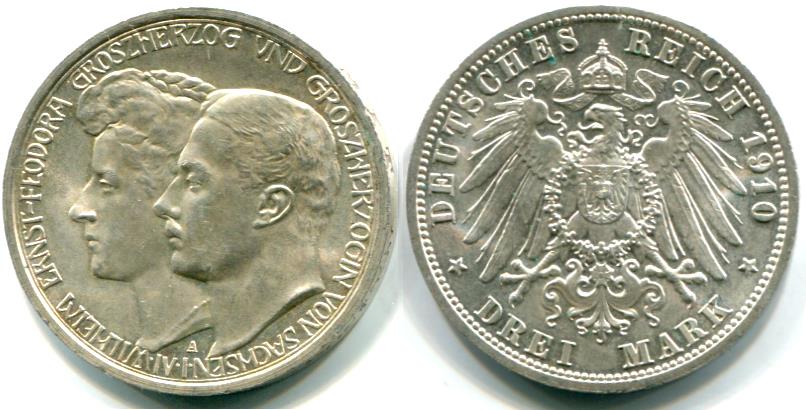 The
Grand Duchy of Saxe-Weimar-Eisenach consisted of over a dozen
non-contiguous territories in central Germany. After the
unification of Germany it issued few coins. This 1910 3 Mark of
Saxe-Weimar-Eisenach commemorates the wedding of Grand Duke Wilhelm
Ernest to Princess Fedora. It was the Duke's second
marriage. The Duke's first wife died after 18 months,
probably by suicide. His marriage to Fedora was not a happy
one. Though Fedora was popular with the people, the Duke was not. The
Duke was known to be a sadist and was widely hated. He was
called "the most unpopular prince in all of Germany". His court was
considered to be one of the most stifling and etiquette-driven in
Germany, and Weimar was considered to be "the dreariest capital in
Europe". The 33mm silver coin depicts the busts of Wilhelm
Ernest and Fedora on the obverse. The imperial German Eagle
is on the reverse. The coin has a lettered edge. It
has a mintage of only 133,000 and was struck in Berlin. It is
an attractive coin from an unpopular monarch.
The
Grand Duchy of Saxe-Weimar-Eisenach consisted of over a dozen
non-contiguous territories in central Germany. After the
unification of Germany it issued few coins. This 1910 3 Mark of
Saxe-Weimar-Eisenach commemorates the wedding of Grand Duke Wilhelm
Ernest to Princess Fedora. It was the Duke's second
marriage. The Duke's first wife died after 18 months,
probably by suicide. His marriage to Fedora was not a happy
one. Though Fedora was popular with the people, the Duke was not. The
Duke was known to be a sadist and was widely hated. He was
called "the most unpopular prince in all of Germany". His court was
considered to be one of the most stifling and etiquette-driven in
Germany, and Weimar was considered to be "the dreariest capital in
Europe". The 33mm silver coin depicts the busts of Wilhelm
Ernest and Fedora on the obverse. The imperial German Eagle
is on the reverse. The coin has a lettered edge. It
has a mintage of only 133,000 and was struck in Berlin. It is
an attractive coin from an unpopular monarch.


 Because
of the difficulty in obtaining nickel and copper needed for coins due
to World War I, Germany made a number of changes in their
coinage. In 1917 the copper 1 Pfennig was switched to
aluminum and shrunk in size. It was discontinued shortly
after that. The copper 2 Pfennig was discontinued due to the
war. The copper-nickel 5 Pfennig was changed to iron in 1915
and continued to be produced until 1922. The
copper-nickel 10 Pfennig was produced in two metals: iron, starting in
1916, and zinc starting in 1917. Both continued to be struck
until 1922. All the coins had the denomination on one side
and the imperial German Eagle on the other. This
World War I era four coin set includes the aluminum 1 Pfennig, iron 5
Pfennig and both the iron and zinc 10 Pfennig in Very Fine of better
condition.
Because
of the difficulty in obtaining nickel and copper needed for coins due
to World War I, Germany made a number of changes in their
coinage. In 1917 the copper 1 Pfennig was switched to
aluminum and shrunk in size. It was discontinued shortly
after that. The copper 2 Pfennig was discontinued due to the
war. The copper-nickel 5 Pfennig was changed to iron in 1915
and continued to be produced until 1922. The
copper-nickel 10 Pfennig was produced in two metals: iron, starting in
1916, and zinc starting in 1917. Both continued to be struck
until 1922. All the coins had the denomination on one side
and the imperial German Eagle on the other. This
World War I era four coin set includes the aluminum 1 Pfennig, iron 5
Pfennig and both the iron and zinc 10 Pfennig in Very Fine of better
condition.
 Kiel
is an important seaport located at the mouth of the Kiel Canal
which connects the Baltic Sea to the North Sea. It was also a
major base for the German Imperial Navy. By the
beginning of 1918 the war effort was not going well for
Germany. Though the German government continued to mint
silver 1/2 Mark coins, they were hoarded almost as soon as they were
minted, resulting in a serious coin shortage. To
help alleviate the shortage and allow merchants and citizens to carry
on commercial transactions the city of Kiel issued this emergency 50
Pfennig note dated January 1, 1918. The front features the denomination
and date in words and has a green under-printing depicting ships on the
ocean. The back features the Kiel city hall.
Kiel
is an important seaport located at the mouth of the Kiel Canal
which connects the Baltic Sea to the North Sea. It was also a
major base for the German Imperial Navy. By the
beginning of 1918 the war effort was not going well for
Germany. Though the German government continued to mint
silver 1/2 Mark coins, they were hoarded almost as soon as they were
minted, resulting in a serious coin shortage. To
help alleviate the shortage and allow merchants and citizens to carry
on commercial transactions the city of Kiel issued this emergency 50
Pfennig note dated January 1, 1918. The front features the denomination
and date in words and has a green under-printing depicting ships on the
ocean. The back features the Kiel city hall.  This attractive 50 Mark note is the
last note of the German Empire. It
is dated June 23, 1919, some seven months after Germany's defeat in
World War I and less than 7 weeks before the signing of the new
constitution in Weimar which formally ended the German Empire and
ushered in the weak and chaotic Weimar Republic. The large, green note
measures 153x102mm and features an allegorical figure of a woman
against a starry background.
This attractive 50 Mark note is the
last note of the German Empire. It
is dated June 23, 1919, some seven months after Germany's defeat in
World War I and less than 7 weeks before the signing of the new
constitution in Weimar which formally ended the German Empire and
ushered in the weak and chaotic Weimar Republic. The large, green note
measures 153x102mm and features an allegorical figure of a woman
against a starry background.

 The Weimar Republic was formed after
the defeat of the German Empire in
World War I. Its early years were a tumultuous period of
uprisings, riots and massive inflation. It is named after the
city where the new German constitution was written and adopted in
August, 1919, and lasted until the rise of the Nazis in
1933. The 100 Mark note features two
images of the head of the “Bamberg Horseman”. The horseman is
an impressive 13th century sculpture in the Bamberg
Cathedral. The Bamberg
Horsman depicts a famous king, however which king it is is a matter of
debate. The note is dated November 1, 1920, measures
162x108mm and includes
the red Weimar Republic crest.
The Weimar Republic was formed after
the defeat of the German Empire in
World War I. Its early years were a tumultuous period of
uprisings, riots and massive inflation. It is named after the
city where the new German constitution was written and adopted in
August, 1919, and lasted until the rise of the Nazis in
1933. The 100 Mark note features two
images of the head of the “Bamberg Horseman”. The horseman is
an impressive 13th century sculpture in the Bamberg
Cathedral. The Bamberg
Horsman depicts a famous king, however which king it is is a matter of
debate. The note is dated November 1, 1920, measures
162x108mm and includes
the red Weimar Republic crest. 
 After
World War I, control of the Schleswig-Holstein region was disputed
between Denmark and Germany. Historically, control of various
portions of the region had alternated between Denmark and Germany over
the centuries. It was decided to hold two plebiscites and let
the inhabitants of the regions decide which country they wished to
join. The first plebiscite held in the northern portion
elected to become part of Denmark. The southern portion elected to join
Germany. The town of Flensburg is at the northern end of the
southern portion and a vast majority of its population was of German
ancestry. Shortly after the plebiscite, Flensburg issued this
25 Pfennig note showing the Danes having lost a tug-of-war with the
Germans and the Germans welcoming them. The date of the
plebiscite, March 14, 1920 appears above the Danes. The
reverse consists of text. It is an unusual note reflecting a
vote.
After
World War I, control of the Schleswig-Holstein region was disputed
between Denmark and Germany. Historically, control of various
portions of the region had alternated between Denmark and Germany over
the centuries. It was decided to hold two plebiscites and let
the inhabitants of the regions decide which country they wished to
join. The first plebiscite held in the northern portion
elected to become part of Denmark. The southern portion elected to join
Germany. The town of Flensburg is at the northern end of the
southern portion and a vast majority of its population was of German
ancestry. Shortly after the plebiscite, Flensburg issued this
25 Pfennig note showing the Danes having lost a tug-of-war with the
Germans and the Germans welcoming them. The date of the
plebiscite, March 14, 1920 appears above the Danes. The
reverse consists of text. It is an unusual note reflecting a
vote.


 This
set of nine banknotes issued by the German government vividly
illustrates the 1920-1923 hyperinflation. This set includes
the 1 and 2 Mark dated March 1, 1920. The notes were needed because all
silver 1 Mark coins had disappeared from circulation. The
large-size (162 x 108mm) 100 Mark note is dated November 1, 1920 and
depicts the head of the Bamberg Horseman. It was worth about
$1.50 when first issued. Also included is the 500 Mark dated
July 7, 1922; 1000 Mark dated September 15, 1922; 5000 Mark
dated December 2, 1922 and 20,000 Mark dated February 20, 1923. The
magnificent, large 100,000 Mark is dated February 1, 1923, features a
cut from Hans Holbein the Younger's portrait "The Merchant Georg
Gisze". The last note in the collection is the 2 Million Mark
note dated August 9, 1923. It was worth less than a dollar
when introduced and would be virtually worthless in less than a month.
This
set of nine banknotes issued by the German government vividly
illustrates the 1920-1923 hyperinflation. This set includes
the 1 and 2 Mark dated March 1, 1920. The notes were needed because all
silver 1 Mark coins had disappeared from circulation. The
large-size (162 x 108mm) 100 Mark note is dated November 1, 1920 and
depicts the head of the Bamberg Horseman. It was worth about
$1.50 when first issued. Also included is the 500 Mark dated
July 7, 1922; 1000 Mark dated September 15, 1922; 5000 Mark
dated December 2, 1922 and 20,000 Mark dated February 20, 1923. The
magnificent, large 100,000 Mark is dated February 1, 1923, features a
cut from Hans Holbein the Younger's portrait "The Merchant Georg
Gisze". The last note in the collection is the 2 Million Mark
note dated August 9, 1923. It was worth less than a dollar
when introduced and would be virtually worthless in less than a month. In
1923, Germany experienced what was then the world’s worst inflation.
Prices increased hourly and the government could not print currency
fast enough to meet the demand. In order to pay employees and
suppliers, the Deutsche Reichsbahn (the German National Railways)
printed its own currency. Unlike most of the corporate or
municipal issues of the period, the Railway notes were accepted
throughout most of Germany. In order to pay workers and suppliers notes
were issued from the company headquarters in Berlin as well as regional
railway offices throughout the country. It is interesting to see how
the denominations increased from week to week. In German
Milliarden is 1 Billion in English. Many notes are printed only on one
side. These sell out quickly, alternates appreciated.
In
1923, Germany experienced what was then the world’s worst inflation.
Prices increased hourly and the government could not print currency
fast enough to meet the demand. In order to pay employees and
suppliers, the Deutsche Reichsbahn (the German National Railways)
printed its own currency. Unlike most of the corporate or
municipal issues of the period, the Railway notes were accepted
throughout most of Germany. In order to pay workers and suppliers notes
were issued from the company headquarters in Berlin as well as regional
railway offices throughout the country. It is interesting to see how
the denominations increased from week to week. In German
Milliarden is 1 Billion in English. Many notes are printed only on one
side. These sell out quickly, alternates appreciated.


 In midst of the Great Depression German
chancellor Heinrich Brüning decided that a 4 Reichspfennig coin would
stimulate the failing economy. The coin was introduced in
1932 by an emergency decree. The 24mm copper coin featured
the German eagle on one side and the denomination and date on the
other. To encourage its use, all wages were supposed to be partially
paid with fifty of the new 4 Reichspfennig coins. As might be
expected the coin was not popular. A smaller and more
convenient 5 Reichspfennig had long been in use. People did not like
the coin and merchants and banks did not want them. It was issued only
a single year: 1932. In 1933 the new Nazi government promptly
did away with the coin. On October 1, 1933 it ceased to be
legal tender. Most were melted for scrap, making it scarce today.
In midst of the Great Depression German
chancellor Heinrich Brüning decided that a 4 Reichspfennig coin would
stimulate the failing economy. The coin was introduced in
1932 by an emergency decree. The 24mm copper coin featured
the German eagle on one side and the denomination and date on the
other. To encourage its use, all wages were supposed to be partially
paid with fifty of the new 4 Reichspfennig coins. As might be
expected the coin was not popular. A smaller and more
convenient 5 Reichspfennig had long been in use. People did not like
the coin and merchants and banks did not want them. It was issued only
a single year: 1932. In 1933 the new Nazi government promptly
did away with the coin. On October 1, 1933 it ceased to be
legal tender. Most were melted for scrap, making it scarce today. 


 This
nickel 1 Reichsmark was the first new coin introduced by the Nazi
government after they assumed power in 1933. The obverse has
the
date and denomination. The reverse features the German
imperial
eagle and the legend "Gemeinnutz
vor Eigennutz" which translates as
"Common Good Takes
Priority over Self-interest". The legend
was
the final point in the Nazi's 25-Point Program which gave the Reich
unlimited authority. The 23mm coin was struck in
nickel and
was minted
from 1933 until 1939. The coins were recalled and melted
after the start of World War II as the nickel was needed for the war
effort. Today it is one of the hardest to find of all the
regular issue Nazi German coins.
This
nickel 1 Reichsmark was the first new coin introduced by the Nazi
government after they assumed power in 1933. The obverse has
the
date and denomination. The reverse features the German
imperial
eagle and the legend "Gemeinnutz
vor Eigennutz" which translates as
"Common Good Takes
Priority over Self-interest". The legend
was
the final point in the Nazi's 25-Point Program which gave the Reich
unlimited authority. The 23mm coin was struck in
nickel and
was minted
from 1933 until 1939. The coins were recalled and melted
after the start of World War II as the nickel was needed for the war
effort. Today it is one of the hardest to find of all the
regular issue Nazi German coins.

 This
historic silver 2 Reichsmark was struck by Nazi Germany from 1936 until
production was halted by the start of World War II in 1939. One side
depicts a Nazi Eagle holding a swastika with the legend "Deutsches Reich",
along with the date and denomination. The other side pictures Paul Von
Hindenburg, who turned Germany over to Hitler. Hitler honored him by
putting him on this coin. The coin is approximately the size of a
quarter and has an unusual lettered edge. The coin contains .1607 troy
ounces of silver and grades Very Fine or better. It is an historic coin
of the failed Third Reich.
This
historic silver 2 Reichsmark was struck by Nazi Germany from 1936 until
production was halted by the start of World War II in 1939. One side
depicts a Nazi Eagle holding a swastika with the legend "Deutsches Reich",
along with the date and denomination. The other side pictures Paul Von
Hindenburg, who turned Germany over to Hitler. Hitler honored him by
putting him on this coin. The coin is approximately the size of a
quarter and has an unusual lettered edge. The coin contains .1607 troy
ounces of silver and grades Very Fine or better. It is an historic coin
of the failed Third Reich. The
Potsdam Garrison Church, also known as the Potsdam Military Church, is
featured on this Nazi German silver 5 Reichsmark. It was at this church
that on March 21, 1933 Hitler ceremonially opened the first Reichstag
of the Third Reich, officially ushering in Nazi control of Germany. To
honor the event, the Church was featured on this silver 5 Reichsmark.
The obverse depicts a Germanic Eagle, two small swastikas and the
legend "Deutsches Reich".
The church was built by Prussian King Friedrich Wilhelm I between 1730
and 1735, and was destroyed by fire on April 14, 1945. Two weeks later
Hitler committed suicide. The coin is approximately the size of a Half
Dollar and has an unusual lettered edge. It is struck in .900 fine
silver, which was the same as was used for United States coins. It
contains .4016 troy ounces of silver. It was struck only 2 years, 1934
and 1935, before being replaced in 1935 with a new design featuring
Paul von Hindenburg.
The
Potsdam Garrison Church, also known as the Potsdam Military Church, is
featured on this Nazi German silver 5 Reichsmark. It was at this church
that on March 21, 1933 Hitler ceremonially opened the first Reichstag
of the Third Reich, officially ushering in Nazi control of Germany. To
honor the event, the Church was featured on this silver 5 Reichsmark.
The obverse depicts a Germanic Eagle, two small swastikas and the
legend "Deutsches Reich".
The church was built by Prussian King Friedrich Wilhelm I between 1730
and 1735, and was destroyed by fire on April 14, 1945. Two weeks later
Hitler committed suicide. The coin is approximately the size of a Half
Dollar and has an unusual lettered edge. It is struck in .900 fine
silver, which was the same as was used for United States coins. It
contains .4016 troy ounces of silver. It was struck only 2 years, 1934
and 1935, before being replaced in 1935 with a new design featuring
Paul von Hindenburg. 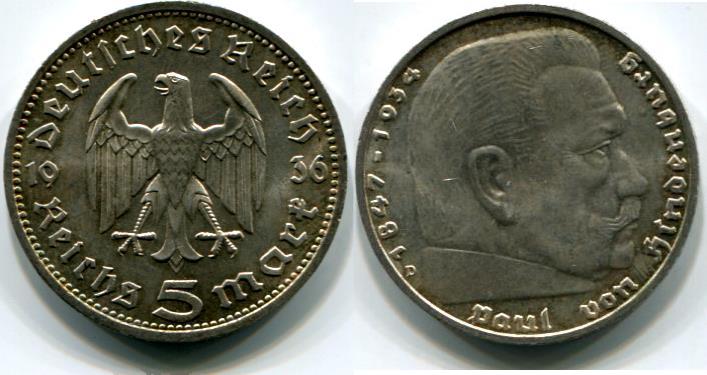 German
President Paul von Hindenburg appointed Hitler as Chancellor of
Germany, putting Germany under Nazi rule. Hindenburg died the following
year in August 1934. Hitler honored him by putting him on this silver 5
Reichsmark coin. Hitler himself never appeared on any official German
coins or currency. The obverse depicts the head of Hindenburg. The
reverse side features a Germanic Eagle, the date, denomination and the
legend "Deutsches Reich".
The coin was struck for only about a year starting in mid 1936. In
mid-1936 the reverse was changed to a new design. The coin is
approximately the size of a Half Dollar and has an unusual lettered
edge. It is struck in .900 fine silver, which was the same as was used
for United States coins. It contains .4016 troy ounces of silver. It is
a short-lived Nazi Germany coin.
German
President Paul von Hindenburg appointed Hitler as Chancellor of
Germany, putting Germany under Nazi rule. Hindenburg died the following
year in August 1934. Hitler honored him by putting him on this silver 5
Reichsmark coin. Hitler himself never appeared on any official German
coins or currency. The obverse depicts the head of Hindenburg. The
reverse side features a Germanic Eagle, the date, denomination and the
legend "Deutsches Reich".
The coin was struck for only about a year starting in mid 1936. In
mid-1936 the reverse was changed to a new design. The coin is
approximately the size of a Half Dollar and has an unusual lettered
edge. It is struck in .900 fine silver, which was the same as was used
for United States coins. It contains .4016 troy ounces of silver. It is
a short-lived Nazi Germany coin.  In
mid-1936 Nazi Germany revised the reverse of their 5 Reichsmark,
replacing the Germanic Eagle with a Nazi Eagle holding a Swastika. The
obverse, featuring the Paul von Hindenburg was left unchanged.
Thevsilver 2 Reichsmark coin
bearing the same design of Hindenburg and the Nazi Eagle holding the
Swastika was introduced at the same time. The coin continued to be
minted until 1939, when it was discontinued due to the war effort. The
coin is approximately the size of a Half Dollar and has an unusual
lettered edge. It is struck in .900 fine silver, which was the same as
was used for United States coins. It contains .4016 troy ounces of
silver. The coin serves as a reminder of the brief but destructive
"1000 Year Reich".
In
mid-1936 Nazi Germany revised the reverse of their 5 Reichsmark,
replacing the Germanic Eagle with a Nazi Eagle holding a Swastika. The
obverse, featuring the Paul von Hindenburg was left unchanged.
Thevsilver 2 Reichsmark coin
bearing the same design of Hindenburg and the Nazi Eagle holding the
Swastika was introduced at the same time. The coin continued to be
minted until 1939, when it was discontinued due to the war effort. The
coin is approximately the size of a Half Dollar and has an unusual
lettered edge. It is struck in .900 fine silver, which was the same as
was used for United States coins. It contains .4016 troy ounces of
silver. The coin serves as a reminder of the brief but destructive
"1000 Year Reich".


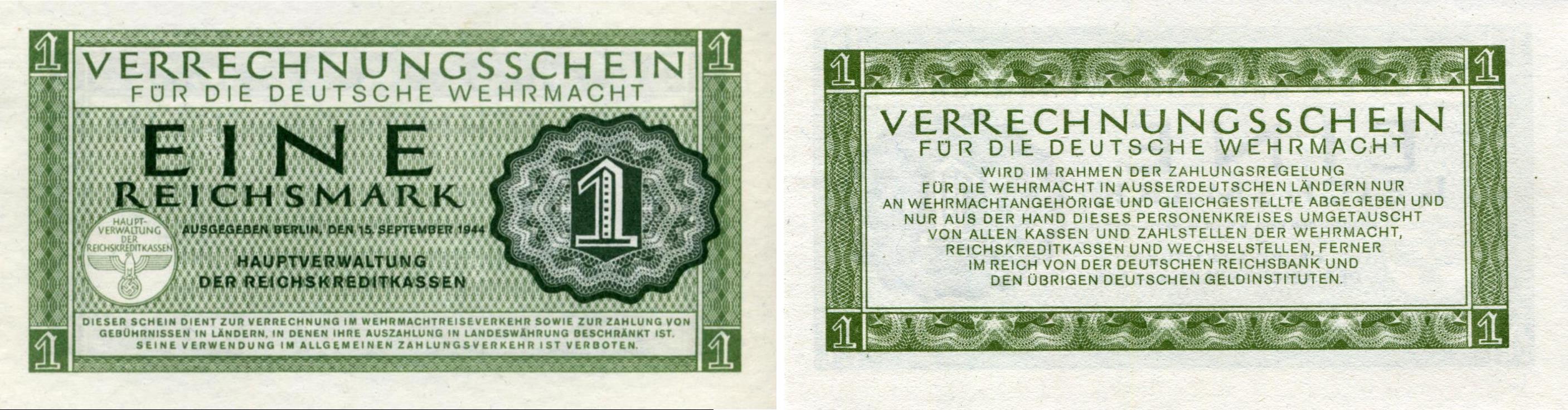


 East
Germany, also known as the German Democratic Republic or DDR, issued
this 5 Mark coin in 1969 to commemorate its 20th anniversary. It was
formed in 1949 from the Soviet occupied portion of Germany following
World War II. The design is simple, with legends "XX JAHRE
DDR", date and denomination on one side and the East German
emblem on the other. The coin is struck in a nickel-bronze
alloy.
East
Germany, also known as the German Democratic Republic or DDR, issued
this 5 Mark coin in 1969 to commemorate its 20th anniversary. It was
formed in 1949 from the Soviet occupied portion of Germany following
World War II. The design is simple, with legends "XX JAHRE
DDR", date and denomination on one side and the East German
emblem on the other. The coin is struck in a nickel-bronze
alloy. East
Germany issued an annual series of popular and well struck
non-circulating copper-nickel 5 Mark commemorative coins honoring
famous Germans and their achievements. The 29mm coin feature the emblem
of the German Democratic Republic on the obverse. The
denomination is repeated on the lettered edges of the coins.
The 125th anniversary of the birth of Wilhelm Conrad Rontgen
commemorated this 1970 issue which depicts his X-ray tube. He
was awarded the inaugural Nobel Prize in Physics in 1901 for his
discovery of X-rays. The 1971 issue marked the 400th
anniversary of the birth of Johannes Kepler. The design
reflects Kepler's theories regarding heliocentric planetary motions.
The 75th anniversary of the death of composer Johannes Brahms is the
theme of the 1972 issue. The design features musical
notes. The 100th anniversary of the death of physicist
Philipp Reis is honored on the 1974 issue. Reis invented a
telephone in 1861, pre-dating Alexander Graham Bell's telephone by more
than a decade. However, Reis's telephone was delicate, tricky
and produced inconsistent results. An image of his telephone
apparatus appears on the coin. The 200th Anniversary of the
birth of military officer Ferdinand von Schill is commemorated on the
1976 issue. In 1809 he led an unsuccessful revolt to liberate
the portions of Germany that were controlled by Napoleon. The
coin features his sword and military hat. The 125th
anniversary of the death of Friedrich Ludwig Jahn, the father of German
gymnastics, is on the 1977 issue. His portrait appears on the
coin.
East
Germany issued an annual series of popular and well struck
non-circulating copper-nickel 5 Mark commemorative coins honoring
famous Germans and their achievements. The 29mm coin feature the emblem
of the German Democratic Republic on the obverse. The
denomination is repeated on the lettered edges of the coins.
The 125th anniversary of the birth of Wilhelm Conrad Rontgen
commemorated this 1970 issue which depicts his X-ray tube. He
was awarded the inaugural Nobel Prize in Physics in 1901 for his
discovery of X-rays. The 1971 issue marked the 400th
anniversary of the birth of Johannes Kepler. The design
reflects Kepler's theories regarding heliocentric planetary motions.
The 75th anniversary of the death of composer Johannes Brahms is the
theme of the 1972 issue. The design features musical
notes. The 100th anniversary of the death of physicist
Philipp Reis is honored on the 1974 issue. Reis invented a
telephone in 1861, pre-dating Alexander Graham Bell's telephone by more
than a decade. However, Reis's telephone was delicate, tricky
and produced inconsistent results. An image of his telephone
apparatus appears on the coin. The 200th Anniversary of the
birth of military officer Ferdinand von Schill is commemorated on the
1976 issue. In 1809 he led an unsuccessful revolt to liberate
the portions of Germany that were controlled by Napoleon. The
coin features his sword and military hat. The 125th
anniversary of the death of Friedrich Ludwig Jahn, the father of German
gymnastics, is on the 1977 issue. His portrait appears on the
coin. The
Bethel Foundation (Bodelschwinghsche Stiftungen Bethel) was founded in
1867 in Prussia to care for epileptics. Its mission has
expanded to care for mentally ill and other challenged
people. It is headquartered in the Bethel district of
Bielefeld and has facilities in eight German states serving 200,000
people per year. It issued its first currency in
1908. After World War II it was the only private institution
in West
Germany authorized to issue its own currency. The notes are
accepted at Bethel facilities and selected
merchants. This four-note set of Bethel currency
includes the 50 Pfennig, 2, 5 and 20 Mark notes dated from 1957 to
1973. In 2002 the notes were replaced with Euro denominated
currency.
The
Bethel Foundation (Bodelschwinghsche Stiftungen Bethel) was founded in
1867 in Prussia to care for epileptics. Its mission has
expanded to care for mentally ill and other challenged
people. It is headquartered in the Bethel district of
Bielefeld and has facilities in eight German states serving 200,000
people per year. It issued its first currency in
1908. After World War II it was the only private institution
in West
Germany authorized to issue its own currency. The notes are
accepted at Bethel facilities and selected
merchants. This four-note set of Bethel currency
includes the 50 Pfennig, 2, 5 and 20 Mark notes dated from 1957 to
1973. In 2002 the notes were replaced with Euro denominated
currency. 

 Germany
commemorated the 30th anniversary of the fall of the
Berlin wall with this 2019 2 Euro coin. The opening of the Berlin wall
in November 1989 led to the collapse of
East Germany and the reunification of the nation. The design,
created by a French engraver, represents joyous people and doves
passing through an opening in the Berlin Wall. In the
background
is the Brandenburg Gate. The "graffiti" on the
wall reads "30 JAHRE
MAUERFAL" (30 years fall of the Berlin
Wall). At the bottom right is a "D" for Deutschland
(Germany). The coins were struck at all five German mints
(A=Berlin, D=Munich,
F=Stuttgart, G=Karlsruhe, J=Hamburg). The mintmark is at the bottom
left of the design. It is small and hard to see. All the
coins
have the standard 2 Euro reverse featuring a map of Europe.
Germany
commemorated the 30th anniversary of the fall of the
Berlin wall with this 2019 2 Euro coin. The opening of the Berlin wall
in November 1989 led to the collapse of
East Germany and the reunification of the nation. The design,
created by a French engraver, represents joyous people and doves
passing through an opening in the Berlin Wall. In the
background
is the Brandenburg Gate. The "graffiti" on the
wall reads "30 JAHRE
MAUERFAL" (30 years fall of the Berlin
Wall). At the bottom right is a "D" for Deutschland
(Germany). The coins were struck at all five German mints
(A=Berlin, D=Munich,
F=Stuttgart, G=Karlsruhe, J=Hamburg). The mintmark is at the bottom
left of the design. It is small and hard to see. All the
coins
have the standard 2 Euro reverse featuring a map of Europe.
 Germany
continued their annual series of 2 Euro coins honoring each of their
Bundesländer (states) with this 2021 issue for Saxony-Anhalt
(Sachsen-Anhalt). The coin depicts the Magdeburg
Cathedral. The
Cathedral is the oldest Gothic Cathedral in
Germany. Construnction
was started in 1209 on the site of an abbey. It was not
completed
until over 300 years later in 1520. The coins were struck at all five
German mints (A=Berlin, D=Munich, F=Stuttgart, G=Karlsruhe, J=Hamburg).
The mintmark is at the left of the cathedral.
Germany
continued their annual series of 2 Euro coins honoring each of their
Bundesländer (states) with this 2021 issue for Saxony-Anhalt
(Sachsen-Anhalt). The coin depicts the Magdeburg
Cathedral. The
Cathedral is the oldest Gothic Cathedral in
Germany. Construnction
was started in 1209 on the site of an abbey. It was not
completed
until over 300 years later in 1520. The coins were struck at all five
German mints (A=Berlin, D=Munich, F=Stuttgart, G=Karlsruhe, J=Hamburg).
The mintmark is at the left of the cathedral. Germany
celebrated the 1275th anniversary of the birth of Charlemagne with this
circulating 2023 2 Euro coin. Charlemagne is known as Karl the Great in
Germany. He unified central and western Europe for the first
time since the fall of the Roman Empire centuries earlier. He
was crowned King of the Franks, King of the Lombards and Emperor of the
Romans, and started what became known as the Holy Roman
Empire. He ruled from his capital in Aachen,
Germany. The coin depicts Charlemagne's monogram over the
octagon of Aachen Cathedral. At the lower right is the "D"
for Deutschland followed by the mintmark (A=Berlin, D=Munich,
F=Stuttgart, G=Karlsruhe, J=Hamburg). At the bottom are the
dates of his birth and death: "748-814".
Germany
celebrated the 1275th anniversary of the birth of Charlemagne with this
circulating 2023 2 Euro coin. Charlemagne is known as Karl the Great in
Germany. He unified central and western Europe for the first
time since the fall of the Roman Empire centuries earlier. He
was crowned King of the Franks, King of the Lombards and Emperor of the
Romans, and started what became known as the Holy Roman
Empire. He ruled from his capital in Aachen,
Germany. The coin depicts Charlemagne's monogram over the
octagon of Aachen Cathedral. At the lower right is the "D"
for Deutschland followed by the mintmark (A=Berlin, D=Munich,
F=Stuttgart, G=Karlsruhe, J=Hamburg). At the bottom are the
dates of his birth and death: "748-814".  Germany
honored the state of Mecklenburg-West Pomerania
(Mecklenburg-Vorpommern) on their 2024 2 Euro coin. The coin
depicts the iconic “Konigsstuhl” (King’s Chair) in the Jasmund National
Park on the island of Rugen.. It is a 387-foot (118m) chalk
cliff rising above the Baltic Sea. A person standing on the
beach gives an idea to the immense size of the cliffs. To the
left is the "D" for Deutschland. Above the cliff is the
mintmark (A=Berlin, D=Munich, F=Stuttgart, G=Karlsruhe, J=Hamburg).
Germany
honored the state of Mecklenburg-West Pomerania
(Mecklenburg-Vorpommern) on their 2024 2 Euro coin. The coin
depicts the iconic “Konigsstuhl” (King’s Chair) in the Jasmund National
Park on the island of Rugen.. It is a 387-foot (118m) chalk
cliff rising above the Baltic Sea. A person standing on the
beach gives an idea to the immense size of the cliffs. To the
left is the "D" for Deutschland. Above the cliff is the
mintmark (A=Berlin, D=Munich, F=Stuttgart, G=Karlsruhe, J=Hamburg). This
German 2024 2 Euro coin commemorates the 175th anniversary the St.
Paul's Church Constitution (Paulskirchenverfassung), also known as the
Frankfurt Constitution. It was an attempt to create
a unified German nation. It included a charter of fundamental
rights and a democratic government in the form of a constitutional
monarchy. The constitution failed due to the objections of
Prussia and some of the smaller states. The coin depicts the
St. Paul's Church memorial (the original church was destroyed by Allied
bombing in 1944). Behind it is a quill and a paper
representing the constitution. In the background are female
allegorical figures representing unity, justice and freedom and the
tri-color German flag. To the left of the church is the
letter "D" for Deutschland (Germany). The mintmark is to the right of
the church just below the quill.
This
German 2024 2 Euro coin commemorates the 175th anniversary the St.
Paul's Church Constitution (Paulskirchenverfassung), also known as the
Frankfurt Constitution. It was an attempt to create
a unified German nation. It included a charter of fundamental
rights and a democratic government in the form of a constitutional
monarchy. The constitution failed due to the objections of
Prussia and some of the smaller states. The coin depicts the
St. Paul's Church memorial (the original church was destroyed by Allied
bombing in 1944). Behind it is a quill and a paper
representing the constitution. In the background are female
allegorical figures representing unity, justice and freedom and the
tri-color German flag. To the left of the church is the
letter "D" for Deutschland (Germany). The mintmark is to the right of
the church just below the quill. Germany
continued their annual series honoring each of their states with this
2025 dated 2 Euro for Saarland. Saarland is located on the
border of Germany, France and Luxembourg. It has long been
contested between France and Germany. It gained importance in
the 19th century due to its rich coal deposits and heavy
industrialization. France tried to establish it as an
independent entity after both World War I and World War II, and both
times Saarland voted overwhelmingly to become part of
Germany. The coin features a birds eye view of the
Saarschleife, which is a big bend in the Saar river. It is a
major tourist attraction. At the bottom is a "D" for Deutschland and
the date. The mintmark is on the middle right side of the
coin.
Germany
continued their annual series honoring each of their states with this
2025 dated 2 Euro for Saarland. Saarland is located on the
border of Germany, France and Luxembourg. It has long been
contested between France and Germany. It gained importance in
the 19th century due to its rich coal deposits and heavy
industrialization. France tried to establish it as an
independent entity after both World War I and World War II, and both
times Saarland voted overwhelmingly to become part of
Germany. The coin features a birds eye view of the
Saarschleife, which is a big bend in the Saar river. It is a
major tourist attraction. At the bottom is a "D" for Deutschland and
the date. The mintmark is on the middle right side of the
coin. German East Africa encompassed what is
today the nations of Rwanda, Burundi, most of Tanzania as well as small
portions of Mozambique, Kenya and Uganda. With the outbreak of World
War I in July 1914, German East Africa soon found itself isolated due
to a British naval blockade. The one German warship in the
region, the light cruiser SMS Konigsberg led British Royal Navy on a
merry chase, sinking both military and merchant ships, before being
forced back to German East Africa due to engine problems. The
British were forced to tie twenty ships and ten aircraft before finding
and trapping the crippled German ship. The Germans scuttled
the ship, salvaging what they could. On land, German Colonel
von Lettow-Vorbeck, with a small force of some 3500 German and 12,000
native soldiers and porters engaged in an effective guerilla war
against the British. He managed to tie up well over 40,000
British soldiers, caused extensive British casualties, and compelled
Britain to commit significant resources to this minor colonial
theater. Though he frequently retreated, he was never
defeated. The Germans needed money to pay their troops and
purchase supplies. Utilizing equipment salvaged from the
Konigsberg, a crude mint was set up in
Tabora. These 20 Heller coins were struck
at the Tabora mint utilizing hand cut dies. Metal for the coins the
coins came from many sources, including spent cartridges, artillery
shell casings, wiring, and metal salvaged from the
Konigsberg. One side depicts the imperial German crown, the
date “1916”, the initials “D.O.A.” (for Deutsch-Ostafrika, or German
East Africa) and the “T” mintmark for Tabora. The other side
has the denomination surrounded by two laurel branches. The
29mm coin is struck in brass. It is an historic but largely
forgotten
piece of World War I history.
German East Africa encompassed what is
today the nations of Rwanda, Burundi, most of Tanzania as well as small
portions of Mozambique, Kenya and Uganda. With the outbreak of World
War I in July 1914, German East Africa soon found itself isolated due
to a British naval blockade. The one German warship in the
region, the light cruiser SMS Konigsberg led British Royal Navy on a
merry chase, sinking both military and merchant ships, before being
forced back to German East Africa due to engine problems. The
British were forced to tie twenty ships and ten aircraft before finding
and trapping the crippled German ship. The Germans scuttled
the ship, salvaging what they could. On land, German Colonel
von Lettow-Vorbeck, with a small force of some 3500 German and 12,000
native soldiers and porters engaged in an effective guerilla war
against the British. He managed to tie up well over 40,000
British soldiers, caused extensive British casualties, and compelled
Britain to commit significant resources to this minor colonial
theater. Though he frequently retreated, he was never
defeated. The Germans needed money to pay their troops and
purchase supplies. Utilizing equipment salvaged from the
Konigsberg, a crude mint was set up in
Tabora. These 20 Heller coins were struck
at the Tabora mint utilizing hand cut dies. Metal for the coins the
coins came from many sources, including spent cartridges, artillery
shell casings, wiring, and metal salvaged from the
Konigsberg. One side depicts the imperial German crown, the
date “1916”, the initials “D.O.A.” (for Deutsch-Ostafrika, or German
East Africa) and the “T” mintmark for Tabora. The other side
has the denomination surrounded by two laurel branches. The
29mm coin is struck in brass. It is an historic but largely
forgotten
piece of World War I history. Saar
is an important center for coal mining and heavy industry located
in Germany along the French border. Most of its citizens are
of German ancestry. Following World War II, France occupied
the region and tried to establish Saarland as a separate nation in an
effort to cripple Germany's industrial base. France assumed
control of its foreign affairs and even issued coins for
Saarland. The coins were struck at the Paris mint and were
the same size and composition as the contemporary French coins. Soon
after the coins were issued, Saarland voted to reunite with Germany,
bringing an end to brief coin issue. We are pleased to offer a complete
set of the only four coins ever issued by Saarland. The set
includes the 1954 aluminum-bronze 10, 20 and 50 Franken and the 1955
copper-nickel 100 Franken. The aluminum-bronze 10, 20 and 50
Franken feature
a stylized factory spewing out pollution and the Saarland arms on the
obverse. The copper-nickel 100 Franken has the arms within a
circle. The reverses of all the coins have the denomination
in German and the date. Perhaps it should have been a clue to
the French when they had to put the legends in German that Saarland
would not remain under French control.
Saar
is an important center for coal mining and heavy industry located
in Germany along the French border. Most of its citizens are
of German ancestry. Following World War II, France occupied
the region and tried to establish Saarland as a separate nation in an
effort to cripple Germany's industrial base. France assumed
control of its foreign affairs and even issued coins for
Saarland. The coins were struck at the Paris mint and were
the same size and composition as the contemporary French coins. Soon
after the coins were issued, Saarland voted to reunite with Germany,
bringing an end to brief coin issue. We are pleased to offer a complete
set of the only four coins ever issued by Saarland. The set
includes the 1954 aluminum-bronze 10, 20 and 50 Franken and the 1955
copper-nickel 100 Franken. The aluminum-bronze 10, 20 and 50
Franken feature
a stylized factory spewing out pollution and the Saarland arms on the
obverse. The copper-nickel 100 Franken has the arms within a
circle. The reverses of all the coins have the denomination
in German and the date. Perhaps it should have been a clue to
the French when they had to put the legends in German that Saarland
would not remain under French control.