IRAQ & KURDISTAN COINS & CURRENCY
SADDAM
HUSSAIN BANKNOTES FROM IRAQ
These five banknotes all picture Iraqi dictator Saddam Husain on the
front. The first banknote to bear Saddam's portrait is the
multi-colored 1986 25 Dinar Note. He is pictured with charging medieval
horsemen in an attempt to link himself with great military victories of
past centuries. The back shows the ancient gate of Babylon at the left,
below it is a lion frieze. In the center is the Martyr’s
Monument (al-Shaheed) in Baghdad. When issued the note had an
exchange
rate of approximately $80 and was the largest denomination in
circulation. The blue 1994 100 Dinar note depicts Saddam and
the medieval Al-Ukhaidir Fortress on the front and the modern Bagdad
Clock
tower on the back. The 1995 250 Dinars pictures Saddam and
the Haditha Dam on the Euphrates on the front. The back shows
the
frieze from the Liberty Monument in Baghdad. At the time it was issued
it was the highest denomination in circulation with an official
exchange rate of over $750, but would buy only a few dollars of goods
on the streets. The green 2001 25 Dinar features Ishtar
Gate. The original gate was built about 569 BC by order of
King Nebuchadnezzar II. It was excavated in the early 20th
century
and most of it was hauled off to Germany. Saddam built a
reproduction of the
gate which opened in 1987. The purple 2002 250 Dinars depicts the Dome
of
the Rock on Temple Mount in Jerusalem. It was one of the last notes
issued before Saddam was overthrown in the Second Gulf War in
2003. The 1986 25 Dinar grades Very Fine. The other
notes are Uncirculated. Notes may be purchased individually
for $3
each or as a set.
Item
PM-IQ-SET5 5 DIFFERENT IRAQ SADDAM HUSSAIN
NOTES 1986-2003 $10.00
Single Notes from the above set:
Item
PM-IQ-25D-86 IRAQ 25 DINAR NOTE, 1986 SADDAM
P73
XF $3.00
Item
PM-IQ-100D-94 IRAQ 100 DINAR NOTE, 1994
SADDAM
P84 UNC. $3.00
Item
PM-IQ-250D-95 IRAQ 250 DINAR NOTE, 1995
SADDAM
P85 UNC. $3.00
Item
PM-IQ-25D-01 IRAQ 25 DINAR NOTE, 2001
SADDAM
P86 UNC. $3.00
Item
PM-IQ-250D-02 IRAQ 250 DINAR NOTE, 2002
SADDAM
P88 UNC. $3.00
ALSO SEE:
 THE GREATEST BANK HEIST OF ALL TIME: KUWAIT 1 DINAR
"CONTRABAND" NOTE (1990) P13d
THE GREATEST BANK HEIST OF ALL TIME: KUWAIT 1 DINAR
"CONTRABAND" NOTE (1990) P13d
SADDAM
GULF WAR NOTE
This 1992 5 Dinars note of Iraq was issued after Iraq's defeat in
the First Gulf War. The country was under a United Nations
embargo so was unable to utilize its regular bank note printers.
Instead it utilized a Chinese printer that was willing to
break the embargo. The quality of the notes left much to be
desired, however they filled the need and were pressed into service.
The red note features a portrait of Saddam Hussein with an
underprint of an ancient temple. The back features Iraq's
Tomb of the Unknown Soldier and a small vignette of an ancient carving
of Hammurabi in conversation with the sun god Shamash. As an
anti-conterfeiting measure, the note contains threads that fluoresce
blue and orange under Ultra-Violet light. The note is
Uncirculated.
Item
PM-IQ-5D IRAQ 5 DINARS NOTE 1992 P80
UNC. $3.00
Item
PM-IQ-5Dx10 TEN of the above IRAQ 5
DINARS NOTES 1992 P80
UNC. $17.00
OPERATION
DESERT STORM PROPAGANDA LEAFLETS
These
propaganda leaflets were prepared by the US Armed Forces and
air-dropped on Iraqi soldiers during the First Gulf War in
1991. They
were part of a PSYOP psychological warfare program to encourage the
Iraqis not to fight. They must have been effective, as almost
half of
the Iraqi soldiers defected, deserted or surrendered. This
set
includes 7 different genuine propaganda leaflets, including both color
and black and white issues. Included in the set is a popular
leaflet
printed to look like an Iraq 25 Dinar note picturing Saddam. What
better way to have a piece of propaganda picked
up than to make it look like real money!
Click here for a
list of the leaflets provided
and their translations.
Item
IQ-PROP
SET OF 7 IRAQ WAR PROPAGANDA LEAFLETS, UNC.
$19.50
IRAQ POST
INVASION COIN SET

Iraq
released three 2004 dated
coins: a 25, 50 and 100 Dinar. They are the first coins
issued
since for circulation since the First Gulf War in 1990 and were issued
as part of America’s plan to bring stability to the country.
Since then no additional coins have been issued for circulation. The
coins have a very simple design. One side shows a map of
Iraq,
showing the Tigris and Euphrates rivers and the date in both the AH and
AD Calendar. The other side shows the denomination and
inscriptions in Arabic. The 25 Dinars is copper plated-steel,
the
50 Dinars is brass plated steel and the 100 Dinar is nickel-plated
steel.
Item
IQ-SET3 IRAQ 25, 50 & 100
DINAR 2004 KM175-177 UNC. $6.00
MODERN
COIN OF KURDISTAN
The Kurds are an
ethnic group divided between Iraq, Turkey and Syria.
Their attempts to establish a Kurdish nation have been repeatedly
thwarted by outside powers. In 2003, after the fall of Saddam Hussein
in Iraq, overseas Kurdish groups authorized the issuance of coins for
what they expected would be their new independent nation.
Because of objections from neighboring Turkey, the United States did
not allow the establishment of Kurdistan. Though the Kurds greatly
assisted the United States by providing ground forces to fight ISIS in
Syria and Iraq, in 2019 the United States again betrayed by withdrawing
United States troops and abandoning them to Turkish and Russian
forces.
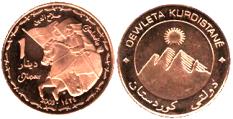
The 2003 1 Dinar depicts the
most famous Kurd of all time: Saladin. He is depicted on
horseback carrying a modern Kurdish flag. Saladin founded the powerful
Ayyubid Dynasty in 1169. His diplomatic skills, backed by
well-disciplined army enabled him to gain control of Egypt, Palestine
and Syria from Islamic as well as Christian opponents. Even
his opponents admired him for his chivalry, justice and piety. The
27.4mm coin is struck in bronze-plated zinc..
The reverse depicts a
Kurdish emblem featuring the sun rising over three
mountains.
Item
KURD1 KURDISTAN
1 DINAR 2003 Br.X1.2 UNC.
$7.50
RARE
KURDISTAN 2006 1000
DINAR COIN

This
Kurdistan 2006 dated 1000 Dinar pictures Mustafa Barzani, a
charismatic Kurdish nationalist leader. He spent almost his entire life
fighting for Kurdish indpendence. When he was only three
years old he and his family were imprisoned by the Ottomans for an
insurrection by his tribe. Much of his family was later executed.
After the British gained control of Iraq following World War
I he engaged in attacks against both British and
Iraqi authorities. In 1946, he was chosen as the leader of the
Kurdistan Democratic Party (KDP) to lead the Kurdish revolt against the
Kingdom of Iraq. He died in 1979 in the United States while
undergoing treatment for lung cancer. The reverse of the coin
features the Kurdish mountain emblem, representing the Kurds of Iraq,
Turkey and Syria. The unofficial 27mm coin is struck in
brass-plated zinc and has a mintage of 8,500 pieces.
Item
KURD1000 KURDISTAN 1000 DINARS 2006 Br.X12
UNC.
$5.00
<--
PREVIOUS
PAGE NEXT
PAGE -->


 Iraq
released three 2004 dated
coins: a 25, 50 and 100 Dinar. They are the first coins
issued
since for circulation since the First Gulf War in 1990 and were issued
as part of America’s plan to bring stability to the country.
Since then no additional coins have been issued for circulation. The
coins have a very simple design. One side shows a map of
Iraq,
showing the Tigris and Euphrates rivers and the date in both the AH and
AD Calendar. The other side shows the denomination and
inscriptions in Arabic. The 25 Dinars is copper plated-steel,
the
50 Dinars is brass plated steel and the 100 Dinar is nickel-plated
steel.
Iraq
released three 2004 dated
coins: a 25, 50 and 100 Dinar. They are the first coins
issued
since for circulation since the First Gulf War in 1990 and were issued
as part of America’s plan to bring stability to the country.
Since then no additional coins have been issued for circulation. The
coins have a very simple design. One side shows a map of
Iraq,
showing the Tigris and Euphrates rivers and the date in both the AH and
AD Calendar. The other side shows the denomination and
inscriptions in Arabic. The 25 Dinars is copper plated-steel,
the
50 Dinars is brass plated steel and the 100 Dinar is nickel-plated
steel. The Kurds are an
ethnic group divided between Iraq, Turkey and Syria.
Their attempts to establish a Kurdish nation have been repeatedly
thwarted by outside powers. In 2003, after the fall of Saddam Hussein
in Iraq, overseas Kurdish groups authorized the issuance of coins for
what they expected would be their new independent nation.
Because of objections from neighboring Turkey, the United States did
not allow the establishment of Kurdistan. Though the Kurds greatly
assisted the United States by providing ground forces to fight ISIS in
Syria and Iraq, in 2019 the United States again betrayed by withdrawing
United States troops and abandoning them to Turkish and Russian
forces.
The Kurds are an
ethnic group divided between Iraq, Turkey and Syria.
Their attempts to establish a Kurdish nation have been repeatedly
thwarted by outside powers. In 2003, after the fall of Saddam Hussein
in Iraq, overseas Kurdish groups authorized the issuance of coins for
what they expected would be their new independent nation.
Because of objections from neighboring Turkey, the United States did
not allow the establishment of Kurdistan. Though the Kurds greatly
assisted the United States by providing ground forces to fight ISIS in
Syria and Iraq, in 2019 the United States again betrayed by withdrawing
United States troops and abandoning them to Turkish and Russian
forces.  This
Kurdistan 2006 dated 1000 Dinar pictures Mustafa Barzani, a
charismatic Kurdish nationalist leader. He spent almost his entire life
fighting for Kurdish indpendence. When he was only three
years old he and his family were imprisoned by the Ottomans for an
insurrection by his tribe. Much of his family was later executed.
After the British gained control of Iraq following World War
I he engaged in attacks against both British and
Iraqi authorities. In 1946, he was chosen as the leader of the
Kurdistan Democratic Party (KDP) to lead the Kurdish revolt against the
Kingdom of Iraq. He died in 1979 in the United States while
undergoing treatment for lung cancer. The reverse of the coin
features the Kurdish mountain emblem, representing the Kurds of Iraq,
Turkey and Syria. The unofficial 27mm coin is struck in
brass-plated zinc and has a mintage of 8,500 pieces.
This
Kurdistan 2006 dated 1000 Dinar pictures Mustafa Barzani, a
charismatic Kurdish nationalist leader. He spent almost his entire life
fighting for Kurdish indpendence. When he was only three
years old he and his family were imprisoned by the Ottomans for an
insurrection by his tribe. Much of his family was later executed.
After the British gained control of Iraq following World War
I he engaged in attacks against both British and
Iraqi authorities. In 1946, he was chosen as the leader of the
Kurdistan Democratic Party (KDP) to lead the Kurdish revolt against the
Kingdom of Iraq. He died in 1979 in the United States while
undergoing treatment for lung cancer. The reverse of the coin
features the Kurdish mountain emblem, representing the Kurds of Iraq,
Turkey and Syria. The unofficial 27mm coin is struck in
brass-plated zinc and has a mintage of 8,500 pieces.