We are out of the office until about August 24.
Your order will be processed after we return.
 ON-LINE ORDER FORM Alphabetical Listings
Coins by theme or topic
New Arrivals
World Coin Sets List
Site Map
Home Page
ON-LINE ORDER FORM Alphabetical Listings
Coins by theme or topic
New Arrivals
World Coin Sets List
Site Map
Home Page |
|
ON-LINE ORDER FORM Alphabetical Listings
Coins by theme or topic
New Arrivals
World Coin Sets List
Site Map
Home Page |
 Well
mixed silver coins of the world sold by silver content.
This is always a popular seller and always a
sellout. These are nice,
collectable
silver coins from around the
world, including older circulated coins, modern Uncirculated and
Proof coins and 1 ounce legal tender coins from around the
world. With silver prices soaring, I am pulling a lot of nice,
collectable coins from old inventory and dumping them into these silver
lots.
Good mix with few, if any,
duplicates.
Silver
content is based on the Standard Catalog of World Coins or similar
standard
sources. Order
by the ounce or request in place of a refund.
Well
mixed silver coins of the world sold by silver content.
This is always a popular seller and always a
sellout. These are nice,
collectable
silver coins from around the
world, including older circulated coins, modern Uncirculated and
Proof coins and 1 ounce legal tender coins from around the
world. With silver prices soaring, I am pulling a lot of nice,
collectable coins from old inventory and dumping them into these silver
lots.
Good mix with few, if any,
duplicates.
Silver
content is based on the Standard Catalog of World Coins or similar
standard
sources. Order
by the ounce or request in place of a refund. 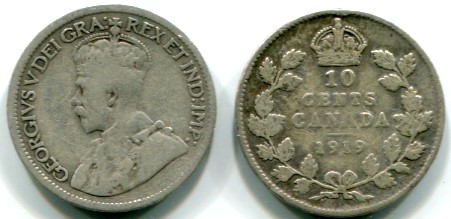 The crowned head of George V is
featured on this silver 10 Cent coin from Canada. The coin is dated
between 1911 and 1919 and is struck in sterling (.925) silver
and contains .069 troy ounces of
silver. Starting in 1920 the Canadian dime was reduced to
.800 fine silver. The reverse includes the denomination and
date within a wreath and the crown above.
The crowned head of George V is
featured on this silver 10 Cent coin from Canada. The coin is dated
between 1911 and 1919 and is struck in sterling (.925) silver
and contains .069 troy ounces of
silver. Starting in 1920 the Canadian dime was reduced to
.800 fine silver. The reverse includes the denomination and
date within a wreath and the crown above. 

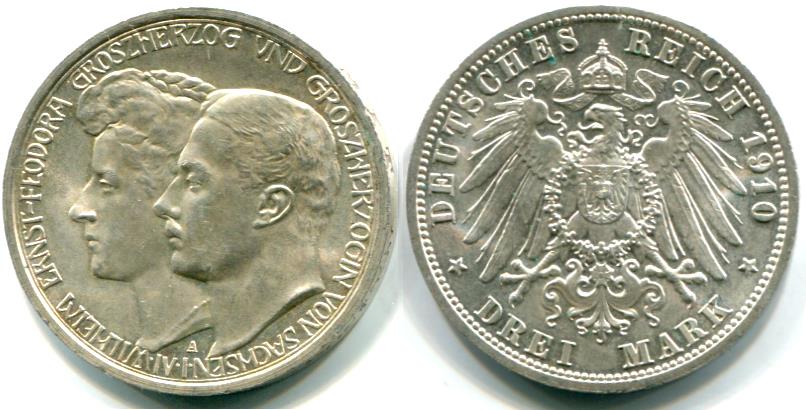 The
Grand Duchy of Saxe-Weimar-Eisenach consisted of over a dozen
non-contiguous territories in central Germany. After the
unification of Germany it issued few coins. This 1910 3 Mark of
Saxe-Weimar-Eisenach commemorates the wedding of Grand Duke Wilhelm
Ernest to Princess Fedora. It was the Duke's second
marriage. The Duke's first wife died after 18 months,
probably by suicide. His marriage to Fedora was not a happy
one. Though Fedora was popular with the people, the Duke was not. The
Duke was known to be a sadist and was widely hated. He was
called "the most unpopular prince in all of Germany". His court was
considered to be one of the most stifling and etiquette-driven in
Germany, and Weimar was considered to be "the dreariest capital in
Europe". The 33mm silver coin depicts the busts of Wilhelm
Ernest and Fedora on the obverse. The imperial German Eagle
is on the reverse. The coin has a lettered edge. It
has a mintage of only 133,000 and was struck in Berlin. It is
an attractive coin from an unpopular monarch.
The
Grand Duchy of Saxe-Weimar-Eisenach consisted of over a dozen
non-contiguous territories in central Germany. After the
unification of Germany it issued few coins. This 1910 3 Mark of
Saxe-Weimar-Eisenach commemorates the wedding of Grand Duke Wilhelm
Ernest to Princess Fedora. It was the Duke's second
marriage. The Duke's first wife died after 18 months,
probably by suicide. His marriage to Fedora was not a happy
one. Though Fedora was popular with the people, the Duke was not. The
Duke was known to be a sadist and was widely hated. He was
called "the most unpopular prince in all of Germany". His court was
considered to be one of the most stifling and etiquette-driven in
Germany, and Weimar was considered to be "the dreariest capital in
Europe". The 33mm silver coin depicts the busts of Wilhelm
Ernest and Fedora on the obverse. The imperial German Eagle
is on the reverse. The coin has a lettered edge. It
has a mintage of only 133,000 and was struck in Berlin. It is
an attractive coin from an unpopular monarch. FIRST
SILVER MARK OF THE GERMAN EMPIRE
FIRST
SILVER MARK OF THE GERMAN EMPIRE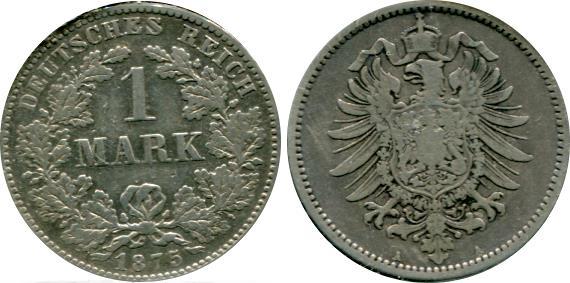 For
most if its history Germany was little more than a loose collection of
independent and semi-independent states. The country was
finally unified in 1871 under Prussian King Wilhelm I as emperor of
Germany. One of the first coins of the German Empire was the
silver 1 Mark. The 24mm coin was struck in .900 fine silver and
contains .1606 troy ounces of silver. The obverse includes
the denomination within a wreath of oak leaves and the date. The
reverse has the German Imperial Eagle and the mint mark. The coin was
struck from 1873 until 1887.WORLD
WAR I GERMAN SILVER 1/2 MARK
For
most if its history Germany was little more than a loose collection of
independent and semi-independent states. The country was
finally unified in 1871 under Prussian King Wilhelm I as emperor of
Germany. One of the first coins of the German Empire was the
silver 1 Mark. The 24mm coin was struck in .900 fine silver and
contains .1606 troy ounces of silver. The obverse includes
the denomination within a wreath of oak leaves and the date. The
reverse has the German Imperial Eagle and the mint mark. The coin was
struck from 1873 until 1887.WORLD
WAR I GERMAN SILVER 1/2 MARK After
the start of World War I in 1914 Germans hoarded their silver coins.
With Germany's defeat and the hyperinflation that followed, it proved
to be a wise move. As a result, World War I era German silver
1/2 Mark coins are available in high grades at a very reasonable
price. The 1/2 Mark is 20mm in diameter, is struck in .900
fine silver and contains .080 troy ounces of silver. The
denomination within an oak wreath is on the obverse. The
German Imperial Eagle within an oak wreath is on the reverse.
They were the last silver coins struck by the German Empire.
After
the start of World War I in 1914 Germans hoarded their silver coins.
With Germany's defeat and the hyperinflation that followed, it proved
to be a wise move. As a result, World War I era German silver
1/2 Mark coins are available in high grades at a very reasonable
price. The 1/2 Mark is 20mm in diameter, is struck in .900
fine silver and contains .080 troy ounces of silver. The
denomination within an oak wreath is on the obverse. The
German Imperial Eagle within an oak wreath is on the reverse.
They were the last silver coins struck by the German Empire.
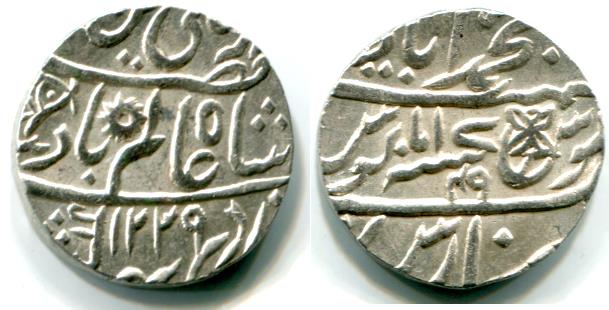 This
amazing Uncirculated silver rupee was one of the last hammer struck
coin by the Bengal Presidency of the British East India
Company. Though struck by the British East India Company, the
coin was struck in the name of Mughal Emperor Shah Alam II.
The coin is dated both AH1229, which corresponds to 1813AD, and Year 49
of the reign of Shah Alam II, which corresponds to 1806. Though Shah
Alam II died in 1806, the coin continued to be struck from 1813 to
1819, always bearing
the same dates. The British East India Company continued to
strike coins in his name as he was well respected and coins in his name
were widely accepted and trusted. By the time the coin was
struck the British East India Company's Bengal Presidency controlled
most of north-east India and the Mughal Emperor was little more than a
figurehead. The coin was struck at the Banaras (now called
Varanasi) Mint.
This
amazing Uncirculated silver rupee was one of the last hammer struck
coin by the Bengal Presidency of the British East India
Company. Though struck by the British East India Company, the
coin was struck in the name of Mughal Emperor Shah Alam II.
The coin is dated both AH1229, which corresponds to 1813AD, and Year 49
of the reign of Shah Alam II, which corresponds to 1806. Though Shah
Alam II died in 1806, the coin continued to be struck from 1813 to
1819, always bearing
the same dates. The British East India Company continued to
strike coins in his name as he was well respected and coins in his name
were widely accepted and trusted. By the time the coin was
struck the British East India Company's Bengal Presidency controlled
most of north-east India and the Mughal Emperor was little more than a
figurehead. The coin was struck at the Banaras (now called
Varanasi) Mint. Young
Queen Victoria is depicted on the 1840 silver Rupee issued by the
British East India Company. At the time the company, rather
than the British government, ruled most of India. It had its
own army and administration. The reverse includes the inscription "EAST
INDIA COMPANY", and the denomination in English and Urdu within a
wreath. The 32mm coin is stuck in .917 fine silver and contains .344
troy ounces of silver. WWII SILVER COINS
FROM BRITISH INDIA
Young
Queen Victoria is depicted on the 1840 silver Rupee issued by the
British East India Company. At the time the company, rather
than the British government, ruled most of India. It had its
own army and administration. The reverse includes the inscription "EAST
INDIA COMPANY", and the denomination in English and Urdu within a
wreath. The 32mm coin is stuck in .917 fine silver and contains .344
troy ounces of silver. WWII SILVER COINS
FROM BRITISH INDIA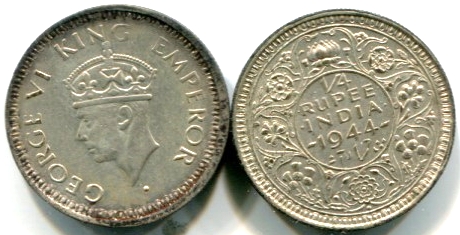
 World
War II brought an economic boon to India as it supplied the Allied
forces with much needed raw materials. Thes silver 1/4, 1/2 and 1 Rupee
coins from India date from 1942 to 1945. The coins feature
Emperor George VI
on the obverse. The reverse includes the denomination in
English and Urdu. Around them is a wreath made of roses,
thistle, shamrock leaves and lotus flowers, representing England,
Scotland, Northern Ireland, and India. The coins are struck
in .500 fine silver. The 19mm 1/4 Rupee contains .0469 troy
ounces of silver.. The 24.1mm 1/2 Rupee .094 troy ounces of
silver. The 30.5mm 1 Rupee contains .1874 troy ounces of
silver.
World
War II brought an economic boon to India as it supplied the Allied
forces with much needed raw materials. Thes silver 1/4, 1/2 and 1 Rupee
coins from India date from 1942 to 1945. The coins feature
Emperor George VI
on the obverse. The reverse includes the denomination in
English and Urdu. Around them is a wreath made of roses,
thistle, shamrock leaves and lotus flowers, representing England,
Scotland, Northern Ireland, and India. The coins are struck
in .500 fine silver. The 19mm 1/4 Rupee contains .0469 troy
ounces of silver.. The 24.1mm 1/2 Rupee .094 troy ounces of
silver. The 30.5mm 1 Rupee contains .1874 troy ounces of
silver.


 Victor
Emmanuel III (Vittorio Emanuele III) became King of Italy in
1900. His reign lasted 45 years, spanning both World War I
and World War II. He was an avid numismatist, which
may explain why he issued such attractive coins. The designs
of his coins reflect those of ancient Italy. From the World
War I era we have these wonderful silver1 and 2 Lire coins issued from
1914 to 1917. Both coins have similar designs. The
reverses feature a quadriga (an ancient carriage) pulled by four
prancing horses, carrying Italia, the female personification of
Italy. She is holding a shield and an olive branch.
The design is based on the coins of ancient Syracuse. The
obverse has the bust of King Victor Emmanuel III. The coin
has a lettered edge with the letters FERT repeated three
times. FERT was the motto of the house of Savoy. It
is thought to be an acronym; however it is unclear about what it stands
for. The coins were struck to the standards of the Latin
Monetary Union. The 1 Lira is 23mm, weighs 5 grams, is struck
in .835 fine silver and contains. .1342 troy ounces of
silver. The 2 Lira is 27mm, weighs 10 grams, is struck in
.835 fine silver and contains .2683 troy ounces of silver.
These beautiful, historic silver coins of World War I show virtually no
wear.
Victor
Emmanuel III (Vittorio Emanuele III) became King of Italy in
1900. His reign lasted 45 years, spanning both World War I
and World War II. He was an avid numismatist, which
may explain why he issued such attractive coins. The designs
of his coins reflect those of ancient Italy. From the World
War I era we have these wonderful silver1 and 2 Lire coins issued from
1914 to 1917. Both coins have similar designs. The
reverses feature a quadriga (an ancient carriage) pulled by four
prancing horses, carrying Italia, the female personification of
Italy. She is holding a shield and an olive branch.
The design is based on the coins of ancient Syracuse. The
obverse has the bust of King Victor Emmanuel III. The coin
has a lettered edge with the letters FERT repeated three
times. FERT was the motto of the house of Savoy. It
is thought to be an acronym; however it is unclear about what it stands
for. The coins were struck to the standards of the Latin
Monetary Union. The 1 Lira is 23mm, weighs 5 grams, is struck
in .835 fine silver and contains. .1342 troy ounces of
silver. The 2 Lira is 27mm, weighs 10 grams, is struck in
.835 fine silver and contains .2683 troy ounces of silver.
These beautiful, historic silver coins of World War I show virtually no
wear. This
silver 5 Lire of Fascist Italy dates from 1927 to 1930. King
Victor Emmanuel III (Vittorio Emanuele III) is on the
obverse. An eagle and fasces, the emblem of Fascist Italy is
on the reverse. The coins have a lettered edge that includes the
letters FERT. "FERT" in the motto of the House of Savoy,
though
what it stands for has long been forgotten. By 1927 Mussolini had
turned Italy into a
dictatorship and the king was largely a figurehead. The 23mm coin
weighs 5 grams and contains .1342 troy ounces of silver. It
is an historic silver coin of Fascist Italy.WWII FASCIST ITALY COIN SETSATTRACTIVE COINS
OF THE ITALIAN REPUBLICFAMOUS ITALIANS ON BEAUTIFUL BANKNOTES
This
silver 5 Lire of Fascist Italy dates from 1927 to 1930. King
Victor Emmanuel III (Vittorio Emanuele III) is on the
obverse. An eagle and fasces, the emblem of Fascist Italy is
on the reverse. The coins have a lettered edge that includes the
letters FERT. "FERT" in the motto of the House of Savoy,
though
what it stands for has long been forgotten. By 1927 Mussolini had
turned Italy into a
dictatorship and the king was largely a figurehead. The 23mm coin
weighs 5 grams and contains .1342 troy ounces of silver. It
is an historic silver coin of Fascist Italy.WWII FASCIST ITALY COIN SETSATTRACTIVE COINS
OF THE ITALIAN REPUBLICFAMOUS ITALIANS ON BEAUTIFUL BANKNOTES  This
unusual rectangular silver coin was some of the last
coins issued by the famous and once powerful Shoguns of Japan. The
Shoguns were the military rulers of Japan, who for hundreds of years
controlled the island nation. They were finally forced from
power in 1867 due to the pressures of modernization brought about by
the United States. Their militaristic influence continued
however, leading to World War II. The silver 1 Bu
(Ichi bu Gin) is approximately 24mm x
16mm. It was issued from 1837 until 1868. It includes an
official countermark on the reverse. It is one of the few rectangular coins ever used by any nation
in general circulation.
This
unusual rectangular silver coin was some of the last
coins issued by the famous and once powerful Shoguns of Japan. The
Shoguns were the military rulers of Japan, who for hundreds of years
controlled the island nation. They were finally forced from
power in 1867 due to the pressures of modernization brought about by
the United States. Their militaristic influence continued
however, leading to World War II. The silver 1 Bu
(Ichi bu Gin) is approximately 24mm x
16mm. It was issued from 1837 until 1868. It includes an
official countermark on the reverse. It is one of the few rectangular coins ever used by any nation
in general circulation.
 In
1871 Japan officially introduced the Yen, The new, round,
machine-struck coins created a unified national currency for Japan. The
word Yen is derived from the Japanese word for round.
Previously coins were round,
rectangular, or oblong.
The Yen was subdivided into 100 Sen. This silver 50 Sen is
dated Meiji Year 4, which is 1871AD. The obverse depicts the
imperial dragon within a circle. The reverse features a sunburst. Above
it is a chrysanthemum between two paulownia flowers. The 31mm coin is
struck in .800 fine silver and contains .3215 troy ounces of silver.BEAUTIFUL
JAPANESE SILVER 1 YEN
In
1871 Japan officially introduced the Yen, The new, round,
machine-struck coins created a unified national currency for Japan. The
word Yen is derived from the Japanese word for round.
Previously coins were round,
rectangular, or oblong.
The Yen was subdivided into 100 Sen. This silver 50 Sen is
dated Meiji Year 4, which is 1871AD. The obverse depicts the
imperial dragon within a circle. The reverse features a sunburst. Above
it is a chrysanthemum between two paulownia flowers. The 31mm coin is
struck in .800 fine silver and contains .3215 troy ounces of silver.BEAUTIFUL
JAPANESE SILVER 1 YEN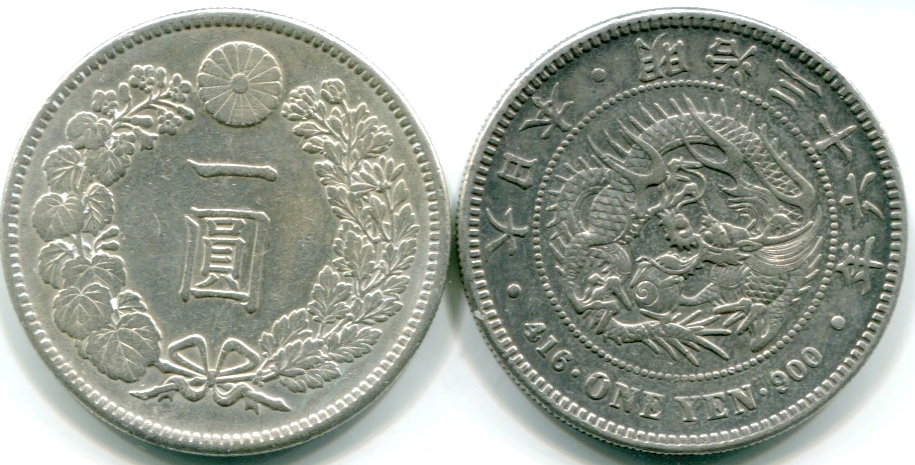 The
obverse of the Japanese silver 1 Yen depicts the Japanese Imperial
Dragon within a beaded circle. Along is the edge is the date
in the Japanese Imperial Calendar and "416 1 Yen 900" in English. 416
is the weight of the coin in grains (equivalent to 26.96 grams) and 900
is the purity of the silver. The reverse has the denomination in
Japanese within a wreath of paulownia flowers and the Japanese Imperial
Chrysanthemum emblem. The 38.1mm coin contains .780 troy ounces of
silver, slightly less than the Mexican Peso (.786 troy ounces) that was
widely used in the Orient. Japan demonetized the silver Yen
for use in Japan in 1897 but continued to strike the coins for use in
Japanese occupied Taiwan, Korea and Royjun (also known as Lushunkou or
Port Arthur) until 1914.
The
obverse of the Japanese silver 1 Yen depicts the Japanese Imperial
Dragon within a beaded circle. Along is the edge is the date
in the Japanese Imperial Calendar and "416 1 Yen 900" in English. 416
is the weight of the coin in grains (equivalent to 26.96 grams) and 900
is the purity of the silver. The reverse has the denomination in
Japanese within a wreath of paulownia flowers and the Japanese Imperial
Chrysanthemum emblem. The 38.1mm coin contains .780 troy ounces of
silver, slightly less than the Mexican Peso (.786 troy ounces) that was
widely used in the Orient. Japan demonetized the silver Yen
for use in Japan in 1897 but continued to strike the coins for use in
Japanese occupied Taiwan, Korea and Royjun (also known as Lushunkou or
Port Arthur) until 1914. The
Kathiri Sultans controlled the towns of Seiyun and Tarim in what is
now Yemen. After losing much of their territory to rival tribes they
agreed to become a British Protectorate. Seiyun was the capital, and
Tarim is a major center of Islamic learning. In 1897 they had
this silver 12 Khumsi coins struck at the Heaton Mint for their
territory. The coin is all in Arabic, except for the Heaton
mintmark and are dated AH1315. 12 Khumsi was
equivalent to
1/10 Riyal. The coin is 18mm in diameter. It is a rarely seen coin from
a now forgotten nation.
The
Kathiri Sultans controlled the towns of Seiyun and Tarim in what is
now Yemen. After losing much of their territory to rival tribes they
agreed to become a British Protectorate. Seiyun was the capital, and
Tarim is a major center of Islamic learning. In 1897 they had
this silver 12 Khumsi coins struck at the Heaton Mint for their
territory. The coin is all in Arabic, except for the Heaton
mintmark and are dated AH1315. 12 Khumsi was
equivalent to
1/10 Riyal. The coin is 18mm in diameter. It is a rarely seen coin from
a now forgotten nation. The
Mauritius 1938 Quarter Rupee was struck only that single
year. The 19mm is struck in .916 fine silver and contains.
.086 troy ounces of silver. The crowned head of King George
VI is on the obverse. The reverse reflects Mauritius'
heritage. At the top is the British crown. To the
left is a stylized lotus flower, representing Indian
influence. About 70% of Mauritius' population has Indian
ancestry. Below is a Fleur-de-lis, representing the French
influence. France controlled Mauritius for almost a century
until British took control in the Napoleonic Wars. French
still is widely spoken. To the left is a Tudor Rose,
representing the English influence. Following World
War II and the lowering of the silver content of the Indian Rupee,
Mauritius again issued the 1/4 Rupee with the same design, however the
silver content was reduced to .500 fine with a silver content of .0469
troy ounces. That coin was struck only a single year:
1946. It was the last silver 1/4 Rupee issued by Mauritius. ATTRACTIVE
WWII ERA MEXICAN SILVER PESO
The
Mauritius 1938 Quarter Rupee was struck only that single
year. The 19mm is struck in .916 fine silver and contains.
.086 troy ounces of silver. The crowned head of King George
VI is on the obverse. The reverse reflects Mauritius'
heritage. At the top is the British crown. To the
left is a stylized lotus flower, representing Indian
influence. About 70% of Mauritius' population has Indian
ancestry. Below is a Fleur-de-lis, representing the French
influence. France controlled Mauritius for almost a century
until British took control in the Napoleonic Wars. French
still is widely spoken. To the left is a Tudor Rose,
representing the English influence. Following World
War II and the lowering of the silver content of the Indian Rupee,
Mauritius again issued the 1/4 Rupee with the same design, however the
silver content was reduced to .500 fine with a silver content of .0469
troy ounces. That coin was struck only a single year:
1946. It was the last silver 1/4 Rupee issued by Mauritius. ATTRACTIVE
WWII ERA MEXICAN SILVER PESO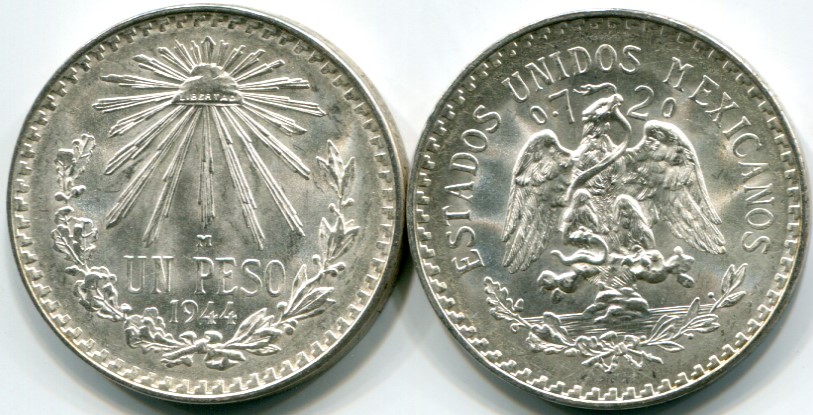 The
silver Peso was the workhorse of the Mexican economy. Mexico's economy
soared during World War II as it produced agricultural products and raw
materials needed for the war effort and its workers found jobs in the
United States, replacing men who were fighting overseas.
These Mexican silver Pesos date from 1940 to 1945. One side features
the Mexican eagle on a cactus eating a snake. The numerals
“0.7 20”, indicating the silver content of the coin (.720 fine silver)
is on either side of the head of the eagle. The other side
has the denomination within a wreath and a rayed liberty cap above. The
34mm coin contains .3857 troy ounces of silver.
The
silver Peso was the workhorse of the Mexican economy. Mexico's economy
soared during World War II as it produced agricultural products and raw
materials needed for the war effort and its workers found jobs in the
United States, replacing men who were fighting overseas.
These Mexican silver Pesos date from 1940 to 1945. One side features
the Mexican eagle on a cactus eating a snake. The numerals
“0.7 20”, indicating the silver content of the coin (.720 fine silver)
is on either side of the head of the eagle. The other side
has the denomination within a wreath and a rayed liberty cap above. The
34mm coin contains .3857 troy ounces of silver.
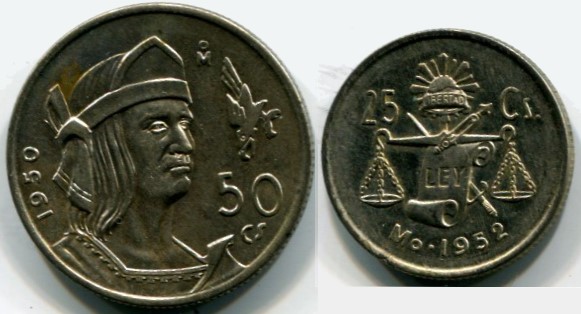 Mexico
introduced new 25 and 50 Centavo coins in 1950. The coin was
made from an unusual silver alloy of 30% silver, 50% copper, 10% nickel
and 10% zinc. Unlike the previous Mexican silver coin, the coins do not
display their weight and fineness, possibly because they had such a low
silver content. The 50 Centavo depicts Cuauhtemoc, the last
Aztec Emperor, looking at a descending eagle. His name means
"one who has descended like an eagle". The coin was struck
only two years, 1950 and 1951. It contains .0642 troy ounces
of silver. The 25 Centavos was the first time that
denomination had been issued since 1892. The coin uses the
"balance of justice" design that was previously employed on 19th
century Mexican gold and silver coins. The coin was unpopular
and was discontinued after only four years. The 25 Centavos
contains .0321 troy ounces of silver. Both coins feature the
Mexican Eagle eating a snake on the obverse.
Mexico
introduced new 25 and 50 Centavo coins in 1950. The coin was
made from an unusual silver alloy of 30% silver, 50% copper, 10% nickel
and 10% zinc. Unlike the previous Mexican silver coin, the coins do not
display their weight and fineness, possibly because they had such a low
silver content. The 50 Centavo depicts Cuauhtemoc, the last
Aztec Emperor, looking at a descending eagle. His name means
"one who has descended like an eagle". The coin was struck
only two years, 1950 and 1951. It contains .0642 troy ounces
of silver. The 25 Centavos was the first time that
denomination had been issued since 1892. The coin uses the
"balance of justice" design that was previously employed on 19th
century Mexican gold and silver coins. The coin was unpopular
and was discontinued after only four years. The 25 Centavos
contains .0321 troy ounces of silver. Both coins feature the
Mexican Eagle eating a snake on the obverse. This
2007 unofficial 2500 Franc pattern was issued for Niger to commemorate
the 100th Anniversary of Great Britain outlawing slavery. The
obverse depicts John Brown. Brown was a radical American abolitionist
who led several violent anti-slavery confrontations in Bleeding Kansas
uprisings in the late 1850's. In 1859 he led a raid on the
Federal Amory in Harper's Ferry, Virginia hoping to spark a widespread
slave revolt. He was captured and hanged. The arms of Niger
is on the reverse. The 27.3mm coin is 1/4 troy ounce of .999 silver and
has a mintage of only 850 pieces.
This
2007 unofficial 2500 Franc pattern was issued for Niger to commemorate
the 100th Anniversary of Great Britain outlawing slavery. The
obverse depicts John Brown. Brown was a radical American abolitionist
who led several violent anti-slavery confrontations in Bleeding Kansas
uprisings in the late 1850's. In 1859 he led a raid on the
Federal Amory in Harper's Ferry, Virginia hoping to spark a widespread
slave revolt. He was captured and hanged. The arms of Niger
is on the reverse. The 27.3mm coin is 1/4 troy ounce of .999 silver and
has a mintage of only 850 pieces. 
 In
1921 Sweden
commemorated the 400th Anniversary of Gustav Vasa's Liberation
War on a silver 2 Kronor. The wars which began in 1521,
resulted in Sweden gaining
its independence from the King of Denmark and Gustav Vasa becoming the
King of Sweden. The obverse depicts Gustav Vasa.
The arms of Sweden are on the reverse. The 31mm coin is struck in .800
fine silver
and contain .3858 troy ounces of silver. TABLE OF
CONTENTS FOR THE INTERESTING STUFF CATALOG
ALPHABETICAL LISTING OF
COINS AND BANKNOTES IN THE INTERESTING STUFF CATALOGWEB SITE MAP & SEARCH
ENGINESECURE ON-LINE CREDIT CARD ORDER PAGE
ORDERING INFORMATION
In
1921 Sweden
commemorated the 400th Anniversary of Gustav Vasa's Liberation
War on a silver 2 Kronor. The wars which began in 1521,
resulted in Sweden gaining
its independence from the King of Denmark and Gustav Vasa becoming the
King of Sweden. The obverse depicts Gustav Vasa.
The arms of Sweden are on the reverse. The 31mm coin is struck in .800
fine silver
and contain .3858 troy ounces of silver. TABLE OF
CONTENTS FOR THE INTERESTING STUFF CATALOG
ALPHABETICAL LISTING OF
COINS AND BANKNOTES IN THE INTERESTING STUFF CATALOGWEB SITE MAP & SEARCH
ENGINESECURE ON-LINE CREDIT CARD ORDER PAGE
ORDERING INFORMATION