COINS OF AMERICAN
INDIAN NATIONSCOINS
OF
WESTEROS - GAME OF THRONES
COINS OF AMERICAN
INDIAN NATIONSCOINS
OF
WESTEROS - GAME OF THRONES WA
COIN DEPICTS ELEPHANT RIDER
WA
COIN DEPICTS ELEPHANT RIDER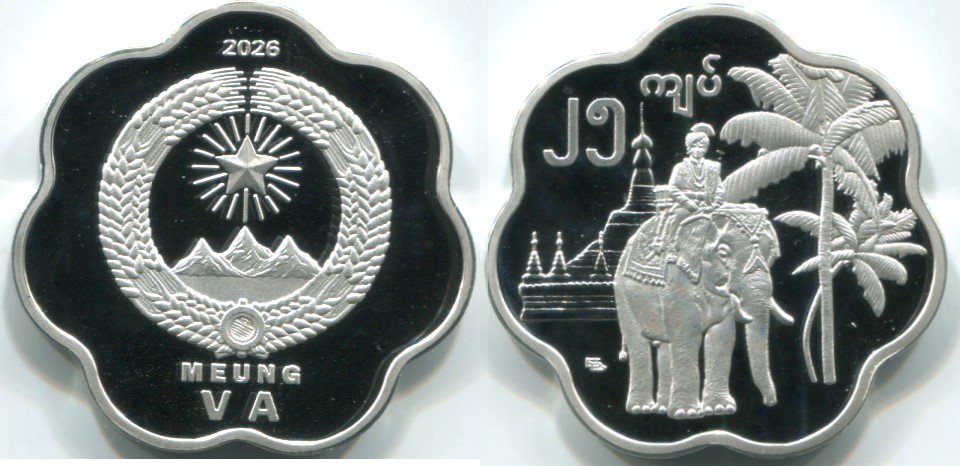 Wa is a de
facto independent nation that controls two areas of eastern
Myanmar. It has its own army, flag, language and does not
accept Myanmar Kyat as legal tender. It is divided into two
regions separated by about 250 miles (400km). The northern
area bordering China is the traditional Wa homeland. It is
noted for providing gambling and prostitution to Chinese tourists. It
gained control of its southern area bordering Thailand in the 1990's
when it overthrew a local drug warlord. After gaining control it
forcibly resettled 80,000 former opium farmers from the north to the
more fertile south to grow food. The obverse of this unofficial Wa 2026
dated 25 Kyats depicts the Wa coat of arms. The reverse
depicts and elephant rider and a temple. The 39mm silver-plated Proof
coin has a mintage of only 110 pieces. COIN
OF ANJOUAN
Wa is a de
facto independent nation that controls two areas of eastern
Myanmar. It has its own army, flag, language and does not
accept Myanmar Kyat as legal tender. It is divided into two
regions separated by about 250 miles (400km). The northern
area bordering China is the traditional Wa homeland. It is
noted for providing gambling and prostitution to Chinese tourists. It
gained control of its southern area bordering Thailand in the 1990's
when it overthrew a local drug warlord. After gaining control it
forcibly resettled 80,000 former opium farmers from the north to the
more fertile south to grow food. The obverse of this unofficial Wa 2026
dated 25 Kyats depicts the Wa coat of arms. The reverse
depicts and elephant rider and a temple. The 39mm silver-plated Proof
coin has a mintage of only 110 pieces. COIN
OF ANJOUAN 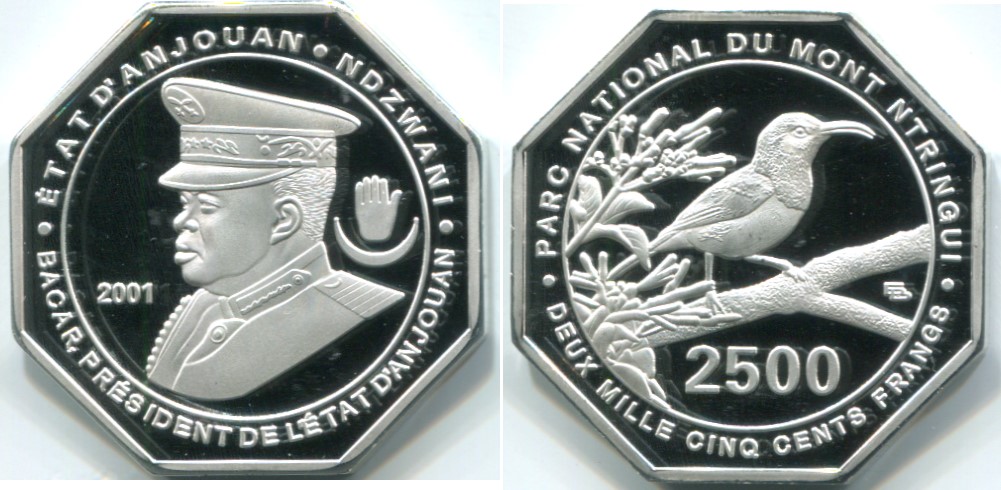 Anjouan
is a 163 square mile (424sq.km) island in the Indian Ocean
with a population of about 280,000. Anjouan was made part of the
Comoros when Comoros gained independence from France in 1975. Since
then, Anjouan has suffered from over 20 attempted coups and several
attempts at secession. In 2001 former Chief of Police Colonel
Mohamed Bacar took control of the government in a coup and tried to
rule it as an independent nation. In 2008 combined forces of Comoros
and the African Union again took control over the island. Bacar escaped
dressed as a woman in a speed boat. This unofficial 2026
silver-plated Proof 2500 Francs of Anjouan depicts Bacar on the
obverse. The reverse depicts an Anjouan sunbird and
commemorates Mount Ntringui National Park. The 8-sided coin
has a mintage of only 110 pieces.SQUARE ARABISTAN COIN DEPICTS
LEOPARDS
Anjouan
is a 163 square mile (424sq.km) island in the Indian Ocean
with a population of about 280,000. Anjouan was made part of the
Comoros when Comoros gained independence from France in 1975. Since
then, Anjouan has suffered from over 20 attempted coups and several
attempts at secession. In 2001 former Chief of Police Colonel
Mohamed Bacar took control of the government in a coup and tried to
rule it as an independent nation. In 2008 combined forces of Comoros
and the African Union again took control over the island. Bacar escaped
dressed as a woman in a speed boat. This unofficial 2026
silver-plated Proof 2500 Francs of Anjouan depicts Bacar on the
obverse. The reverse depicts an Anjouan sunbird and
commemorates Mount Ntringui National Park. The 8-sided coin
has a mintage of only 110 pieces.SQUARE ARABISTAN COIN DEPICTS
LEOPARDS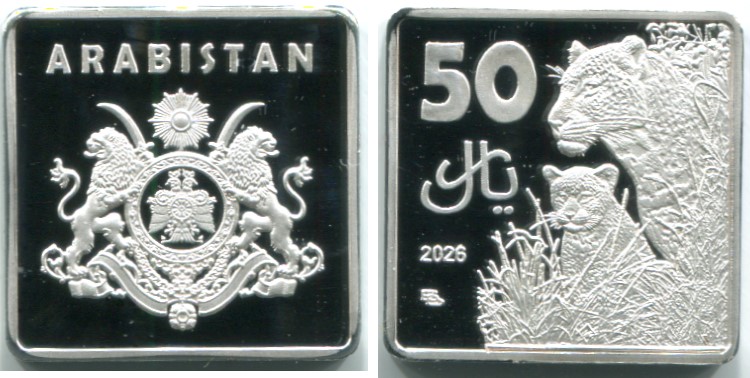 Arabistan
is a territory extending from the northern end of the Persian Gulf to
south of the Strait of Hormuz in Iran. Much of the region had a history
of autonomy under the Ottoman and later under the
Persians. A majority of its inhabitants are Arabs
who face discrimination from the Persians who rule Iran.
Since it was formally incorporated into Iran in 1925 there have been
multiple conflicts fighting for Arabistan independence or autonomy.
Because the territory includes much of Iran's oil fields, access to the
Persian Gulf and control of the Strait of Hormuz it is unlikely to
happen. This unofficial 2026 square Arabistan 50 Rials depicts the coat
of arms on the obverse. The reverse features a Persian
Leopard and her cub. The 30mm silver-plated Proof con has a mintage of
110. ODD-SHAPED
TOORO KINGDOM COIN FEATURES ELEPHANT AND HIPPO
Arabistan
is a territory extending from the northern end of the Persian Gulf to
south of the Strait of Hormuz in Iran. Much of the region had a history
of autonomy under the Ottoman and later under the
Persians. A majority of its inhabitants are Arabs
who face discrimination from the Persians who rule Iran.
Since it was formally incorporated into Iran in 1925 there have been
multiple conflicts fighting for Arabistan independence or autonomy.
Because the territory includes much of Iran's oil fields, access to the
Persian Gulf and control of the Strait of Hormuz it is unlikely to
happen. This unofficial 2026 square Arabistan 50 Rials depicts the coat
of arms on the obverse. The reverse features a Persian
Leopard and her cub. The 30mm silver-plated Proof con has a mintage of
110. ODD-SHAPED
TOORO KINGDOM COIN FEATURES ELEPHANT AND HIPPO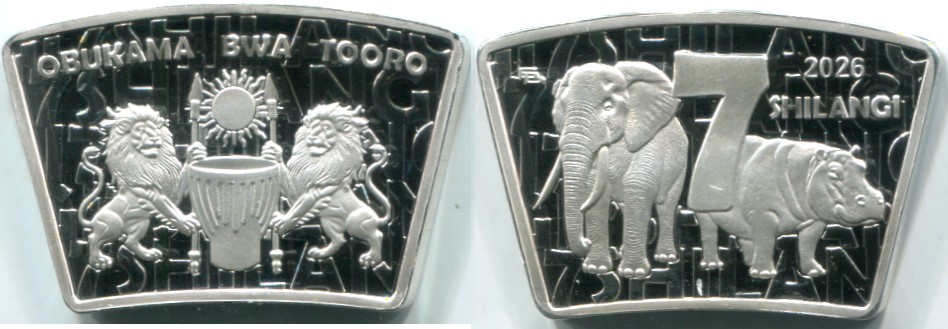 The Tooro Kingdom is a Bantu kingdom
located in western Uganda. It was founded in 1830. Uganda
abolished the monarchy in 1967 but reinstated it in 1993. The
king is a unifying figure over his people. He holds cultural,
traditional, and ceremonial power rather than formal political
authority. One side of this unofficial 2026 Tooro Kingdom 7
Shilangi depicts an elephant and a hippopotamus on one side and the
coat of arms supported by two lions on the other. The odd-shaped 39mm
silver-plated Proof coin has a mintage of just 110 pieces.PROBOSCIS
MONKEY ON SABAH COIN
The Tooro Kingdom is a Bantu kingdom
located in western Uganda. It was founded in 1830. Uganda
abolished the monarchy in 1967 but reinstated it in 1993. The
king is a unifying figure over his people. He holds cultural,
traditional, and ceremonial power rather than formal political
authority. One side of this unofficial 2026 Tooro Kingdom 7
Shilangi depicts an elephant and a hippopotamus on one side and the
coat of arms supported by two lions on the other. The odd-shaped 39mm
silver-plated Proof coin has a mintage of just 110 pieces.PROBOSCIS
MONKEY ON SABAH COIN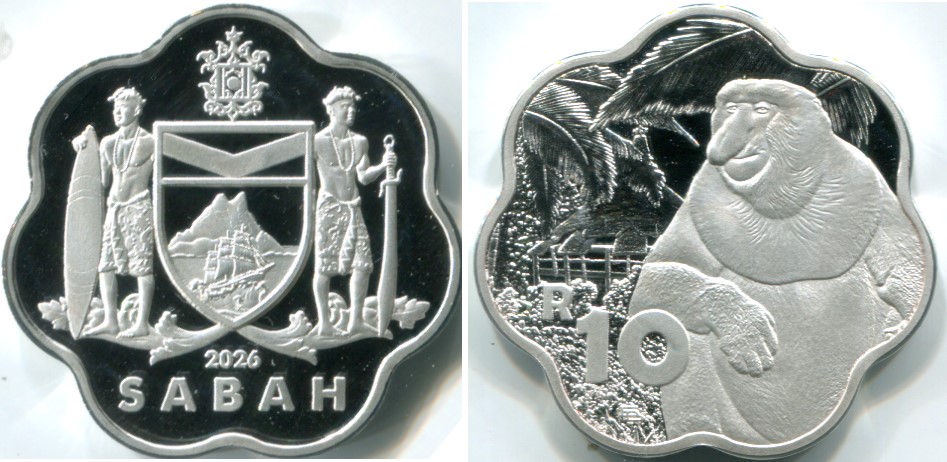 A
relaxed looking Proboscis Monkey (Nasalis larvatus) is featured on this
unofficial 2026 10 Ringgit of Sabah. The obverse features the
coat of arms. Sabah is located at the north-eastern end of the island
of Borneo. It is controlled by Malaysia, though the
Philippines and the self-proclaimed Sultan of Sulu both claim
sovereignty over the territory. In 1878 the Sultan of Sulu
signed a treaty with the British North Borneo Company.
Philippines and the Sultan of Sulu claim it was only leased the
territory. Malaysia claims the territory was ceded.
The dispute centers on an ambiguous Malay term "pajakkan", that could
be translated as "lease" or "cede". Philippines claims it is
the successor of the Sultans of Sulu. In 2013 followers of
the Sultan attempted an invasion of Sabah, resulting in 72
deaths. Since then, the Sultan and his family have brought
lawsuits in courts around the world in an attempt to assert their claim
to Sabah. The silver-plated Proof coin has a mintage of only 110 pieces.FREE
AND SOVEREIGN STATE OF CHIAPAS
A
relaxed looking Proboscis Monkey (Nasalis larvatus) is featured on this
unofficial 2026 10 Ringgit of Sabah. The obverse features the
coat of arms. Sabah is located at the north-eastern end of the island
of Borneo. It is controlled by Malaysia, though the
Philippines and the self-proclaimed Sultan of Sulu both claim
sovereignty over the territory. In 1878 the Sultan of Sulu
signed a treaty with the British North Borneo Company.
Philippines and the Sultan of Sulu claim it was only leased the
territory. Malaysia claims the territory was ceded.
The dispute centers on an ambiguous Malay term "pajakkan", that could
be translated as "lease" or "cede". Philippines claims it is
the successor of the Sultans of Sulu. In 2013 followers of
the Sultan attempted an invasion of Sabah, resulting in 72
deaths. Since then, the Sultan and his family have brought
lawsuits in courts around the world in an attempt to assert their claim
to Sabah. The silver-plated Proof coin has a mintage of only 110 pieces.FREE
AND SOVEREIGN STATE OF CHIAPAS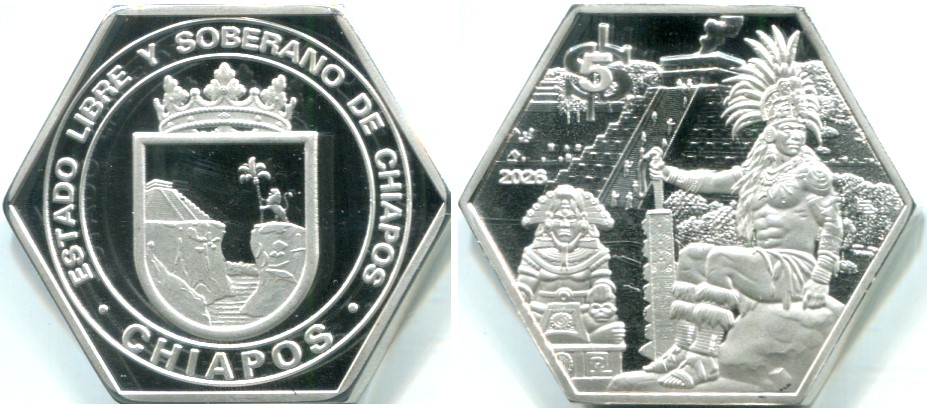 Chiapas
is southernmost state in Mexico, bordering Guatemala and the Pacific
Ocean. Being isolated and distant from the capital of Mexico
City, Chiapas has a long history of revolts and uprisings.
During the Mexican War of Independence, it attempted to become an
independent nation, but was later reincorporated into Mexico. The
border between Mexico and Guatemala was not settled until
1882. Though the Mexican Revolution officially ended in 1920,
fighting for control of Chiapas continued until 1936. The leftist
guerrilla group called the Zapatista Army of National Liberation has
controlled a significant portion of Chiapas since 1994. The Marxist
movement includes "independence" as part of their demands.
This unofficial 2026 5 Peso coin of the Free and Sovereign State of
Chiapas depicts the coat of arms on the obverse and a Mayan in front of
a pyramid on the reverse. The six-sided, 39mm, silver plated Proof coin
has a mintage of just 110 pieces.DRUZE
WARRIOR ON SWEIDA COIN
Chiapas
is southernmost state in Mexico, bordering Guatemala and the Pacific
Ocean. Being isolated and distant from the capital of Mexico
City, Chiapas has a long history of revolts and uprisings.
During the Mexican War of Independence, it attempted to become an
independent nation, but was later reincorporated into Mexico. The
border between Mexico and Guatemala was not settled until
1882. Though the Mexican Revolution officially ended in 1920,
fighting for control of Chiapas continued until 1936. The leftist
guerrilla group called the Zapatista Army of National Liberation has
controlled a significant portion of Chiapas since 1994. The Marxist
movement includes "independence" as part of their demands.
This unofficial 2026 5 Peso coin of the Free and Sovereign State of
Chiapas depicts the coat of arms on the obverse and a Mayan in front of
a pyramid on the reverse. The six-sided, 39mm, silver plated Proof coin
has a mintage of just 110 pieces.DRUZE
WARRIOR ON SWEIDA COIN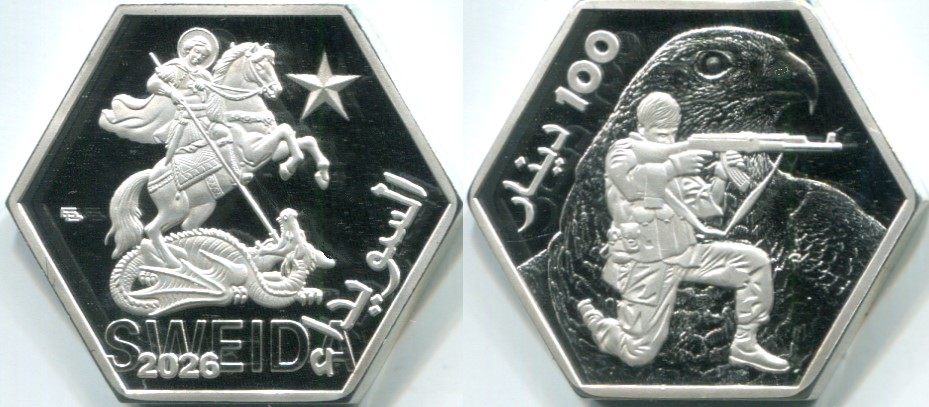 On
September 21, 2025, Ayoub Kara, an ethnic Druze and former member of
the Israeli Knesset, declared Sweida, (also known as Suwayda) an
independent state, seceding from Syria. It is the main Druze city in
Syria and is famous for its Byzantine mosaic museums and a Roman road,
still in use. It suffered greatly during the Syrian Civil War. In 2018
ISIS militants stormed the city resulting in 246 deaths and kidnapping
46
Druze residents. In 2025 fierce fighting broke out between Druze and
Bedouins resulting in more than 600 Druze reportedly being killed.
Israel has supported the Druze due to their close ties with the Israeli
Druze and to help protect their borders by stopping the deployment of
Syrian forces and weapons. The obverse of the unofficial
Sweida 2026 100 Dinars depicts Saint George slaying the
dragon. Saint George is a revered figure in Druze culture,
signifying the triumph of good over evil. The reverse a Druze
warrior and the head of a hawk. The silver-plated Proof coin has a
mintage of only 110 pieces.
On
September 21, 2025, Ayoub Kara, an ethnic Druze and former member of
the Israeli Knesset, declared Sweida, (also known as Suwayda) an
independent state, seceding from Syria. It is the main Druze city in
Syria and is famous for its Byzantine mosaic museums and a Roman road,
still in use. It suffered greatly during the Syrian Civil War. In 2018
ISIS militants stormed the city resulting in 246 deaths and kidnapping
46
Druze residents. In 2025 fierce fighting broke out between Druze and
Bedouins resulting in more than 600 Druze reportedly being killed.
Israel has supported the Druze due to their close ties with the Israeli
Druze and to help protect their borders by stopping the deployment of
Syrian forces and weapons. The obverse of the unofficial
Sweida 2026 100 Dinars depicts Saint George slaying the
dragon. Saint George is a revered figure in Druze culture,
signifying the triumph of good over evil. The reverse a Druze
warrior and the head of a hawk. The silver-plated Proof coin has a
mintage of only 110 pieces.
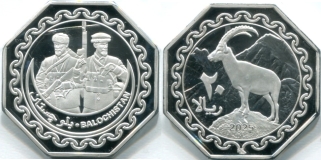 Balochistan
is a historic region on the north coast of the Indian
Ocean. It lies
on the critical route connecting India with Persia. As a
result, it
has been the scene of numerous fierce battles for control of the
region, usually to the detriment of the traditionally nomadic
Balochs.. It is currently divided between Pakistan, Iran and
Afghanistan. In recent years there were uprisings in 1948,
1958-59,
1962-63, 1973-77 and a low level insurgency since 2003 in an effort to
gain independence or greater autonomy. This unofficial 2025
Balochistan 20 Rials depicts soldiers of the Balochistan Liberation
Army on the obverse and a Siberian Ibex (Capra sibirica) on the
reverse. . The 40mm, eight-sided, silver plated
Proof coin has a
mintage of just 110 pieces.
Balochistan
is a historic region on the north coast of the Indian
Ocean. It lies
on the critical route connecting India with Persia. As a
result, it
has been the scene of numerous fierce battles for control of the
region, usually to the detriment of the traditionally nomadic
Balochs.. It is currently divided between Pakistan, Iran and
Afghanistan. In recent years there were uprisings in 1948,
1958-59,
1962-63, 1973-77 and a low level insurgency since 2003 in an effort to
gain independence or greater autonomy. This unofficial 2025
Balochistan 20 Rials depicts soldiers of the Balochistan Liberation
Army on the obverse and a Siberian Ibex (Capra sibirica) on the
reverse. . The 40mm, eight-sided, silver plated
Proof coin has a
mintage of just 110 pieces. The
Republic of Independent Guiana, also known as the Cunani Republic,
after the name of its capital, was a series of self-proclaimed nations
in the late 19th and early 20th century that were located in what is
now northern Brazil. At the time the area was claimed by both
France and Brazil, but controlled by neither. The first
republic was established by French journalist Jules Gros in 1886,
consisting primarily of adventurers and escaped slaves. In 1887 French
troops shut down the Republic, but it re-established itself later that
year after the troops left the area. Brazilian troops invaded
and shut down the Republic in 1891, only to pop up again a short time
later. Despite the territory having been formally awarded to
Brazil in 1900, the Republic continued to assert authority in the area
and briefly received diplomatic recognition from the Boer Republic,
Belgium, Japan and Russia. The republic faded out during
World War I. In the 1990's an attempt to revive the republic
and assert independence from Brazil also fizzled out. This
unofficial Republic of Independent Guiana 2026 50 Amero depicts a
galleon on one side and a capybara on the other. The six-sided, 39mm,
silver plated Proof coin has a mintage of just 110 pieces.
The
Republic of Independent Guiana, also known as the Cunani Republic,
after the name of its capital, was a series of self-proclaimed nations
in the late 19th and early 20th century that were located in what is
now northern Brazil. At the time the area was claimed by both
France and Brazil, but controlled by neither. The first
republic was established by French journalist Jules Gros in 1886,
consisting primarily of adventurers and escaped slaves. In 1887 French
troops shut down the Republic, but it re-established itself later that
year after the troops left the area. Brazilian troops invaded
and shut down the Republic in 1891, only to pop up again a short time
later. Despite the territory having been formally awarded to
Brazil in 1900, the Republic continued to assert authority in the area
and briefly received diplomatic recognition from the Boer Republic,
Belgium, Japan and Russia. The republic faded out during
World War I. In the 1990's an attempt to revive the republic
and assert independence from Brazil also fizzled out. This
unofficial Republic of Independent Guiana 2026 50 Amero depicts a
galleon on one side and a capybara on the other. The six-sided, 39mm,
silver plated Proof coin has a mintage of just 110 pieces.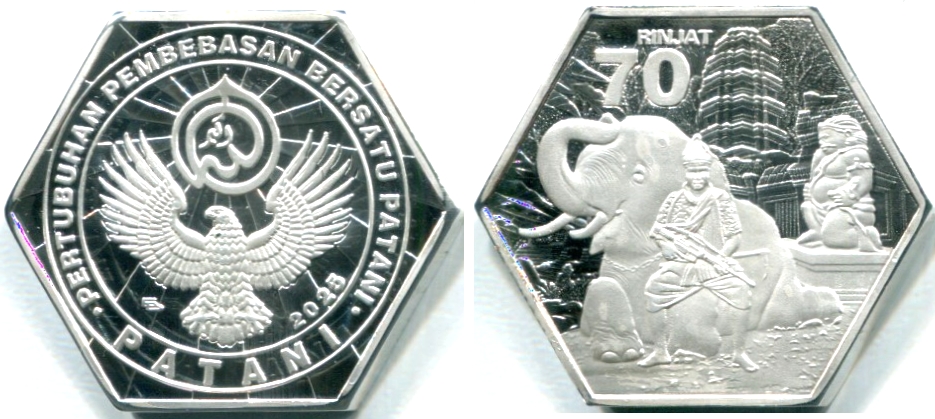 Patani was once a powerful Muslim
Sultanate that included southern Thailand and northern
Malaysia. Siam conquered it in 1786, gradually made it part
of Thailand and imposed Thai-Buddhist law and practices. In recent
years militants fighting for an independent Patani or incorporating
into Malayia have made much of the region largely
ungovernable. The obverse of this unofficial 2025 Patani 70
Rinjat coin depicts the Patani coat of arms. The reverse
features an armed rebel with an elephant in front of an ancient Hindu
temple and a dvarapala (gate keeper) statue. The six-sided,
39mm silver plated Proof coin has a mintage of only 110 pieces.
Patani was once a powerful Muslim
Sultanate that included southern Thailand and northern
Malaysia. Siam conquered it in 1786, gradually made it part
of Thailand and imposed Thai-Buddhist law and practices. In recent
years militants fighting for an independent Patani or incorporating
into Malayia have made much of the region largely
ungovernable. The obverse of this unofficial 2025 Patani 70
Rinjat coin depicts the Patani coat of arms. The reverse
features an armed rebel with an elephant in front of an ancient Hindu
temple and a dvarapala (gate keeper) statue. The six-sided,
39mm silver plated Proof coin has a mintage of only 110 pieces. An
Argentinosaurus
dinosaur (Argentinosaurus
huinculensis) in a forest is depicted on the
unofficial 2025 10 Austral
issued for the Kingdom of Araucania and Patagonia. The coat
of arms is
on the obverse. The Argentinosaurus is one of the largest
land animals
of all time. It is estimated to be about 100 feet long (31m)
and weighs
72 to 88 tons (65–80 metric tonnes). It was first discovered
in 1987
and only fragmentary remains have been found so much about it is
uncertain.
ARAUCANIA-PATAGONIA 87 PESOS 2014
An
Argentinosaurus
dinosaur (Argentinosaurus
huinculensis) in a forest is depicted on the
unofficial 2025 10 Austral
issued for the Kingdom of Araucania and Patagonia. The coat
of arms is
on the obverse. The Argentinosaurus is one of the largest
land animals
of all time. It is estimated to be about 100 feet long (31m)
and weighs
72 to 88 tons (65–80 metric tonnes). It was first discovered
in 1987
and only fragmentary remains have been found so much about it is
uncertain.
ARAUCANIA-PATAGONIA 87 PESOS 2014
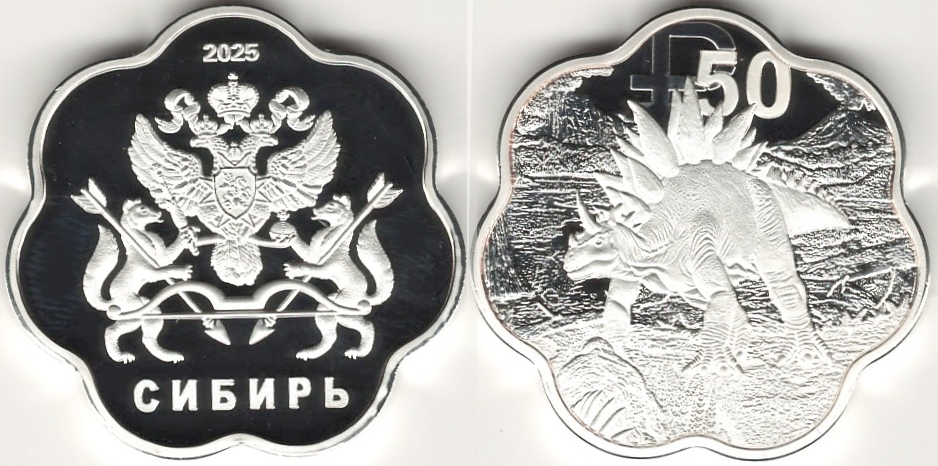 A
Stegosaurus is featured on this unofficial 2025 dated 50 Ruble coin of
Siberia. The dinosaur once roamed Siberia. One of
the oldest stegosaur skeletons dating from the Middle Jurassic period
(about 175 million years ago) was found in the Berezovsk Quarry in
western Siberia. The obverse of the coin features the
Siberian coat of arms. Russia gradually took control of
Siberia between the late 15th and early 18th centuries. Since
then, there have been various attempts to form an independent
Siberia. It briefly achieved independence after the collapse
of the Czarist government in Russia. Ideas for political
independence have resurfaced periodically since the collapse of the
Soviet Union. The odd-shaped 39mm silver-plated Proof coin
has a mintage of only 115 pieces.
A
Stegosaurus is featured on this unofficial 2025 dated 50 Ruble coin of
Siberia. The dinosaur once roamed Siberia. One of
the oldest stegosaur skeletons dating from the Middle Jurassic period
(about 175 million years ago) was found in the Berezovsk Quarry in
western Siberia. The obverse of the coin features the
Siberian coat of arms. Russia gradually took control of
Siberia between the late 15th and early 18th centuries. Since
then, there have been various attempts to form an independent
Siberia. It briefly achieved independence after the collapse
of the Czarist government in Russia. Ideas for political
independence have resurfaced periodically since the collapse of the
Soviet Union. The odd-shaped 39mm silver-plated Proof coin
has a mintage of only 115 pieces.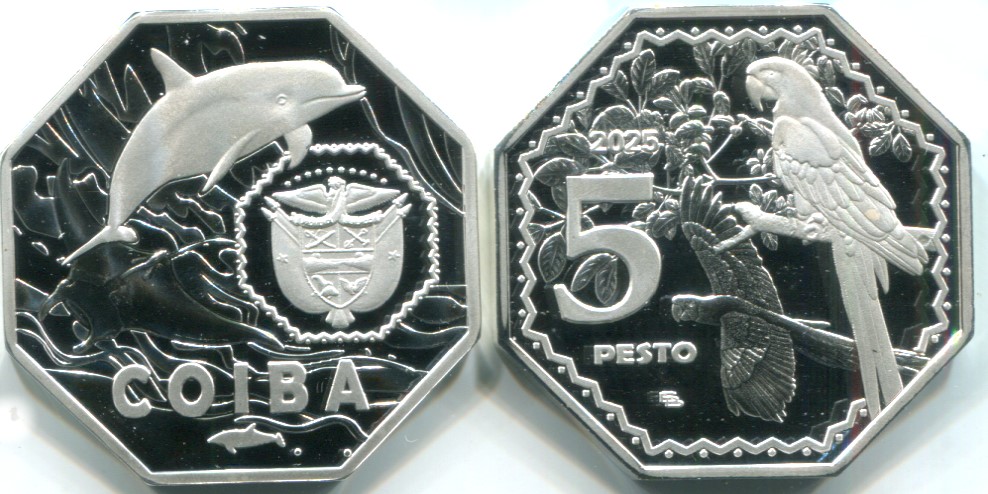 Coiba is an island off the western
coast of Panama. The original inhabitants were enslaved by the Spanish
in 1560. Panama operated brutal prison on the island from
1919 until 2004. Now Coiba and nearby islands are a national
park. Because the it separated from the mainland 12,000 to
18,000 years ago, it is the home of many endemic subspecies which are
only found on the island. The obverse of this unofficial 2025
Coiba 5 Pesto coin features a dolphin, a stingray and the Panamanian
coat of arms. The reverse depicts Scarlet
Macaws. The eight sided, 40mm, silver-plated brass
coin has a mintage of only 110 pieces.
Coiba is an island off the western
coast of Panama. The original inhabitants were enslaved by the Spanish
in 1560. Panama operated brutal prison on the island from
1919 until 2004. Now Coiba and nearby islands are a national
park. Because the it separated from the mainland 12,000 to
18,000 years ago, it is the home of many endemic subspecies which are
only found on the island. The obverse of this unofficial 2025
Coiba 5 Pesto coin features a dolphin, a stingray and the Panamanian
coat of arms. The reverse depicts Scarlet
Macaws. The eight sided, 40mm, silver-plated brass
coin has a mintage of only 110 pieces. Ogaden is the eastern portion of
Ethiopia, surrounded on two sides by Somalia. Most of its
inhabitants are Muslim Somalis. Conflict over control of the
area between Ethiopia and the Somalis has been going on for
centuries. Both sides have been indiscriminate in their
attacks and killings. The obverse of this unofficial 2025
Ogaden 1000 Lacag features the Ogaden coat of arms. The reverse depicts
a warrior with a bow and arrow and the head of a lion. The
39mm silver-plated Proof coin has a scalloped edge. Only 115
pieces were minted.
Ogaden is the eastern portion of
Ethiopia, surrounded on two sides by Somalia. Most of its
inhabitants are Muslim Somalis. Conflict over control of the
area between Ethiopia and the Somalis has been going on for
centuries. Both sides have been indiscriminate in their
attacks and killings. The obverse of this unofficial 2025
Ogaden 1000 Lacag features the Ogaden coat of arms. The reverse depicts
a warrior with a bow and arrow and the head of a lion. The
39mm silver-plated Proof coin has a scalloped edge. Only 115
pieces were minted.


 Marie-Galante
is one of the islands that makes up Guadeloupe in the
Caribbean. Christopher Columbus discovered and anchored at
the island in 1793 on his second voyage. He named the island
after his flagship Marigalante (gallant Mary), which is pictured on the
reverse of the coin. The French first attempted to
settle the island in 1648. Sugar plantations worked by
African slaves became the mainstay of the economy by the late 17th
century. Over they years the island was controlled at various
times by the British, French Sweden and the Netherlands. At
the conclusion of the Seven-Years War in 1863 France gave French Canada
to the British in exchange for Guadeloupe. The sugar
plantations, run by slaves were seen as having far more value than the
wilderness of Canada. By 1818 there were over 100 sugar mills
on the island. In recent years the population has
dropped from over 30,000 in 1953 to less than 12,000 as many emigrated
due to the lack of opportunity on the small island. The
obverse depicts the head of an Arawak man as it appeared on Guadeloupe
coins issued in 1903 and 1921. This unofficial 2025
Marie-Galante 750 Franc coin has a mintage of just 120
pieces. The eight-sided, 40mm, silver-plated brass coin is
Proof.
Marie-Galante
is one of the islands that makes up Guadeloupe in the
Caribbean. Christopher Columbus discovered and anchored at
the island in 1793 on his second voyage. He named the island
after his flagship Marigalante (gallant Mary), which is pictured on the
reverse of the coin. The French first attempted to
settle the island in 1648. Sugar plantations worked by
African slaves became the mainstay of the economy by the late 17th
century. Over they years the island was controlled at various
times by the British, French Sweden and the Netherlands. At
the conclusion of the Seven-Years War in 1863 France gave French Canada
to the British in exchange for Guadeloupe. The sugar
plantations, run by slaves were seen as having far more value than the
wilderness of Canada. By 1818 there were over 100 sugar mills
on the island. In recent years the population has
dropped from over 30,000 in 1953 to less than 12,000 as many emigrated
due to the lack of opportunity on the small island. The
obverse depicts the head of an Arawak man as it appeared on Guadeloupe
coins issued in 1903 and 1921. This unofficial 2025
Marie-Galante 750 Franc coin has a mintage of just 120
pieces. The eight-sided, 40mm, silver-plated brass coin is
Proof.  Franceville
(now Port Vila) was a short-lived self-declared nation on the island of
Efate in what is now Vanuatu. In 1887, the Anglo-French Joint Naval
Commission took control of the territory, but did not provide a
functional local government. The lack of government and
conflicts between French and British laws made life
difficult. In August 1889 it declared itself and independent
commune. It was one of the first nations in history to
practice universal suffrage without distinction of sex or race, however
only white males (of which there were fewer than 50) could hold
office. The government was suppressed by the following year.
This unofficial 2025 Franceville 50 Watue depicts the national emblem
of Vanuatu on one side and a sailing ship on the other. The
square, 39mm silver-plated Proof coin has a mintage of only 120 pieces.
Franceville
(now Port Vila) was a short-lived self-declared nation on the island of
Efate in what is now Vanuatu. In 1887, the Anglo-French Joint Naval
Commission took control of the territory, but did not provide a
functional local government. The lack of government and
conflicts between French and British laws made life
difficult. In August 1889 it declared itself and independent
commune. It was one of the first nations in history to
practice universal suffrage without distinction of sex or race, however
only white males (of which there were fewer than 50) could hold
office. The government was suppressed by the following year.
This unofficial 2025 Franceville 50 Watue depicts the national emblem
of Vanuatu on one side and a sailing ship on the other. The
square, 39mm silver-plated Proof coin has a mintage of only 120 pieces.


 Item
NUMISMA-25 NUMISMA 60 NUMISMARU, 2025 PROOF
$24.00
Item
NUMISMA-25 NUMISMA 60 NUMISMARU, 2025 PROOF
$24.00 Hawar is
an archipelago in the Persian Gulf just off the coast of
Qatar. It was settled by a Bedouin clan in the early 19th
century. Ownership of islands were the center of a
territorial dispute between Bahrain and Qatar that was finally settled
by the International Court of Justice in 2001, with control of the
islands going to Bahrain. The islands are now uninhabited
other than a hotel and a police station on the main island.
One side of the this unofficial 5 Dihars of Hawar features an Osprey
and a Dugong. The coat of arms is on the other
side.
The 2025 dated six-sided silver plated Proof coin has a mintage of only
120 pieces.
Hawar is
an archipelago in the Persian Gulf just off the coast of
Qatar. It was settled by a Bedouin clan in the early 19th
century. Ownership of islands were the center of a
territorial dispute between Bahrain and Qatar that was finally settled
by the International Court of Justice in 2001, with control of the
islands going to Bahrain. The islands are now uninhabited
other than a hotel and a police station on the main island.
One side of the this unofficial 5 Dihars of Hawar features an Osprey
and a Dugong. The coat of arms is on the other
side.
The 2025 dated six-sided silver plated Proof coin has a mintage of only
120 pieces. This
2025 dated 500 Francs of the Loyalty Islands (Iles Loyaute) depicts a
breaching whale as seen from the deck of a whaling ship. The
first recorded contact with the West was by British captain William
Raven of the whaling ship Britannia in 1793. The obverse of
the coin features a Fleche faitere, which is a carved rooftop spire
that adorns houses of Loyalty Island natives. The unofficial
eight-sided silver-plated Proof coin has a mintage of only 120 pieces.
This
2025 dated 500 Francs of the Loyalty Islands (Iles Loyaute) depicts a
breaching whale as seen from the deck of a whaling ship. The
first recorded contact with the West was by British captain William
Raven of the whaling ship Britannia in 1793. The obverse of
the coin features a Fleche faitere, which is a carved rooftop spire
that adorns houses of Loyalty Island natives. The unofficial
eight-sided silver-plated Proof coin has a mintage of only 120 pieces. Moorea
is a volcanic island that is part of French Polynesia about 11 miles
(17km) northwest of Tahiti. The obverse of this 2025 dated
500 Poe Rava of Moorea features a camakau sailing by a village nestled
below the mountains. A camakau is a large sailing outrigger that was
often used to travel long distances between islands. The
reverse features a pair of dolphins leaping from the
ocean, The unofficial silver-plated Proof coin has
a mintage of just 120 pieces.
Moorea
is a volcanic island that is part of French Polynesia about 11 miles
(17km) northwest of Tahiti. The obverse of this 2025 dated
500 Poe Rava of Moorea features a camakau sailing by a village nestled
below the mountains. A camakau is a large sailing outrigger that was
often used to travel long distances between islands. The
reverse features a pair of dolphins leaping from the
ocean, The unofficial silver-plated Proof coin has
a mintage of just 120 pieces.  Sanusiyya
was a political and religious order that that exerted control over
parts of north Africa in the 19th century, and led to the creation of
the Kingdom of Libya. It was founded in Mecca in 1837 by
Muhammad ibn Ali as-Sanusi to overcome what he believed was the decline
of Islamic thought and spirituality and to strengthen Muslim political
unity. After being forced our of Mecca it moved to Cyrenaica (eastern
Libya) and spread its influence over a significant part of North and
Central Africa. It fought against French, Italian and British
colonial rule. In World War II it assisted the British in
their fight against German and Italian forces in north Africa. In 1951,
the head of Senussi, Muhammad Idris (Idris I), the grandson of Muhammad
ibn Ali as-Senussi, became the King of Libya. This unofficial
Sanusiyya 2025 dated 70 Pounds coin features the Sanusiyya coat of arms
of on the obverse. The reverse depicts a lion and Omar al-Mukhtar, who
led the Sanusiyya resistance against the Italians in the early 20th
century and who is a national hero of Libya. The six-sided
silver-plated Proof coin has a mintage of 120 pieces.
Sanusiyya
was a political and religious order that that exerted control over
parts of north Africa in the 19th century, and led to the creation of
the Kingdom of Libya. It was founded in Mecca in 1837 by
Muhammad ibn Ali as-Sanusi to overcome what he believed was the decline
of Islamic thought and spirituality and to strengthen Muslim political
unity. After being forced our of Mecca it moved to Cyrenaica (eastern
Libya) and spread its influence over a significant part of North and
Central Africa. It fought against French, Italian and British
colonial rule. In World War II it assisted the British in
their fight against German and Italian forces in north Africa. In 1951,
the head of Senussi, Muhammad Idris (Idris I), the grandson of Muhammad
ibn Ali as-Senussi, became the King of Libya. This unofficial
Sanusiyya 2025 dated 70 Pounds coin features the Sanusiyya coat of arms
of on the obverse. The reverse depicts a lion and Omar al-Mukhtar, who
led the Sanusiyya resistance against the Italians in the early 20th
century and who is a national hero of Libya. The six-sided
silver-plated Proof coin has a mintage of 120 pieces. Sint
Maarten is the Dutch portion of the Caribbean Island of Saint Martin.
In 1648 the French and Dutch decided the island was not worth fighting
over, so divided it, with the northern portion going to France and the
southern portion to the Netherlands. The tiny island has
remained divided ever since. This unofficial square 2024 Sint
Maarten 10 Gulden depicts Netherlands King Willem-Alexander and the
coast of arms on the obverse. The reverse features a view of
an island and a cruise liner from an airplane window. The
silver-plated Proof coin has a mintage of only 120 pieces.
Sint
Maarten is the Dutch portion of the Caribbean Island of Saint Martin.
In 1648 the French and Dutch decided the island was not worth fighting
over, so divided it, with the northern portion going to France and the
southern portion to the Netherlands. The tiny island has
remained divided ever since. This unofficial square 2024 Sint
Maarten 10 Gulden depicts Netherlands King Willem-Alexander and the
coast of arms on the obverse. The reverse features a view of
an island and a cruise liner from an airplane window. The
silver-plated Proof coin has a mintage of only 120 pieces. One
of the famous and mysterious moai statues is featured on the obverse of
this 2007 Easter Island 1 Peso coin. A Bonito fish is on the
reverse. Easter Island, also known as Rapa Nui is controlled
by Chile. This unofficial 16.5mm nickel-plated brass coin has
a mintage of 9000 pieces.
One
of the famous and mysterious moai statues is featured on the obverse of
this 2007 Easter Island 1 Peso coin. A Bonito fish is on the
reverse. Easter Island, also known as Rapa Nui is controlled
by Chile. This unofficial 16.5mm nickel-plated brass coin has
a mintage of 9000 pieces.  Bermania
is the fantasy kingdom created by coin dealer Allen G. Berman located
somewhere in Eastern Europe. Its long and extensive history
that is described in the book “Please Ignore Our Time Machine, the
Story of Bermania”. In 2024 Bermania issued this
nickel-silver 5 Denari Plumbi to commemorate the Golden Anniversary of
both The Fig Revolt and the reign of King Alanus I. The
revolt was instigated in 1974 by a young boy throwing a fig at the
Communist Party Boss of Bermania. The revolt was further
encouraged when the Bermanians heard of a dancing fig in a Fig Newton
television commercial in the United States. This led to the overthrow
of the communists that had ruled Bermania since 1945 and the
restoration of the monarchy, putting King Alanus I on his rightful
throne. To mark the event a statue of the Dancing Fig was
erected in the Bermanplatz. The 39mm coin depicts King Alanus
I on the obverse, along with his royal titles which stand for: “Alanus,
by the Grace of God King of Bermania, Emperor of Our Terrestrial Orb,
Count of Fairfield, etc.” The reverse features the statue of
the Dancing Fig. It has a mintage of only 580
pieces of which about 200 were reserved
for Royal Largess.
Bermania
is the fantasy kingdom created by coin dealer Allen G. Berman located
somewhere in Eastern Europe. Its long and extensive history
that is described in the book “Please Ignore Our Time Machine, the
Story of Bermania”. In 2024 Bermania issued this
nickel-silver 5 Denari Plumbi to commemorate the Golden Anniversary of
both The Fig Revolt and the reign of King Alanus I. The
revolt was instigated in 1974 by a young boy throwing a fig at the
Communist Party Boss of Bermania. The revolt was further
encouraged when the Bermanians heard of a dancing fig in a Fig Newton
television commercial in the United States. This led to the overthrow
of the communists that had ruled Bermania since 1945 and the
restoration of the monarchy, putting King Alanus I on his rightful
throne. To mark the event a statue of the Dancing Fig was
erected in the Bermanplatz. The 39mm coin depicts King Alanus
I on the obverse, along with his royal titles which stand for: “Alanus,
by the Grace of God King of Bermania, Emperor of Our Terrestrial Orb,
Count of Fairfield, etc.” The reverse features the statue of
the Dancing Fig. It has a mintage of only 580
pieces of which about 200 were reserved
for Royal Largess.  The
State of Poyais was one of the largest scams of the 19th
Century. Scottish soldier and adventurer Gregor MacGregor
showed up in London in 1821 claiming to be the Cacique (Prince) of
Poyais. Poyais is located on the Mosquito Coast of what is
now Honduras. He created numerous documents to make the
nation appear legitimate. He opened offices in London,
Edinburgh and Glasgow where he sold property in Poyais, officer
commissions in the Poyais military, and sold Poyais bonds on the London
stock exchange. Those emigrating to Poyais could exchange
their gold or silver for Bank of Poyais currency. The first
group of settlers arrived from England in autumn of 1822 and found no
nation and no settlement, just jungle. They refused to
believe they had been duped until after a second ship of settlers
arrived. Eventually a few settlers made it back to London, by which
time MacGregor escaped to Paris where he continued his
scheme. After being arrested in France he made his way to
Venezuela where he became a respected member of society.
Almost 200 settlers lost their lives and thousands lost their savings
in the scheme. This unofficial 2024 rectangular 40 Qetsales
of Poyais depicts the coat of arms on the obverse and a sailing ship
and Indian chief on the reverse. The silver-plated Proof coin
has a mintage of only 120 pieces.
The
State of Poyais was one of the largest scams of the 19th
Century. Scottish soldier and adventurer Gregor MacGregor
showed up in London in 1821 claiming to be the Cacique (Prince) of
Poyais. Poyais is located on the Mosquito Coast of what is
now Honduras. He created numerous documents to make the
nation appear legitimate. He opened offices in London,
Edinburgh and Glasgow where he sold property in Poyais, officer
commissions in the Poyais military, and sold Poyais bonds on the London
stock exchange. Those emigrating to Poyais could exchange
their gold or silver for Bank of Poyais currency. The first
group of settlers arrived from England in autumn of 1822 and found no
nation and no settlement, just jungle. They refused to
believe they had been duped until after a second ship of settlers
arrived. Eventually a few settlers made it back to London, by which
time MacGregor escaped to Paris where he continued his
scheme. After being arrested in France he made his way to
Venezuela where he became a respected member of society.
Almost 200 settlers lost their lives and thousands lost their savings
in the scheme. This unofficial 2024 rectangular 40 Qetsales
of Poyais depicts the coat of arms on the obverse and a sailing ship
and Indian chief on the reverse. The silver-plated Proof coin
has a mintage of only 120 pieces. This
unofficial 2024 dated 10 Shekels coin of East Jerusalem has the name
East Jerusalem in eight different languages! Important holy sites of
the three major Abrahamic religions in East Jerusalem. The
Wailing Wall which is the only remaining portion of the ancient Jewish
Temple, the Muslim al-Aqsa Mosque (Dome of the Rock on Temple Mount)
where Mohammed is said to have ascended into heaven and the Christian
Church of the Holy Sepulcher where it is believed Jesus was crucified
and buriedThe obverse of the coin depicts the Dome of the Rock and has
the name of the city in Hebrew and Arabic, reflecting the Jewish and
Muslim claims to Temple Mount. A crescent and a Star of David are in
the background. The date is given in the Jewish, AH and AD
calendars. The reverse depicts the Church of the Holy
Sepulcher and has the name of the city in the six languages of the six
Christian sects that divide ownership of the church: Greek Orthodox,
Roman Catholic, Coptic, Ethiopian, Armenian and Syriac. A
Jerusalem Cross is in the background. The eight-sided, 40mm,
silver-plated Proof coin has a mintage of only 120 pieces.
This
unofficial 2024 dated 10 Shekels coin of East Jerusalem has the name
East Jerusalem in eight different languages! Important holy sites of
the three major Abrahamic religions in East Jerusalem. The
Wailing Wall which is the only remaining portion of the ancient Jewish
Temple, the Muslim al-Aqsa Mosque (Dome of the Rock on Temple Mount)
where Mohammed is said to have ascended into heaven and the Christian
Church of the Holy Sepulcher where it is believed Jesus was crucified
and buriedThe obverse of the coin depicts the Dome of the Rock and has
the name of the city in Hebrew and Arabic, reflecting the Jewish and
Muslim claims to Temple Mount. A crescent and a Star of David are in
the background. The date is given in the Jewish, AH and AD
calendars. The reverse depicts the Church of the Holy
Sepulcher and has the name of the city in the six languages of the six
Christian sects that divide ownership of the church: Greek Orthodox,
Roman Catholic, Coptic, Ethiopian, Armenian and Syriac. A
Jerusalem Cross is in the background. The eight-sided, 40mm,
silver-plated Proof coin has a mintage of only 120 pieces. Alboran
is a small island in the western Mediterranean between Spain and
Morocco. The name comes from a Tunisian pirate who used it as
a base to attack ships passing through the Straits of
Gibraltar. His attacks were so fierce he became known as
Al-Borani (hence the island's name), which means
"thunderstorm". The island was captured by Spain in a bloody
battle in 1540. Today the island is inhabited by a small
Spanish military garrison. This unofficial 2025 dated 2
Taleros of Alboran depicts two sailing ships engaged in battle on one
side and a Wildman leaning on the coat of arms on the other. The 40mm
rectangular silver-plated Proof coin has a mintage of only 120 pieces.
Alboran
is a small island in the western Mediterranean between Spain and
Morocco. The name comes from a Tunisian pirate who used it as
a base to attack ships passing through the Straits of
Gibraltar. His attacks were so fierce he became known as
Al-Borani (hence the island's name), which means
"thunderstorm". The island was captured by Spain in a bloody
battle in 1540. Today the island is inhabited by a small
Spanish military garrison. This unofficial 2025 dated 2
Taleros of Alboran depicts two sailing ships engaged in battle on one
side and a Wildman leaning on the coat of arms on the other. The 40mm
rectangular silver-plated Proof coin has a mintage of only 120 pieces.

The 1/2
Oklahoma Goldback celebrates Honestas or
Honesty through the determined figure of a young cowgirl guiding her
herd along
the historic Chisholm Trail near Red River Station.
 The Acteon Islands are an isolated
group of four atolls located about 870 miles (1,400 km) east-southeast
of Tahiti that are under the jurisdiction of French Polynesia. They
were first sighted by a European in 1605, but then lost until
rediscovered in 1833. In 1836, Lord Edward Russell mapped the
islands and named them after his ship, HMS Actaeon. In 1953 French
Polynesia established two civil property companies to develop the
atolls and granted them exclusive use for a period of ten
years. Though little was done, the agreement and the atolls
were permanently transferred to the companies. The companies
were later dissolved, leaving ownership of the atolls uncertain. In
March 2021 the Catholic Mission of Tahiti (CAMICA) claimed ownership of
the seven atolls by right of occupation. The acquisition was
challenged in court by decedents of the original owners and
has still not been resolved. One side of the coin depicts a
sailing ship sailing into the sunset. Below are Moorish Idol
fish (Zanclus cornutus) and coral. The other side features
Marianne, who is the symbol of the French Republic. This unofficial
2024 silver plated Proof 750 Francs of the Acteon Islands has a mintage
of only 120 pieces.
The Acteon Islands are an isolated
group of four atolls located about 870 miles (1,400 km) east-southeast
of Tahiti that are under the jurisdiction of French Polynesia. They
were first sighted by a European in 1605, but then lost until
rediscovered in 1833. In 1836, Lord Edward Russell mapped the
islands and named them after his ship, HMS Actaeon. In 1953 French
Polynesia established two civil property companies to develop the
atolls and granted them exclusive use for a period of ten
years. Though little was done, the agreement and the atolls
were permanently transferred to the companies. The companies
were later dissolved, leaving ownership of the atolls uncertain. In
March 2021 the Catholic Mission of Tahiti (CAMICA) claimed ownership of
the seven atolls by right of occupation. The acquisition was
challenged in court by decedents of the original owners and
has still not been resolved. One side of the coin depicts a
sailing ship sailing into the sunset. Below are Moorish Idol
fish (Zanclus cornutus) and coral. The other side features
Marianne, who is the symbol of the French Republic. This unofficial
2024 silver plated Proof 750 Francs of the Acteon Islands has a mintage
of only 120 pieces.  Ducie is an uninhabited atoll in the
Pacific Ocean, located 470 km east of Pitcairn. Administratively it is
a British Overseas Territory. Ducie was discovered in 1606 by Pedro
Fernandez Quiros, who called it Luna Puesta. It was rediscovered by HMS
Pandora captain Edward Edwards, who was sent in 1790 to capture the
mutiny participants on HMS Bounty. He named it Ducie in honor of the
3rd Earl Ducie, Francis Reynolds-Moreton, under whom he had previously
served. In 1867, under the Guano Act, the United States laid claim to
the territory, but on December 19, 1902, the island was annexed by
Great Britain and became part of the Pitcairn Islands. On 4 August
1937, Captain J. W. Rivers-Carnac, commanding HMS Leander, asserted
British sovereignty over Ducie by raising the Union Flag and erecting
plaques declaring the island to be the property of King George VI. Due
to its inaccessibility and distance from Pitcairn, cruise ships visit
Ducie once or twice a year. The obverse of this unofficial
2024 100 Tala of Ducie Island depicts King Charles III, his cypher and
Pitcairn coast of arms. The reverse includes a Red-tailed
tropicbird, a sailing ship and palm trees. The 39 mm,
silver-plated brass Proof coin has a mintage of 125 pieces.
Ducie is an uninhabited atoll in the
Pacific Ocean, located 470 km east of Pitcairn. Administratively it is
a British Overseas Territory. Ducie was discovered in 1606 by Pedro
Fernandez Quiros, who called it Luna Puesta. It was rediscovered by HMS
Pandora captain Edward Edwards, who was sent in 1790 to capture the
mutiny participants on HMS Bounty. He named it Ducie in honor of the
3rd Earl Ducie, Francis Reynolds-Moreton, under whom he had previously
served. In 1867, under the Guano Act, the United States laid claim to
the territory, but on December 19, 1902, the island was annexed by
Great Britain and became part of the Pitcairn Islands. On 4 August
1937, Captain J. W. Rivers-Carnac, commanding HMS Leander, asserted
British sovereignty over Ducie by raising the Union Flag and erecting
plaques declaring the island to be the property of King George VI. Due
to its inaccessibility and distance from Pitcairn, cruise ships visit
Ducie once or twice a year. The obverse of this unofficial
2024 100 Tala of Ducie Island depicts King Charles III, his cypher and
Pitcairn coast of arms. The reverse includes a Red-tailed
tropicbird, a sailing ship and palm trees. The 39 mm,
silver-plated brass Proof coin has a mintage of 125 pieces. The Republic of Srpska was declared in
1992 during the Bosnian War that followed the break-up of
Yugoslavia. It was incorporated into Bosnia-Herzegovina in
1995 as part of the Dayton Accords. Since then, many in largely Serbian
Christian Srpska have been agitating for regaining independence from
the rest of Bosnia-Herzegovina that is largely made up of Muslim
Bosniaks. On December 11, 2021, the Sprska National Assembly voted to
secede from the Bosnian armed forces, judiciary and the tax system.
This unofficial 2024 Republic of Srpska 25 Dinar features an eagle and
the coat of arms on the obverse and a lynx on the reverse.
The six-sided, 39mm, silver-plated Proof coin has a mintage of only 120
pieces.
The Republic of Srpska was declared in
1992 during the Bosnian War that followed the break-up of
Yugoslavia. It was incorporated into Bosnia-Herzegovina in
1995 as part of the Dayton Accords. Since then, many in largely Serbian
Christian Srpska have been agitating for regaining independence from
the rest of Bosnia-Herzegovina that is largely made up of Muslim
Bosniaks. On December 11, 2021, the Sprska National Assembly voted to
secede from the Bosnian armed forces, judiciary and the tax system.
This unofficial 2024 Republic of Srpska 25 Dinar features an eagle and
the coat of arms on the obverse and a lynx on the reverse.
The six-sided, 39mm, silver-plated Proof coin has a mintage of only 120
pieces. Western
Togoland is a self-declared, unrecognized nation in west Africa that
consists of what was formerly British Togoland. After World
War I, France and Great Britain divided the German colony of Togoland
between them. In 1956 British Togoland voted to join the
British Colony of Gold Coast to form the nation of Ghana. In
2017 and again in 2020 Western Togoland declared independence from
Ghana. Many have been killed or injured in the clashes
between Togoland supporters and Ghana's troops. This
unofficial 2024 Western Togoland 5000 Francs coin depicts a mother
hippopotamus and her child on one side and the arms of Western Togoland
on the other. The 40mm silver-plated Proof coin has a mintage
of only 120 pieces.
Western
Togoland is a self-declared, unrecognized nation in west Africa that
consists of what was formerly British Togoland. After World
War I, France and Great Britain divided the German colony of Togoland
between them. In 1956 British Togoland voted to join the
British Colony of Gold Coast to form the nation of Ghana. In
2017 and again in 2020 Western Togoland declared independence from
Ghana. Many have been killed or injured in the clashes
between Togoland supporters and Ghana's troops. This
unofficial 2024 Western Togoland 5000 Francs coin depicts a mother
hippopotamus and her child on one side and the arms of Western Togoland
on the other. The 40mm silver-plated Proof coin has a mintage
of only 120 pieces. The
Republic of Dar el Kuti, also called the Republic of Logon, was a
self-proclaimed independent region of the Central African
Republic. It was formed in December 14, 2015 by a Muslim
rebel movement that did not believe the Christians and Muslims could
co-exist in the Central African Republic. Its
capital was recaptured by the Central African Republic in April
2021. It was named after Dar al Kuti, an Islamic state that
existed in the region from about 1830 until 1912. The
unofficial 2024 5000 Francs coin is dated 2015, though was not struck
until 2024. The obverse depicts a roaring lion. The
other side depicts a soldier crouching in the grass. The silver-plated
Proof coin has a mintage of 130 pieces.
The
Republic of Dar el Kuti, also called the Republic of Logon, was a
self-proclaimed independent region of the Central African
Republic. It was formed in December 14, 2015 by a Muslim
rebel movement that did not believe the Christians and Muslims could
co-exist in the Central African Republic. Its
capital was recaptured by the Central African Republic in April
2021. It was named after Dar al Kuti, an Islamic state that
existed in the region from about 1830 until 1912. The
unofficial 2024 5000 Francs coin is dated 2015, though was not struck
until 2024. The obverse depicts a roaring lion. The
other side depicts a soldier crouching in the grass. The silver-plated
Proof coin has a mintage of 130 pieces. Golan Heights is a disputed territory
controlled by Israel. From 1944 until 1967 it was part of
Syria. Israel took control of the territory in 1967 during
the six-days war. It is now at the center of the conflict
between Israel and the Iranian supported Hezbollah in Lebanon. The
obverse of this unofficial 2024 Golan Heights 10 Shekels coin pictures
a caracal, which is a long-eared wildcat native to the
region. The reverse features an Israeli Merkava Mark 4M main
battle tank in front of the Nimrod Fortress. Nimrod Fortress
is located on the southern slopes of Mount Hermon, overlooking the
Golan Heights. It was built to guard a major access route to
Damascus. It dates back to ancient times though most of the
structure was built in the 13th century. The square, 39mm
silver-plated brass coin has a mintage of only 125 pieces.
Golan Heights is a disputed territory
controlled by Israel. From 1944 until 1967 it was part of
Syria. Israel took control of the territory in 1967 during
the six-days war. It is now at the center of the conflict
between Israel and the Iranian supported Hezbollah in Lebanon. The
obverse of this unofficial 2024 Golan Heights 10 Shekels coin pictures
a caracal, which is a long-eared wildcat native to the
region. The reverse features an Israeli Merkava Mark 4M main
battle tank in front of the Nimrod Fortress. Nimrod Fortress
is located on the southern slopes of Mount Hermon, overlooking the
Golan Heights. It was built to guard a major access route to
Damascus. It dates back to ancient times though most of the
structure was built in the 13th century. The square, 39mm
silver-plated brass coin has a mintage of only 125 pieces.
 Martin
Garcia is an island located at the mouth of the Rio de la Plata between
Argentina and Uruguay. It is named after the storekeeper of the Juan
Diaz de Solis expedition who was buried on the island. Due to
its strategic location ownership of the island was disputed between
Brazil, Argentina and Uruguay. There have been a number of battles for
control of the island between various groups. Argentina used it as a
penal colony. In 1973 Argentina and Uruguay agreed to divide
the island, with the northern portion, called Timoteo Domínguez Islands
going to Uruguay, the southern portion called Martin Garcia going to
Argentina, with the stipulation that the island would be a natural
reserve. The silver-plated Proof 2024 Martin Garcia 5000 Peso
coin depicts an early 19th century sailing ship. The coat of arms is on
the obverse. The unofficial issue has a mintage of only 150
pieces.
Martin
Garcia is an island located at the mouth of the Rio de la Plata between
Argentina and Uruguay. It is named after the storekeeper of the Juan
Diaz de Solis expedition who was buried on the island. Due to
its strategic location ownership of the island was disputed between
Brazil, Argentina and Uruguay. There have been a number of battles for
control of the island between various groups. Argentina used it as a
penal colony. In 1973 Argentina and Uruguay agreed to divide
the island, with the northern portion, called Timoteo Domínguez Islands
going to Uruguay, the southern portion called Martin Garcia going to
Argentina, with the stipulation that the island would be a natural
reserve. The silver-plated Proof 2024 Martin Garcia 5000 Peso
coin depicts an early 19th century sailing ship. The coat of arms is on
the obverse. The unofficial issue has a mintage of only 150
pieces. Geyser Reef (Banc du Geyser) is a
dangerous, low reef in the Mozambique Channel about 78 miles (125km)
northeast of Mayotte. France, Comoros and Madagascar all
claim the reef, though it is presently under French control.
It was first known to Arab sailors about 700AD and has been shown on
some navigation charts since about 800AD. It got its present
name when the British ship HMS Geysir ran aground on the reef on
December 23, 1678. The ship is depicted on the reverse of this
unofficial triangular 2024 Geyser 5000 Francs. The obverse
depict a whale shark and a manta ray. The silver-plated
Proof coin has a mintage of 125 pieces.
Geyser Reef (Banc du Geyser) is a
dangerous, low reef in the Mozambique Channel about 78 miles (125km)
northeast of Mayotte. France, Comoros and Madagascar all
claim the reef, though it is presently under French control.
It was first known to Arab sailors about 700AD and has been shown on
some navigation charts since about 800AD. It got its present
name when the British ship HMS Geysir ran aground on the reef on
December 23, 1678. The ship is depicted on the reverse of this
unofficial triangular 2024 Geyser 5000 Francs. The obverse
depict a whale shark and a manta ray. The silver-plated
Proof coin has a mintage of 125 pieces. A
mother and young Guanaco are featured on this unofficial 2 Bocades coin
of La Roija. The Guanaco is closely related to the llama but
are smaller and slenderer. The obverse of the coin features a
Puma and the arms of La Rioja. La Rioja is located in the
Andes
foothills in western Argentina. It has tended to be a
politically restive region. It gained independence from Spain in 1820
but did not join the Argentine Confederation until 1850. The 37mm,
silver-plated, five-sided coin is Proof and has a mintage of just 120
pieces.
A
mother and young Guanaco are featured on this unofficial 2 Bocades coin
of La Roija. The Guanaco is closely related to the llama but
are smaller and slenderer. The obverse of the coin features a
Puma and the arms of La Rioja. La Rioja is located in the
Andes
foothills in western Argentina. It has tended to be a
politically restive region. It gained independence from Spain in 1820
but did not join the Argentine Confederation until 1850. The 37mm,
silver-plated, five-sided coin is Proof and has a mintage of just 120
pieces. Likoma
is an island in Lake Malawi a short distance from Mozambique and
surrounded by Mozambican territorial waters. In 1880 the
Universities' Mission to Central Africa established their headquarters
on the island at the request of David Livingstone. In the
early 20th century, they built St. Peter's Cathedral on the island
which is modeled after Westminster Abbey and measures 100 by 30 meters
(328 x 98 feet). At the end of World War II, the island was
awarded to British East Africa rather than Portuguese Mozambique due to
the presence of the British missionaries. It is now an
exclave of Malawi. The obverse of the six-sided silver-plated
coin feature a screaming eagle and the arms of Malawi. A
crocodile is on the reverse. This unofficial 2024 Likoma 2000
Kwacha has a mintage of just 125 pieces.
Likoma
is an island in Lake Malawi a short distance from Mozambique and
surrounded by Mozambican territorial waters. In 1880 the
Universities' Mission to Central Africa established their headquarters
on the island at the request of David Livingstone. In the
early 20th century, they built St. Peter's Cathedral on the island
which is modeled after Westminster Abbey and measures 100 by 30 meters
(328 x 98 feet). At the end of World War II, the island was
awarded to British East Africa rather than Portuguese Mozambique due to
the presence of the British missionaries. It is now an
exclave of Malawi. The obverse of the six-sided silver-plated
coin feature a screaming eagle and the arms of Malawi. A
crocodile is on the reverse. This unofficial 2024 Likoma 2000
Kwacha has a mintage of just 125 pieces. Ile de Sein is a flat, treeless, island
5 miles (8km.) off the coast of France. It is part of a
dangerous line of reefs south of the English Channel
stretching
some 30 miles (48km.) west from Pointe du Raz. The island
women used to wear a black headdress, and in the past, they had a
reputation for enticing sailors onto the rocks by witchcraft.
A Breton legend states that the island was inhabited by virgin druid
priestesses that could predict the future, calm the winds and take the
form of animals. After the World War II German invasion of
France nearly every adult male fled the island in their fishing boats
to join the Free French Forces in England. This unofficial
2024 500 Libres of Ile de Sein depicts a woman and a wolf on one side
and a Gallic rooster on the other. The six-sided 39mm silver
plated brass Proof coin has a mintage of only 120 pieces.
Ile de Sein is a flat, treeless, island
5 miles (8km.) off the coast of France. It is part of a
dangerous line of reefs south of the English Channel
stretching
some 30 miles (48km.) west from Pointe du Raz. The island
women used to wear a black headdress, and in the past, they had a
reputation for enticing sailors onto the rocks by witchcraft.
A Breton legend states that the island was inhabited by virgin druid
priestesses that could predict the future, calm the winds and take the
form of animals. After the World War II German invasion of
France nearly every adult male fled the island in their fishing boats
to join the Free French Forces in England. This unofficial
2024 500 Libres of Ile de Sein depicts a woman and a wolf on one side
and a Gallic rooster on the other. The six-sided 39mm silver
plated brass Proof coin has a mintage of only 120 pieces. The Republic of Tule was declared by
Guna people living along the eastern coast of southern Panama and
northern Columbia. The region was formerly called San Blas
and is now called Guna Yala. The obverse of this unofficial
2024 Republic of Tule 10 Balboa depicts the head of a Jaguar.
The reverse features a Jaguar in the forest. The eight-sided
40mmm silver plated brass Proof coin has a mintage of only 125 pieces.
The Republic of Tule was declared by
Guna people living along the eastern coast of southern Panama and
northern Columbia. The region was formerly called San Blas
and is now called Guna Yala. The obverse of this unofficial
2024 Republic of Tule 10 Balboa depicts the head of a Jaguar.
The reverse features a Jaguar in the forest. The eight-sided
40mmm silver plated brass Proof coin has a mintage of only 125 pieces.  A sailing
ship if featured on this square 2023 dated 2000 Pesos of Sala Y
Gomez. The coat of arms is on the obverse. Sala Y
Gomez is sometimes considered the easternmost point of the Polynesian
Triangle. It was known to the inhabitants of Easter Island,
which is located 243 miles (391km) to the southwest. It is
uninhabited due to its remoteness, small size, lack of fresh water and
rough terrain. It is named after Spanish sailor Jose Salas
Valdes who discovered it in 1793 and Jose Manuel Gomez who later
explored it. Today the island belongs to Chile, which is
located 2000 miles (3210km) to the east. The surrounding waters are a
Marine Protected Area. The unofficial 39mm silver-plated
brass Proof coin has a mintage of only 145 pieces.
A sailing
ship if featured on this square 2023 dated 2000 Pesos of Sala Y
Gomez. The coat of arms is on the obverse. Sala Y
Gomez is sometimes considered the easternmost point of the Polynesian
Triangle. It was known to the inhabitants of Easter Island,
which is located 243 miles (391km) to the southwest. It is
uninhabited due to its remoteness, small size, lack of fresh water and
rough terrain. It is named after Spanish sailor Jose Salas
Valdes who discovered it in 1793 and Jose Manuel Gomez who later
explored it. Today the island belongs to Chile, which is
located 2000 miles (3210km) to the east. The surrounding waters are a
Marine Protected Area. The unofficial 39mm silver-plated
brass Proof coin has a mintage of only 145 pieces. The
Islas Desventuradas are four remote islands belonging to Chile that are
530 miles (850 km.) off the coast of Chile. The
name translates as the "Unlucky Islands". The only
inhabitants is a garrison of the Chilean Navy located on Isla San
Felix. A 6,600 foot (2000m.) runway runs the entire length of
the island. The unofficial 2023 5000 Pesos of Islas
Desventuradas depicts a nereid (sea nymph) riding hippocampus and the
coat of arms on the obverse. A sailboat is on the
reverse. The, unofficial silver-plated Proof coin has a
mintage of just 145 pieces.
The
Islas Desventuradas are four remote islands belonging to Chile that are
530 miles (850 km.) off the coast of Chile. The
name translates as the "Unlucky Islands". The only
inhabitants is a garrison of the Chilean Navy located on Isla San
Felix. A 6,600 foot (2000m.) runway runs the entire length of
the island. The unofficial 2023 5000 Pesos of Islas
Desventuradas depicts a nereid (sea nymph) riding hippocampus and the
coat of arms on the obverse. A sailboat is on the
reverse. The, unofficial silver-plated Proof coin has a
mintage of just 145 pieces.  Migingo is a 1/2 acre (.2 hectare)
island in Lake Victoria in Kenya. The island was believed to be the
home of an evil spirit and uninhabited until 1991 when two fishermen
paid a sorcerer to expel the spirit. It is a rich fishing
area, especially for Nile Perch. More fishermen moved to the
island and attempted to establish an independent commune.
Uganda then claimed the island and a low-level war broke out between
Kenya and Uganda, before Uganda finally relinquished its claims in
2009. In 2018 the tiny island was inhabited by more than 400
people, making one of the most densely populated regions in the
world. The men engage primarily in fishing and the women in
prostitution. This unofficial 2024 dated 1500 Shillings of
Migingo depicts the coat of arms on the obverse and a Nile perch and a
fisherman in a boat on the reverse. The 37mm silver-plated
Proof coin has a mintage of 120 pieces.
Migingo is a 1/2 acre (.2 hectare)
island in Lake Victoria in Kenya. The island was believed to be the
home of an evil spirit and uninhabited until 1991 when two fishermen
paid a sorcerer to expel the spirit. It is a rich fishing
area, especially for Nile Perch. More fishermen moved to the
island and attempted to establish an independent commune.
Uganda then claimed the island and a low-level war broke out between
Kenya and Uganda, before Uganda finally relinquished its claims in
2009. In 2018 the tiny island was inhabited by more than 400
people, making one of the most densely populated regions in the
world. The men engage primarily in fishing and the women in
prostitution. This unofficial 2024 dated 1500 Shillings of
Migingo depicts the coat of arms on the obverse and a Nile perch and a
fisherman in a boat on the reverse. The 37mm silver-plated
Proof coin has a mintage of 120 pieces. Agalega
consists of two small islands in the western part of the Indian Ocean
located. They are administered my Mauritius, which is located
683
miles (1100 km) to the south. It has a population of about
330. The
first settlement was established by a former French Privateer in 1808
who imported slaves. The exact location of the islands was
finally
mapped in 1811 by Captain Briggs of HMS Clorinde. The ship
appears on
the reverse of the coin. Mauritius allowed India to start
building a
major military base on the islands in 2015, over the objection of the
residents who saw it as a threat to self-determination and creole
language and culture. The obverse of this unofficial Agalega
2023
dated 500 Rupees coin features a Gecko over the Agalega coat of arms.
The coat of arms includes a ship, palm treed, star above a mountain and
a key. The odd shaped coin is struck on silver-plated brass
and has a
mintage of only 150 pieces.
Agalega
consists of two small islands in the western part of the Indian Ocean
located. They are administered my Mauritius, which is located
683
miles (1100 km) to the south. It has a population of about
330. The
first settlement was established by a former French Privateer in 1808
who imported slaves. The exact location of the islands was
finally
mapped in 1811 by Captain Briggs of HMS Clorinde. The ship
appears on
the reverse of the coin. Mauritius allowed India to start
building a
major military base on the islands in 2015, over the objection of the
residents who saw it as a threat to self-determination and creole
language and culture. The obverse of this unofficial Agalega
2023
dated 500 Rupees coin features a Gecko over the Agalega coat of arms.
The coat of arms includes a ship, palm treed, star above a mountain and
a key. The odd shaped coin is struck on silver-plated brass
and has a
mintage of only 150 pieces. Ambazonia
is a self-declared, unrecognized
state in western Africa. In 1961 the southern portion of
English-speaking British Cameroon was attached to the larger French
Cameroon to create the independent Federal Republic of
Cameroon. Many
of the English speakers did not feel they were being fairly treated by
the French majority and in 1972 a new constitution stripped the region
of much of its local authority. After a series of wide spread protests,
the Federal Republic of Ambazonia declared independence in 2017.
GuerilSuggest that you and Carolyn attend the next Endowment meeting so
these things can be discussed. la warfare has been ongoing.
The
obverse of this
unofficial
Ambazonia 5 Ambo coin features the coat of arms. The reverse depicts a
Drill (Mandrillus leucophaeus) and the outlines of other Old World
Monkeys (Cercopithecidae). The 40mm eight-sided
silver-plated Proof
coin has a mintage of only 135 pieces.
Ambazonia
is a self-declared, unrecognized
state in western Africa. In 1961 the southern portion of
English-speaking British Cameroon was attached to the larger French
Cameroon to create the independent Federal Republic of
Cameroon. Many
of the English speakers did not feel they were being fairly treated by
the French majority and in 1972 a new constitution stripped the region
of much of its local authority. After a series of wide spread protests,
the Federal Republic of Ambazonia declared independence in 2017.
GuerilSuggest that you and Carolyn attend the next Endowment meeting so
these things can be discussed. la warfare has been ongoing.
The
obverse of this
unofficial
Ambazonia 5 Ambo coin features the coat of arms. The reverse depicts a
Drill (Mandrillus leucophaeus) and the outlines of other Old World
Monkeys (Cercopithecidae). The 40mm eight-sided
silver-plated Proof
coin has a mintage of only 135 pieces. The
Bass Islands are the southernmost islands of French
Polynesia. The
were first settled in the 12th century. By the mid-16th
century
population growth and ecological degradation of farming areas caused
shortages which led to warfare between clans. The population
moved
from coastal villages to mountain fortresses. Life in the
fortresses
continued until the arrival of Europeans in the early 19th century,
bringing illness, alcoholism and slave traders which killed off most of
the population. The few survivors returned to the coast,
settled
around the Catholic mission. Two Green Sea Turtles are on the
obverse
this unofficial Bass Islands 2023 750 Francs coin. The reverse depicts
the head of Marianne, who is the symbol of the French
Republic. The
40mm eight-sided silver-plated Proof coin has a mintage of only 125
pieces.
The
Bass Islands are the southernmost islands of French
Polynesia. The
were first settled in the 12th century. By the mid-16th
century
population growth and ecological degradation of farming areas caused
shortages which led to warfare between clans. The population
moved
from coastal villages to mountain fortresses. Life in the
fortresses
continued until the arrival of Europeans in the early 19th century,
bringing illness, alcoholism and slave traders which killed off most of
the population. The few survivors returned to the coast,
settled
around the Catholic mission. Two Green Sea Turtles are on the
obverse
this unofficial Bass Islands 2023 750 Francs coin. The reverse depicts
the head of Marianne, who is the symbol of the French
Republic. The
40mm eight-sided silver-plated Proof coin has a mintage of only 125
pieces. Kabylia
is a region of northern Algeria,
including parts of the Atlas Mountains and the Mediterranean
coast. It
is inhabited by fiercely independent Berbers. The
region was the last
stronghold against the French colonization of Algeria. The
French
gradually took control of the region after 1830 despite numerous
revolts. Revolts continued after Algeria's independence in
1962 as the
region sought further autonomy. More recently Kabylia leaders
have
called for complete independence. The unofficial 2023 Kabylia
25
Dinars has the Kabylia arms on the obverse with the name of the country
in Arabic, Tifinagh and Kabyle. The reverse depicts 3 ants on
leaves.
The six-sided, silver plated, Proof coin has a mintage of just 125
pieces.
Kabylia
is a region of northern Algeria,
including parts of the Atlas Mountains and the Mediterranean
coast. It
is inhabited by fiercely independent Berbers. The
region was the last
stronghold against the French colonization of Algeria. The
French
gradually took control of the region after 1830 despite numerous
revolts. Revolts continued after Algeria's independence in
1962 as the
region sought further autonomy. More recently Kabylia leaders
have
called for complete independence. The unofficial 2023 Kabylia
25
Dinars has the Kabylia arms on the obverse with the name of the country
in Arabic, Tifinagh and Kabyle. The reverse depicts 3 ants on
leaves.
The six-sided, silver plated, Proof coin has a mintage of just 125
pieces. Oil
Rocks, known as Neft Dashlari in Azerbaijan, is a city built on a
series of platforms over the Caspian Sea. The first oil well
in complex was drilled in 1949. Soon an entire functioning
city was built over the Caspian Sea as oil production
expanded. At its peak in the 1960's the city housed some 5000
workers and included nine-story living quarters, hotels, parks with
trees, a restaurant, movie theater, soccer pitch, and hospital
connected by some 190 miles (300km) of streets built on piles or
landfill. Control of Oil Rocks passed to Azerbaijan after the
collapse of the Soviet Union. Since then, oil production has
declined and portions of the city has fallen into disrepair or
collapsed, though it is estimated there is as much as 178 million
barrels (30 million tons) of recoverable oil remain. The
obverse coin depicts a helicopter landing on one of the city's
platforms. The reverse depicts the Lun Ekranoplan.
The Lun is the world's only Ground Effect Vehicle (GEV) to be deployed
as a warship. It resembles an airplane but can only fly up to
about 13 feet (4m) off the surface of the water. The plan was to create
an attack/transport ship that had the speed of an airplane.
Its eight jet engines gave it a top speed of 297 knots (340mph,
550kph). The 242 foot long vessel (73.8m) carried a crew of
15. Its weapons included six guided missile launchers and two 23mm
cannons. Only one was ever completed which entered service in
the Soviet Navy in 1987. It was soon discovered that the Lun
was unable to operate in rough seas. After the collapse of
the Soviet Union it was abandoned. An attempt to tow it to a
museum in 2020 resulted it in it getting stuck on a sandy beach, where
at last reports, it remains today. The unofficial,
odd-shaped, 42mm, silver-plated, Proof 2023 Naft Dashlari 500 Manat has
a mintage of only 125 pieces.
Oil
Rocks, known as Neft Dashlari in Azerbaijan, is a city built on a
series of platforms over the Caspian Sea. The first oil well
in complex was drilled in 1949. Soon an entire functioning
city was built over the Caspian Sea as oil production
expanded. At its peak in the 1960's the city housed some 5000
workers and included nine-story living quarters, hotels, parks with
trees, a restaurant, movie theater, soccer pitch, and hospital
connected by some 190 miles (300km) of streets built on piles or
landfill. Control of Oil Rocks passed to Azerbaijan after the
collapse of the Soviet Union. Since then, oil production has
declined and portions of the city has fallen into disrepair or
collapsed, though it is estimated there is as much as 178 million
barrels (30 million tons) of recoverable oil remain. The
obverse coin depicts a helicopter landing on one of the city's
platforms. The reverse depicts the Lun Ekranoplan.
The Lun is the world's only Ground Effect Vehicle (GEV) to be deployed
as a warship. It resembles an airplane but can only fly up to
about 13 feet (4m) off the surface of the water. The plan was to create
an attack/transport ship that had the speed of an airplane.
Its eight jet engines gave it a top speed of 297 knots (340mph,
550kph). The 242 foot long vessel (73.8m) carried a crew of
15. Its weapons included six guided missile launchers and two 23mm
cannons. Only one was ever completed which entered service in
the Soviet Navy in 1987. It was soon discovered that the Lun
was unable to operate in rough seas. After the collapse of
the Soviet Union it was abandoned. An attempt to tow it to a
museum in 2020 resulted it in it getting stuck on a sandy beach, where
at last reports, it remains today. The unofficial,
odd-shaped, 42mm, silver-plated, Proof 2023 Naft Dashlari 500 Manat has
a mintage of only 125 pieces.  Sentosa,
originally known as Blakang Mati, is located off the southern coast of
Singapore. Fortifications to protect Singapore were built on
the island in the 19th century. In the 1970's the island was
renamed Sentosa and turned into a resort. Today it houses 14
hotels, 2 golf courses, a theme park, casino and a sheltered
beach. It attracts more than 20 million visitors a
year. The obverse of this unofficial 2023 Sentosa 50 Dollar
coin depicts the Singapore coat of arms and Merlion with the name
Sentosa in English, Tamil and Chinese. The reverse depicts a
Concorde landing in Singapore with the Marina Bay Sands Resort in the
background. The Concorde was a supersonic airplane that
served Singapore between 1977 and 1980. The Concorde ceased
all operations in 2003. The Marina Bay Sands Resort was not
built until 2010. The 39mm silver plated brass coin
has a mintage of 125 pieces.
Sentosa,
originally known as Blakang Mati, is located off the southern coast of
Singapore. Fortifications to protect Singapore were built on
the island in the 19th century. In the 1970's the island was
renamed Sentosa and turned into a resort. Today it houses 14
hotels, 2 golf courses, a theme park, casino and a sheltered
beach. It attracts more than 20 million visitors a
year. The obverse of this unofficial 2023 Sentosa 50 Dollar
coin depicts the Singapore coat of arms and Merlion with the name
Sentosa in English, Tamil and Chinese. The reverse depicts a
Concorde landing in Singapore with the Marina Bay Sands Resort in the
background. The Concorde was a supersonic airplane that
served Singapore between 1977 and 1980. The Concorde ceased
all operations in 2003. The Marina Bay Sands Resort was not
built until 2010. The 39mm silver plated brass coin
has a mintage of 125 pieces. Rhinoceros
are featured on both the obverse and reverse of this odd-shaped coin of
the Free Republic of Rehoboth. The Free Republic of Rehoboth
was first founded in 1868 by a group of Basters who left British-ruled
Cape Colony. The Basters are of mixed African, European and
Asian ancestry. Their territory was incorporated into
South-West Africa, which later became Namibia. On March 20,
1990 they again declared independence. A day later Namibia
became independent from South Africa and soon confiscated all their
territory. The unofficial 2023 coin is denominated 250
Rehoboth Dollars. The silver-plated coin is 42mm, has a
mintage of only 125 pieces and is Proof.
Rhinoceros
are featured on both the obverse and reverse of this odd-shaped coin of
the Free Republic of Rehoboth. The Free Republic of Rehoboth
was first founded in 1868 by a group of Basters who left British-ruled
Cape Colony. The Basters are of mixed African, European and
Asian ancestry. Their territory was incorporated into
South-West Africa, which later became Namibia. On March 20,
1990 they again declared independence. A day later Namibia
became independent from South Africa and soon confiscated all their
territory. The unofficial 2023 coin is denominated 250
Rehoboth Dollars. The silver-plated coin is 42mm, has a
mintage of only 125 pieces and is Proof. The
Kingdom of Kabuto is a micronation that was proclaimed in
2016. It claims previously unclaimed waters in the Dixon
Strait between Alaska and British Columbia and enclaves within Poland
and Croatia. This unofficial 2023 7 Buto coin of Kabuto
depicts a European Bison and calf on one side and the national emblem
on the other. The inscriptions are in Polish, which along
with English is one of the official languages of the Kingdom. The
eight-sided silver-plated Proof coin has a mintage of only 125 pieces.
The
Kingdom of Kabuto is a micronation that was proclaimed in
2016. It claims previously unclaimed waters in the Dixon
Strait between Alaska and British Columbia and enclaves within Poland
and Croatia. This unofficial 2023 7 Buto coin of Kabuto
depicts a European Bison and calf on one side and the national emblem
on the other. The inscriptions are in Polish, which along
with English is one of the official languages of the Kingdom. The
eight-sided silver-plated Proof coin has a mintage of only 125 pieces.  Lajtabansag
existed as an independent state between October 4 and November 10,
1921. After the collapse of the Austro-Hungarian Empire in
World War I the Treaty of Trinon assigned the territory to Austria,
which many inhabitants did not want. Leaders in the territory
declared independence and formed an army of former soldiers, students
and peasants that managed to hold off the Austrian army.
Lajtabansag extracted “customs duties” from trains passing through the
region by confiscating goods. The result was not acceptable
to either Austria or Hungary. After high level negotiations,
a plebiscite was held, which resulted in the city of Sopron becoming
part of Hungary while other territory of Burgenland going to
Austria. The obverse of this unofficial 2023
Lajtabansag 10,000 Korona includes the national emblem. The
reverse depicts a grasshopper. The five-sided 37mm
silver-plated Proof coin has a mintage of only 140 pieces.
Lajtabansag
existed as an independent state between October 4 and November 10,
1921. After the collapse of the Austro-Hungarian Empire in
World War I the Treaty of Trinon assigned the territory to Austria,
which many inhabitants did not want. Leaders in the territory
declared independence and formed an army of former soldiers, students
and peasants that managed to hold off the Austrian army.
Lajtabansag extracted “customs duties” from trains passing through the
region by confiscating goods. The result was not acceptable
to either Austria or Hungary. After high level negotiations,
a plebiscite was held, which resulted in the city of Sopron becoming
part of Hungary while other territory of Burgenland going to
Austria. The obverse of this unofficial 2023
Lajtabansag 10,000 Korona includes the national emblem. The
reverse depicts a grasshopper. The five-sided 37mm
silver-plated Proof coin has a mintage of only 140 pieces. The
Republic of West Papua is an unrecognized state consisting of the
Indonesian part of the island of New Guinea. The Dutch
retained possession of the west New Guinea after the independence of
Indonesia in 1949, with the expectation that it would eventually become
an independent nation. Instead, Indonesia took over the
territory in 1963 against the will of much of the indigenous
population. The Republic of West Papua is the
provisional government that is fighting for the independence of West
Papua.. This unofficial 2023 40 Basan coin of the Republic of
West New Guinea depicts the West Papua coat of arms on the obverse. The
reverse depicts a native Chocolate Frog, (Litoria mira) which was
discovered in 2016. The six-sided, 39mm, silver-plated Proof coin has a
mintage of only 135 pieces.
The
Republic of West Papua is an unrecognized state consisting of the
Indonesian part of the island of New Guinea. The Dutch
retained possession of the west New Guinea after the independence of
Indonesia in 1949, with the expectation that it would eventually become
an independent nation. Instead, Indonesia took over the
territory in 1963 against the will of much of the indigenous
population. The Republic of West Papua is the
provisional government that is fighting for the independence of West
Papua.. This unofficial 2023 40 Basan coin of the Republic of
West New Guinea depicts the West Papua coat of arms on the obverse. The
reverse depicts a native Chocolate Frog, (Litoria mira) which was
discovered in 2016. The six-sided, 39mm, silver-plated Proof coin has a
mintage of only 135 pieces. The Free
Republic of Nias was a short-lived Nazi state proclaimed by German
prisoners on the Island of Nias in what is now Indonesia.
After Germany invaded the Netherlands in May 1940, the Dutch rounded up
the Germans living in the Netherlands East Indies and attempted to
transport them in three ships to India. One of the ships was
attacked by Japanese bombers. Of the 477 prisoners who were
aboard, just 67 managed to survive and reach Nias in
lifeboats. There local Dutch authorities placed them under
arrest. On March 28, 1942, news came of the
Japanese military successes. The local police revolted and
placed the Dutch authorities under arrest and released the
Germans. The following day the Germans, in cooperation with
the leaders of Nias, proclaimed the Free Republic of Nias.
The Germans reached out to Japanese authorities who they expected to be
their allies. They attempted to turn their Dutch and English prisoners
to the Japanese Instead, the Japanese sent six
ships to occupy the island, and on April 24, 1942 all Europeans,
regardless of nationality were transported off Nias to Sumatra. The
obverse of the unofficial 2023 Free Republic of Nias 20 Mark coin
depicts the republic's emblem. The reverse features a Pinisi
type sailing ship that was likely used by Japanese to remove the
Europeans. The triangular, silver-plated Proof coin has a
mintage of 150 pieces.
The Free
Republic of Nias was a short-lived Nazi state proclaimed by German
prisoners on the Island of Nias in what is now Indonesia.
After Germany invaded the Netherlands in May 1940, the Dutch rounded up
the Germans living in the Netherlands East Indies and attempted to
transport them in three ships to India. One of the ships was
attacked by Japanese bombers. Of the 477 prisoners who were
aboard, just 67 managed to survive and reach Nias in
lifeboats. There local Dutch authorities placed them under
arrest. On March 28, 1942, news came of the
Japanese military successes. The local police revolted and
placed the Dutch authorities under arrest and released the
Germans. The following day the Germans, in cooperation with
the leaders of Nias, proclaimed the Free Republic of Nias.
The Germans reached out to Japanese authorities who they expected to be
their allies. They attempted to turn their Dutch and English prisoners
to the Japanese Instead, the Japanese sent six
ships to occupy the island, and on April 24, 1942 all Europeans,
regardless of nationality were transported off Nias to Sumatra. The
obverse of the unofficial 2023 Free Republic of Nias 20 Mark coin
depicts the republic's emblem. The reverse features a Pinisi
type sailing ship that was likely used by Japanese to remove the
Europeans. The triangular, silver-plated Proof coin has a
mintage of 150 pieces.
 This copper coin is
based on the fictional works of J. R.
R. Tolkien,
author of THE LORD OF
THE RINGS and THE
HOBBIT. The Great Halls and
Mines of Mouria were built
by Durin (Duriun), leader of the Dwarves, late in the First
Age. This large copper coin bears the dour and bearded
profile of Durin himself on the obverse, along with the Dwarfish
Angerthaus inscription "Durin Turgul Khauzaddhum" which translates as
"Duruin Lord of Mouria". On reverse below the double-bitted axe blade
are the letters "BK" which are thought to represent "Bauruk Khauzad",
meaning "Axes of the Dwarves". These coins would have been
small change to the Dwarves... possibly enough to buy a half-pint of
ale. The coin weighs
about 9 grams of pure copper, and is struck on a "button blank" meaning
that it is not punched from sheet metal, but rather cold-forged with a
50 ton hammer from a small thick metal button. The result is a slightly
off-round but thoroughly antique look. It has a mintage of
2000 pieces.
This copper coin is
based on the fictional works of J. R.
R. Tolkien,
author of THE LORD OF
THE RINGS and THE
HOBBIT. The Great Halls and
Mines of Mouria were built
by Durin (Duriun), leader of the Dwarves, late in the First
Age. This large copper coin bears the dour and bearded
profile of Durin himself on the obverse, along with the Dwarfish
Angerthaus inscription "Durin Turgul Khauzaddhum" which translates as
"Duruin Lord of Mouria". On reverse below the double-bitted axe blade
are the letters "BK" which are thought to represent "Bauruk Khauzad",
meaning "Axes of the Dwarves". These coins would have been
small change to the Dwarves... possibly enough to buy a half-pint of
ale. The coin weighs
about 9 grams of pure copper, and is struck on a "button blank" meaning
that it is not punched from sheet metal, but rather cold-forged with a
50 ton hammer from a small thick metal button. The result is a slightly
off-round but thoroughly antique look. It has a mintage of
2000 pieces. The
Republic of South Moluccas , (Indonian: Republik Maluku Selatan) is a
government in exile that claims the islands of Ambon, Buru, and Seram
in the Indonesian province of Maluku. Indonesia gained
independence from Indonesia in December 1949. In April 1950
the heavily Christian South Maluku declared independence from mostly
Muslim Indonesia. The revolt was largely put down by the
Indonesian army by November 1950, though fighting continued until
1963. Thousands of Moluccans and the South Moluccan
government went into exile in The Netherlands. The
unofficial Republic of South Moluccas 2023 5000 Rupiah coin depicts the
head of a Cassowary bird, the national emblem and a cross on the
obverse. The reverse features a standing Cassowary.
It is a large, flightless bird that inhabits the
islands.
It
can grow to 6 feet (2m) tall and weigh over 150 pounds
(70kg). The 23mm, silver plated brass coin has a scalloped
edge and a mintage of only 120 pieces.
The
Republic of South Moluccas , (Indonian: Republik Maluku Selatan) is a
government in exile that claims the islands of Ambon, Buru, and Seram
in the Indonesian province of Maluku. Indonesia gained
independence from Indonesia in December 1949. In April 1950
the heavily Christian South Maluku declared independence from mostly
Muslim Indonesia. The revolt was largely put down by the
Indonesian army by November 1950, though fighting continued until
1963. Thousands of Moluccans and the South Moluccan
government went into exile in The Netherlands. The
unofficial Republic of South Moluccas 2023 5000 Rupiah coin depicts the
head of a Cassowary bird, the national emblem and a cross on the
obverse. The reverse features a standing Cassowary.
It is a large, flightless bird that inhabits the
islands.
It
can grow to 6 feet (2m) tall and weigh over 150 pounds
(70kg). The 23mm, silver plated brass coin has a scalloped
edge and a mintage of only 120 pieces.  Autonomous
Republic of Northern Epirus was proclaimed on February 28, 1914 by
Greeks who did not want to be incorporated into the recently created
Principality of Albania, whose boundaries were drawn by the Great
European Powers. After the outbreak of World War I in July
1914 Greek forces occupied the area and tried to incorporate it into
Greece, until they were driven out by French and Italian forces in
1916. With the support of Italy, in 1921 the area was
formally ceded to Albania though calls for independence or union with
Greece have continued since then. This unofficial 10 Drachmas
coin of Northern Epirus features the Northern Epirus national emblem on
the obverse and a rabbit on the reverse. The six-sided 39mm
silver-plated brass coin has a mintage of just 125 pieces.
Autonomous
Republic of Northern Epirus was proclaimed on February 28, 1914 by
Greeks who did not want to be incorporated into the recently created
Principality of Albania, whose boundaries were drawn by the Great
European Powers. After the outbreak of World War I in July
1914 Greek forces occupied the area and tried to incorporate it into
Greece, until they were driven out by French and Italian forces in
1916. With the support of Italy, in 1921 the area was
formally ceded to Albania though calls for independence or union with
Greece have continued since then. This unofficial 10 Drachmas
coin of Northern Epirus features the Northern Epirus national emblem on
the obverse and a rabbit on the reverse. The six-sided 39mm
silver-plated brass coin has a mintage of just 125 pieces. The Albulian Railway is commemorated on
this unofficial 2023 10 Franc coin for the Swiss canton of
Graubunden. The obverse features the coat of arms of
Graubunden and two women, one personifying the canton of Graubunden and
the other is Helvetia personifying Switzerland. The reverse
depicts a steam engine and the Landwasser viaduct on the
railway. The construction of the railroad began in 1898, it
was opened in 1903 and since 2008 has been a UNESCO World Heritage
Site. The odd-shaped coin is 42 x 21mm. The silver
plated Proof coin has a mintage of only 120 pieces.
The Albulian Railway is commemorated on
this unofficial 2023 10 Franc coin for the Swiss canton of
Graubunden. The obverse features the coat of arms of
Graubunden and two women, one personifying the canton of Graubunden and
the other is Helvetia personifying Switzerland. The reverse
depicts a steam engine and the Landwasser viaduct on the
railway. The construction of the railroad began in 1898, it
was opened in 1903 and since 2008 has been a UNESCO World Heritage
Site. The odd-shaped coin is 42 x 21mm. The silver
plated Proof coin has a mintage of only 120 pieces. 
 BYZANTIUM
was the eastern
portion of the Roman Empire.
After Rome fell in 476AD,
however the eastern portion of the Roman Empire with its capital in
Constantinople continued for almost another 1000 years, before falling
to the Ottomans in 1453. This 2023 Byzantium 1/2 Follis
features the Coat of Arms on the obverse and Zatrikion, also known as
Byzantine Chess on the reverse. The nine-sided, 39mm coin has
a mintage of only 150 pieces.
BYZANTIUM
was the eastern
portion of the Roman Empire.
After Rome fell in 476AD,
however the eastern portion of the Roman Empire with its capital in
Constantinople continued for almost another 1000 years, before falling
to the Ottomans in 1453. This 2023 Byzantium 1/2 Follis
features the Coat of Arms on the obverse and Zatrikion, also known as
Byzantine Chess on the reverse. The nine-sided, 39mm coin has
a mintage of only 150 pieces. PERSIA
is the ancient name for what is now Iran.
The First Persian
Empire, also known as the Achaemenid Empire, was founded by
Cyrus the
Great in 550BC. It eventually stretched from Egypt to the
Indus River. It fell to Alexander the Great in 330BC. In the
middle of the second century BC the Parthians became the main power in
what is now Iran. The Parthians were succeeded by the Sasanian Empire
in 224AD, which lasted until the Muslim conquest of Persia in
651AD. This 2022 Persian 10,000 Rials depicts an ancient
Persian warrior and the emblem of the Islamic Republic of Iran on one
side. The other side the crowned Persian Lion used by the Shahs of Iran
until they were overthrown by the Islamic Republic in 1979.
The six-sided, 39mm coin has a mintage of only 145 pieces.
PERSIA
is the ancient name for what is now Iran.
The First Persian
Empire, also known as the Achaemenid Empire, was founded by
Cyrus the
Great in 550BC. It eventually stretched from Egypt to the
Indus River. It fell to Alexander the Great in 330BC. In the
middle of the second century BC the Parthians became the main power in
what is now Iran. The Parthians were succeeded by the Sasanian Empire
in 224AD, which lasted until the Muslim conquest of Persia in
651AD. This 2022 Persian 10,000 Rials depicts an ancient
Persian warrior and the emblem of the Islamic Republic of Iran on one
side. The other side the crowned Persian Lion used by the Shahs of Iran
until they were overthrown by the Islamic Republic in 1979.
The six-sided, 39mm coin has a mintage of only 145 pieces. SPARTA
became the prominent military power in Greece by 650BC.
Spartan government and society focused on maximizing military
proficiency at all costs. It was the leading force during the
Greco-Persian Wars between 499BC and 449BC. It defeated its
principal enemy, Athens, in the Peloponnesian War (431–404
BC). It was defeated by Thebes in the Battle of Leuctra in
371BC and was forced into the Achaean League in 192 BC. The
obverse of this 2023 Tetradrachm of Sparta features Artemis, the Greek
goddess of wild animals and hunting, with a deer and holding a bow. The
reverse depicts a Spartan warrior in front of a Greek temple.
The six-sided, 39mm has a mintage of just 120.
SPARTA
became the prominent military power in Greece by 650BC.
Spartan government and society focused on maximizing military
proficiency at all costs. It was the leading force during the
Greco-Persian Wars between 499BC and 449BC. It defeated its
principal enemy, Athens, in the Peloponnesian War (431–404
BC). It was defeated by Thebes in the Battle of Leuctra in
371BC and was forced into the Achaean League in 192 BC. The
obverse of this 2023 Tetradrachm of Sparta features Artemis, the Greek
goddess of wild animals and hunting, with a deer and holding a bow. The
reverse depicts a Spartan warrior in front of a Greek temple.
The six-sided, 39mm has a mintage of just 120. 

 A Russian Polikarpov I-15 bi-plane
fighter is featured on this unofficial 2023 dated 50 Markka coin of
Hanko (Hango). The plane was used between 1939 and 1944 in the two wars
between Finland and the Soviet Union. The Hanko peninsula is the
southernmost point of mainland Finland and is the home of the port and
city of Hanko. During the 19th and early 20th centuries while
Finland was under Russian control, Hanko was the port of choice for
emigrants leaving Finland for a new life in North America and a popular
resort of Russian nobility. After the 1939 Winter War between
Finland and the Soviet Union, Finland was forced to lease the peninsula
to Russia for 30 years as a naval base. Finland regained
control of the peninsula in 1941 during the second Soviet-Finnish
war. The obverse of the coin depicts the heraldic
Finnish lion. The Proof silver-plated brass coin
has a mintage of only 125 pieces.
A Russian Polikarpov I-15 bi-plane
fighter is featured on this unofficial 2023 dated 50 Markka coin of
Hanko (Hango). The plane was used between 1939 and 1944 in the two wars
between Finland and the Soviet Union. The Hanko peninsula is the
southernmost point of mainland Finland and is the home of the port and
city of Hanko. During the 19th and early 20th centuries while
Finland was under Russian control, Hanko was the port of choice for
emigrants leaving Finland for a new life in North America and a popular
resort of Russian nobility. After the 1939 Winter War between
Finland and the Soviet Union, Finland was forced to lease the peninsula
to Russia for 30 years as a naval base. Finland regained
control of the peninsula in 1941 during the second Soviet-Finnish
war. The obverse of the coin depicts the heraldic
Finnish lion. The Proof silver-plated brass coin
has a mintage of only 125 pieces. Tory
Island (Oilean Thoraigh in Irish) is a remote island off the
northern coast of Ireland inhabited by less than 150 people.
It is about 5 kilometers (3.1 miles) long and 1 kilometer (.6 miles)
wide. The northern coast is
heavily indented by bays and bays, the coasts are rather steep and
steep. Tory is mentioned in a number of Irish legends. Today
it is noted for its rugged beauty and an artist colony. This
unofficial 2023 six-sided 10 Pound coin of Tory Island features a
Celtic Cross and an Irish Harp on the obverse. The reverse
depicts a raven on the handle of a sword. Morrigan, the goddess of war
in Irish mythology would often take the form of a raven.
Morrigan would not take part in the battles, but she would be present
on the battlefield and used all her power to help one side or
another. The 39mm silver-plated brass coin has a mintage of
only 125 pieces.
Tory
Island (Oilean Thoraigh in Irish) is a remote island off the
northern coast of Ireland inhabited by less than 150 people.
It is about 5 kilometers (3.1 miles) long and 1 kilometer (.6 miles)
wide. The northern coast is
heavily indented by bays and bays, the coasts are rather steep and
steep. Tory is mentioned in a number of Irish legends. Today
it is noted for its rugged beauty and an artist colony. This
unofficial 2023 six-sided 10 Pound coin of Tory Island features a
Celtic Cross and an Irish Harp on the obverse. The reverse
depicts a raven on the handle of a sword. Morrigan, the goddess of war
in Irish mythology would often take the form of a raven.
Morrigan would not take part in the battles, but she would be present
on the battlefield and used all her power to help one side or
another. The 39mm silver-plated brass coin has a mintage of
only 125 pieces. Varkana, also called Hyrcania is a
territory along the southeastern coast of the Caspian
Sea. The name Varkana is derived from Persian for
"Country of Wolves". It was a province in the Midian,
Akhe-menid, Seleucid and Parthian empires. In 72AD became an
independent kingdom with nominal allegiance to Parthia. This
unofficial 2022 10,000 Rials of Varkana features a fierce ancient
warrior on the reverse. A heraldic wolf is on the
obverse. The39mm, six-sided, silver-plated brass
Proof coin has a mintage of only 120 pieces.
Varkana, also called Hyrcania is a
territory along the southeastern coast of the Caspian
Sea. The name Varkana is derived from Persian for
"Country of Wolves". It was a province in the Midian,
Akhe-menid, Seleucid and Parthian empires. In 72AD became an
independent kingdom with nominal allegiance to Parthia. This
unofficial 2022 10,000 Rials of Varkana features a fierce ancient
warrior on the reverse. A heraldic wolf is on the
obverse. The39mm, six-sided, silver-plated brass
Proof coin has a mintage of only 120 pieces. The
Skordiski were an Iron Age Celtic tribe who were centered at at the
confluence of the Savus (Sava), Dravus (Drava), Margus (Morava) and
Danube rivers in what is now Serbia. By the second half the of the 3rd
century BC they became the most important power in the northern
Balkans. They built fortresses at Singidunum (the modern city
of Belgrade) and Taurun (the modern Zemun). At their peak they
controlled portions of present-day Serbia, Croatia, Bulgaria and
Romania. From 141BC they were constantly at war against
Roman-held Macedonia. Roman sources report that they had the custom of
drinking blood from hollow skulls and that they sacrificed captives to
their deities. They were defeated by the Romans in 15BC. This
unofficial 2022 5000 Dinara of the State of Scordisk features a fierce
Skordiski warrior on one side and the Serbian coat-of-arms supported by
two angels on the other. The eight-sided, 40mm, silver-plated
brass Proof coin has a mintage of only 120 pieces.
The
Skordiski were an Iron Age Celtic tribe who were centered at at the
confluence of the Savus (Sava), Dravus (Drava), Margus (Morava) and
Danube rivers in what is now Serbia. By the second half the of the 3rd
century BC they became the most important power in the northern
Balkans. They built fortresses at Singidunum (the modern city
of Belgrade) and Taurun (the modern Zemun). At their peak they
controlled portions of present-day Serbia, Croatia, Bulgaria and
Romania. From 141BC they were constantly at war against
Roman-held Macedonia. Roman sources report that they had the custom of
drinking blood from hollow skulls and that they sacrificed captives to
their deities. They were defeated by the Romans in 15BC. This
unofficial 2022 5000 Dinara of the State of Scordisk features a fierce
Skordiski warrior on one side and the Serbian coat-of-arms supported by
two angels on the other. The eight-sided, 40mm, silver-plated
brass Proof coin has a mintage of only 120 pieces. This
odd-shaped, unofficial 3 Perpera was issued for the Dubrovnik Republic
in 2022. Dubrovnik, also known by its Latin name of Ragusa,
was a
small, wealthy independent city-state until it was conquered by
Napoleon in 1806. Though it never relinquished its sovereignty, it was
given to the Hapsburgs following the defeat of Napoleon.
After World
War I it was incorporated into what became Yugoslavia. It
briefly
regained independence during the breakup of Yugoslavia before becoming
the southernmost portion of Croatia. The obverse of the silver-plated
brass coin features the arms of Dubrovnik and Saint Blaise as he
appeared on the flag of Ragusa. The reverse depicts Black
Swifts (Apus
apus) flying around old town Dubrovnik. The Proof coin has a
mintage
of only 150 pieces.
This
odd-shaped, unofficial 3 Perpera was issued for the Dubrovnik Republic
in 2022. Dubrovnik, also known by its Latin name of Ragusa,
was a
small, wealthy independent city-state until it was conquered by
Napoleon in 1806. Though it never relinquished its sovereignty, it was
given to the Hapsburgs following the defeat of Napoleon.
After World
War I it was incorporated into what became Yugoslavia. It
briefly
regained independence during the breakup of Yugoslavia before becoming
the southernmost portion of Croatia. The obverse of the silver-plated
brass coin features the arms of Dubrovnik and Saint Blaise as he
appeared on the flag of Ragusa. The reverse depicts Black
Swifts (Apus
apus) flying around old town Dubrovnik. The Proof coin has a
mintage
of only 150 pieces. Fiume
gained autonomy for the first time in 1719 when it was proclaimed a
free port of the Holy Roman Empire. The port city was later
transferred to the Kingdom of Hungary, but given a special separate
status. After World War I its status was disputed between Italy,
Kingdom of Serbs, Croats and Slovenes (later Yugoslavia) and the Great
Powers (Great Britain, France and the United States). In 1919
it proclaimed itself the independent state of Italian Regency of
Carnaro (Reggenza Italiana del Carnaro) under a fascist government with
a plan unite with Italy. Under pressure of the Great Powers
Italy did not take control of the territory and it was proclaimed the
Free State of Fiume. Control of the city remained unstable,
with control passing between fascist, communists and nationalists until
1924 when the Treaty of Rome awarded the city to Italy.
Following World War II another attempt was made to set up an
independent free state, but instead it was incorporated into
Yugoslavia. Fiume is now the city of Rijeka in
Croatia. The obverse of the unofficial 2022 dated
200 Lire features the two-headed eagle symbol of the city, whose use
was forbidden by both the Italian and Yugoslavian
governments. The reverse features a statue of the Archangel
of Justice and the emblem of Regency of Carnaro depicting an
ouroboros. The 40mm silver-plated Proof coin has a mintage of
just 130 pieces.
Fiume
gained autonomy for the first time in 1719 when it was proclaimed a
free port of the Holy Roman Empire. The port city was later
transferred to the Kingdom of Hungary, but given a special separate
status. After World War I its status was disputed between Italy,
Kingdom of Serbs, Croats and Slovenes (later Yugoslavia) and the Great
Powers (Great Britain, France and the United States). In 1919
it proclaimed itself the independent state of Italian Regency of
Carnaro (Reggenza Italiana del Carnaro) under a fascist government with
a plan unite with Italy. Under pressure of the Great Powers
Italy did not take control of the territory and it was proclaimed the
Free State of Fiume. Control of the city remained unstable,
with control passing between fascist, communists and nationalists until
1924 when the Treaty of Rome awarded the city to Italy.
Following World War II another attempt was made to set up an
independent free state, but instead it was incorporated into
Yugoslavia. Fiume is now the city of Rijeka in
Croatia. The obverse of the unofficial 2022 dated
200 Lire features the two-headed eagle symbol of the city, whose use
was forbidden by both the Italian and Yugoslavian
governments. The reverse features a statue of the Archangel
of Justice and the emblem of Regency of Carnaro depicting an
ouroboros. The 40mm silver-plated Proof coin has a mintage of
just 130 pieces. Brittany
is the northwest region of France. During the Middle Ages, Brittany was
a vassal duchy of France, while maintaining almost complete
independence. Control frequently passed between England and
France during their many wars. In 1963, the Brittany
Liberation Front was created, which began the struggle for the
independence of Brittany. The obverse of the unofficial 2022
dated Brittany 100 Franc coin features the previous arms of Brittany
surrounded by the arms of the bishoprics and regions of
Brittany: Leon, Tregor, Cornuay, the Vannes Rennes, Nantes, Dol,
Malouin and Penthievre. The reverse depicts a
knight on horseback with a dog and the Tanti tower. The 39mm
silver-plated Proof coin has a mintage of only 150 pieces.
Brittany
is the northwest region of France. During the Middle Ages, Brittany was
a vassal duchy of France, while maintaining almost complete
independence. Control frequently passed between England and
France during their many wars. In 1963, the Brittany
Liberation Front was created, which began the struggle for the
independence of Brittany. The obverse of the unofficial 2022
dated Brittany 100 Franc coin features the previous arms of Brittany
surrounded by the arms of the bishoprics and regions of
Brittany: Leon, Tregor, Cornuay, the Vannes Rennes, Nantes, Dol,
Malouin and Penthievre. The reverse depicts a
knight on horseback with a dog and the Tanti tower. The 39mm
silver-plated Proof coin has a mintage of only 150 pieces. Abyei is a territory of some 4000
square miles (10,000 sq.km.) of desert located on the border of Sudan
and South Sudan. Because it has rich oil deposits both nations claim
the territory. Under a peace agreement it was supposed to be
considered on an interim basis to be simultaneously part of both
nations until a referendum could be held. The referendum has
never held due to disputes over voter eligibility. The area
is currently under the control of United Nations Peacekeeping forces
from Ethiopia. The obverse of this unofficial 39mm 2020 dated
500 Franc
coin features the arms of Abyei, which includes elements of both the
Sudanese and South Sudanese arms. The reverse features a map
of Africa that depicts a rhinoceros, giraffe and lion. The
silver-plated Proof coin has a scalloped edge and a mintage of just 160.
Abyei is a territory of some 4000
square miles (10,000 sq.km.) of desert located on the border of Sudan
and South Sudan. Because it has rich oil deposits both nations claim
the territory. Under a peace agreement it was supposed to be
considered on an interim basis to be simultaneously part of both
nations until a referendum could be held. The referendum has
never held due to disputes over voter eligibility. The area
is currently under the control of United Nations Peacekeeping forces
from Ethiopia. The obverse of this unofficial 39mm 2020 dated
500 Franc
coin features the arms of Abyei, which includes elements of both the
Sudanese and South Sudanese arms. The reverse features a map
of Africa that depicts a rhinoceros, giraffe and lion. The
silver-plated Proof coin has a scalloped edge and a mintage of just 160. The
Colossus of Rhodes is featured on this unofficial 2021 500 Drachma of
Rhodes. The Colossus was a statue of the Greek sun god Helios
that was erected in 280BC at the mouth of the harbor of
Rhodes. It was some 108 feet(33m) high, approximately the
height of the Statue of Liberty from head to feet. It was one
of the seven ancient wonders of the world. It collapsed
during an earthquake in 226BC. The broken statue remained in
place until the Arab conquest of Rhodes in 653AD, and it was sold for
scrap metal. Rhodes is an island off the
coast of Turkey. In 1309, the Knights Hospitaller took over
the island and made it their headquarters until it was conquered by
Suleyman the Magnificent in 1522 after a long siege. Italy
seized the territory in 1912 and in 1947 it was united with
Greece. The obverse of the eight-sided
silver-plated brass Proof coin features the Rhodes coat of
arms. The coin has a mintage of only 145 pieces.
The
Colossus of Rhodes is featured on this unofficial 2021 500 Drachma of
Rhodes. The Colossus was a statue of the Greek sun god Helios
that was erected in 280BC at the mouth of the harbor of
Rhodes. It was some 108 feet(33m) high, approximately the
height of the Statue of Liberty from head to feet. It was one
of the seven ancient wonders of the world. It collapsed
during an earthquake in 226BC. The broken statue remained in
place until the Arab conquest of Rhodes in 653AD, and it was sold for
scrap metal. Rhodes is an island off the
coast of Turkey. In 1309, the Knights Hospitaller took over
the island and made it their headquarters until it was conquered by
Suleyman the Magnificent in 1522 after a long siege. Italy
seized the territory in 1912 and in 1947 it was united with
Greece. The obverse of the eight-sided
silver-plated brass Proof coin features the Rhodes coat of
arms. The coin has a mintage of only 145 pieces. The
Savage Islands, also known as the Selvagens or Salvage Islands is
an uninhabited archipelago belonging to Portugal midway between Madeira
and the Canary Islands. Since 1971 it has been a nature
reserve. This unofficial 8-sided 2022 Savage Islands 200
Escudos depicts two Pink Terns and a Madeira Lizard on one side and the
coat of arms on the other. The 40mm Proof silver-plated brass
coins have a mintage of just 145 pieces.
The
Savage Islands, also known as the Selvagens or Salvage Islands is
an uninhabited archipelago belonging to Portugal midway between Madeira
and the Canary Islands. Since 1971 it has been a nature
reserve. This unofficial 8-sided 2022 Savage Islands 200
Escudos depicts two Pink Terns and a Madeira Lizard on one side and the
coat of arms on the other. The 40mm Proof silver-plated brass
coins have a mintage of just 145 pieces. The Republic of Karelia is an
autonomous republic that remained part of
Russia after the collapse of the Soviet Union in 1991. It was
originally formed in 1923 as part of the Soviet Union.
Between 1939 and 1944 Finland and the Soviet Union fought over Karelia
which resulted in Finland losing large portions of its Finnish Karelia
to the Soviet Union. This unofficial 2021 dated 50 Rubles of
the Republic of Karelia features two reindeer on one side and the arms
of Karelia on the other. The six-sided 39mm silver-plated
brass coin has a mintage of 170 pieces and is Proof.
The Republic of Karelia is an
autonomous republic that remained part of
Russia after the collapse of the Soviet Union in 1991. It was
originally formed in 1923 as part of the Soviet Union.
Between 1939 and 1944 Finland and the Soviet Union fought over Karelia
which resulted in Finland losing large portions of its Finnish Karelia
to the Soviet Union. This unofficial 2021 dated 50 Rubles of
the Republic of Karelia features two reindeer on one side and the arms
of Karelia on the other. The six-sided 39mm silver-plated
brass coin has a mintage of 170 pieces and is Proof.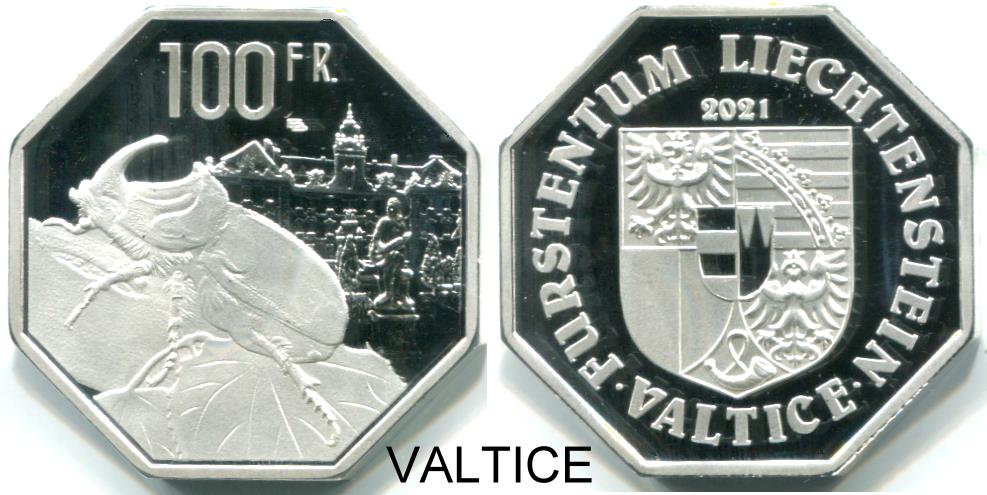

 Cameria
(Chameria) is a region of southern Albania and north-western Greece
bordering the Ionian Sea. The Chams were primarily a Muslim
ethnic group. During the first half of the 20th century most
Chams in Greece were expelled, emegrated or assimilated into Greek
culture. The Democratic Foundation of Chameria, a
pro=indepenence movement, was founded in 2006 in Hague,
Netherlands. The organization seems to have disappeared in
2019, after the murder of its chair and disputes over the goals of the
organization. The 2020 dated 500 Leke Proof coin depicts a
Short-toed snake eagle (Circaetus gallicus) holding a snake in its
talons one side. The other side has the arms of Cameria. The
six-sided silver-plated Proof coin is 39mm and has a mintage of only
160 pieces.
Cameria
(Chameria) is a region of southern Albania and north-western Greece
bordering the Ionian Sea. The Chams were primarily a Muslim
ethnic group. During the first half of the 20th century most
Chams in Greece were expelled, emegrated or assimilated into Greek
culture. The Democratic Foundation of Chameria, a
pro=indepenence movement, was founded in 2006 in Hague,
Netherlands. The organization seems to have disappeared in
2019, after the murder of its chair and disputes over the goals of the
organization. The 2020 dated 500 Leke Proof coin depicts a
Short-toed snake eagle (Circaetus gallicus) holding a snake in its
talons one side. The other side has the arms of Cameria. The
six-sided silver-plated Proof coin is 39mm and has a mintage of only
160 pieces.


 PIEGAN BLACKFOOT INDIAN ON MONTANA COIN: 20
Dollars 2020COINS OF AMERICAN
INDIAN NATIONS
PIEGAN BLACKFOOT INDIAN ON MONTANA COIN: 20
Dollars 2020COINS OF AMERICAN
INDIAN NATIONS ARGENTINOSAURUS ON ARAUCANIA & PATAGONIA
COIN: 500 Australs 2025
ARGENTINOSAURUS ON ARAUCANIA & PATAGONIA
COIN: 500 Australs 2025 Vitebsk
is the northern region of Belarus, bordering Russia, Latvia and
Lithuania. Recently Russia has been circulating the idea of creating
the Vitebsk People's Republic, which would be a puppet state of Moscow
rather than part of Belarus. Shortly there after an
unofficial coin for the Vitebsk People's Republic was issued by a
Russian coin dealer. The 2020 dated 20 Rubles commemorates
the 150th Anniversary of the birth of Lenin. One side of the
silver-plated Proof coin depicts the bust of Lenin. The other
side depicts the coat of arms in red and gold. The
odd-shaped coin measures 40x30mm and has a mintage of only 140 pieces.
Vitebsk
is the northern region of Belarus, bordering Russia, Latvia and
Lithuania. Recently Russia has been circulating the idea of creating
the Vitebsk People's Republic, which would be a puppet state of Moscow
rather than part of Belarus. Shortly there after an
unofficial coin for the Vitebsk People's Republic was issued by a
Russian coin dealer. The 2020 dated 20 Rubles commemorates
the 150th Anniversary of the birth of Lenin. One side of the
silver-plated Proof coin depicts the bust of Lenin. The other
side depicts the coat of arms in red and gold. The
odd-shaped coin measures 40x30mm and has a mintage of only 140 pieces. A
movement to create California as an independent nation has been active
for some years. The movement is headed by a New Yorker living in
Russia. It appears most its funding is from Russia and social media
support from both Russia and Iran. The movement has
found little backing within the state, (though there are probably some
conservatives who would be happy to see California leave the
Union.) Recently a Russian coin dealer created two beautiful
coins for the California Republic. Both coins are denominated as 20
California Dollars and are dated 2020. They are 40mm
eight-sided, silver plated Proof coins. One depicts a Bobcat
and her kitten in Yosemite Valley. The other features Minerva
and sailing ships. The design is from the state
seal. The reverses of both coins depict a Grizzly Bear and
the words "CALIFORNIA REPUBLIC". The design comes from the California
State Flag. The Bear Flag Republic design is based on a flag
used in the 1846 revolt against Mexico. Each coin
has a mintage of only 160 pieces.
A
movement to create California as an independent nation has been active
for some years. The movement is headed by a New Yorker living in
Russia. It appears most its funding is from Russia and social media
support from both Russia and Iran. The movement has
found little backing within the state, (though there are probably some
conservatives who would be happy to see California leave the
Union.) Recently a Russian coin dealer created two beautiful
coins for the California Republic. Both coins are denominated as 20
California Dollars and are dated 2020. They are 40mm
eight-sided, silver plated Proof coins. One depicts a Bobcat
and her kitten in Yosemite Valley. The other features Minerva
and sailing ships. The design is from the state
seal. The reverses of both coins depict a Grizzly Bear and
the words "CALIFORNIA REPUBLIC". The design comes from the California
State Flag. The Bear Flag Republic design is based on a flag
used in the 1846 revolt against Mexico. Each coin
has a mintage of only 160 pieces.  In Greek mythology the Minotaur as a
creature that was part man, part bull. It was contained the
elaborate and confusing Labyrinth on Crete. The Minotaur is
featured on the reverse of this unofficial five-sided 500 Drachmai of
Crete. The obverse features the coat of arms of
Crete. The silver-plated Proof coin is 36mm and has a mintage
of just 160 pieces.
In Greek mythology the Minotaur as a
creature that was part man, part bull. It was contained the
elaborate and confusing Labyrinth on Crete. The Minotaur is
featured on the reverse of this unofficial five-sided 500 Drachmai of
Crete. The obverse features the coat of arms of
Crete. The silver-plated Proof coin is 36mm and has a mintage
of just 160 pieces. Dahlac is an archipelago of over 100
islands located in the Red Sea, only four of which are permanently
inhabited. It has a population of about 2500. In Roman times
it was
famous for its pearls. Even today it still has a small pearl diving
industry. Over the centuries it has been used as a prison and a major
conduit of trade and slaves between Africa and Arabia.
Recently it has
become a popular destination for yacht cruising and scuba
divers. It is
currently controlled by Eritrea. This unofficial six-sided
2020 50
Nafka coin of Dahlac depicts a Goliath Heron on the reverse.
The large
bird can reach up to 5 feet (152cm) and have a 7.5 foot (230cm)
wingspan. The emblem of Dahlac featuring a camel is on the
obverse.
The silver-plated Proof coin has a mintage of only 160 pieces.
Dahlac is an archipelago of over 100
islands located in the Red Sea, only four of which are permanently
inhabited. It has a population of about 2500. In Roman times
it was
famous for its pearls. Even today it still has a small pearl diving
industry. Over the centuries it has been used as a prison and a major
conduit of trade and slaves between Africa and Arabia.
Recently it has
become a popular destination for yacht cruising and scuba
divers. It is
currently controlled by Eritrea. This unofficial six-sided
2020 50
Nafka coin of Dahlac depicts a Goliath Heron on the reverse.
The large
bird can reach up to 5 feet (152cm) and have a 7.5 foot (230cm)
wingspan. The emblem of Dahlac featuring a camel is on the
obverse.
The silver-plated Proof coin has a mintage of only 160 pieces.  This
unofficial bi-metallic 100 Ruble coin picturing Pope John Paul II was
issued for The Moldavian Republic of Dniestr, also known as
Transniestria or Transdniestra. The national arm featuring a hammer and
sickle and a star is on the back of the 2011 dated coin. The
small, communist state bordering the Dniester river declared
independence from Moldova in 1990. Though its independence is
not
widely recognized, it operates as a sovereign nation. The
26mm
coin has a mintage of only 2500 pieces and is Uncirculated.
This
unofficial bi-metallic 100 Ruble coin picturing Pope John Paul II was
issued for The Moldavian Republic of Dniestr, also known as
Transniestria or Transdniestra. The national arm featuring a hammer and
sickle and a star is on the back of the 2011 dated coin. The
small, communist state bordering the Dniester river declared
independence from Moldova in 1990. Though its independence is
not
widely recognized, it operates as a sovereign nation. The
26mm
coin has a mintage of only 2500 pieces and is Uncirculated.

 The
Sahrawi Arab Democratic Republic, also known as Sahraui, is what used
to be the Spanish Sahara or Western Sahara. In 2004 Saharawi
issued
two bi-metallic 500 Peseta coins. One coin features a cute
pair
of
Fennecs, a long eared desert fox that is native to Saharawi. The other
commemorates the 28th anniversary of nation’s independence (though in
reality it is largely controlled by Morocco) and features a map of the
country. The obverse of both coins features the arms of
Saharawi,
which includes a pair of rifles. The coins are 26mm in
diameter
and
have a mintage of only 5000 pieces each.
The
Sahrawi Arab Democratic Republic, also known as Sahraui, is what used
to be the Spanish Sahara or Western Sahara. In 2004 Saharawi
issued
two bi-metallic 500 Peseta coins. One coin features a cute
pair
of
Fennecs, a long eared desert fox that is native to Saharawi. The other
commemorates the 28th anniversary of nation’s independence (though in
reality it is largely controlled by Morocco) and features a map of the
country. The obverse of both coins features the arms of
Saharawi,
which includes a pair of rifles. The coins are 26mm in
diameter
and
have a mintage of only 5000 pieces each.
 This
2010 dated bi-metal 500 Peseta coin of the Sahrawi Arab Democratic
Republic honors Arab culture. The coin was issued in
conjunction with the Namur Expo in 2010. One side depicts
the national arms which feature a pair of crossed rifles
holding flags. The other depicts traditional Arab
hospitality, with one man preparing tea over a small fire while the
other plays a flute. Saharawi, formerly known as Spanish
Sahara, declared independence in 1976, however Morocco controls most of
its territory. The 26mm coin has a mintage of only 2500
pieces and is Uncirculated.
This
2010 dated bi-metal 500 Peseta coin of the Sahrawi Arab Democratic
Republic honors Arab culture. The coin was issued in
conjunction with the Namur Expo in 2010. One side depicts
the national arms which feature a pair of crossed rifles
holding flags. The other depicts traditional Arab
hospitality, with one man preparing tea over a small fire while the
other plays a flute. Saharawi, formerly known as Spanish
Sahara, declared independence in 1976, however Morocco controls most of
its territory. The 26mm coin has a mintage of only 2500
pieces and is Uncirculated.

 A humpback
whale is
pictured this rectangular 8 dollar coin from the Galapagos
Islands. The coin is the first in a series of coins issued
for the isolated islands. The reverse features the arms of
the islands. The islands are famous for their wide array of
unusual wildlife. The Galapagos is a posession of Ecuador. Since 2000
the United States dollar has been Ecuador's official
currency, thus the coin is denominated in U.S. dollars. Like
most odd-ball coins, it is not meant to circulate, and it is not a
legal tender issue. The attractive and unusual coin is struck
in silver-plated brass. It has a mintage of only 3000
pieces.
A humpback
whale is
pictured this rectangular 8 dollar coin from the Galapagos
Islands. The coin is the first in a series of coins issued
for the isolated islands. The reverse features the arms of
the islands. The islands are famous for their wide array of
unusual wildlife. The Galapagos is a posession of Ecuador. Since 2000
the United States dollar has been Ecuador's official
currency, thus the coin is denominated in U.S. dollars. Like
most odd-ball coins, it is not meant to circulate, and it is not a
legal tender issue. The attractive and unusual coin is struck
in silver-plated brass. It has a mintage of only 3000
pieces.
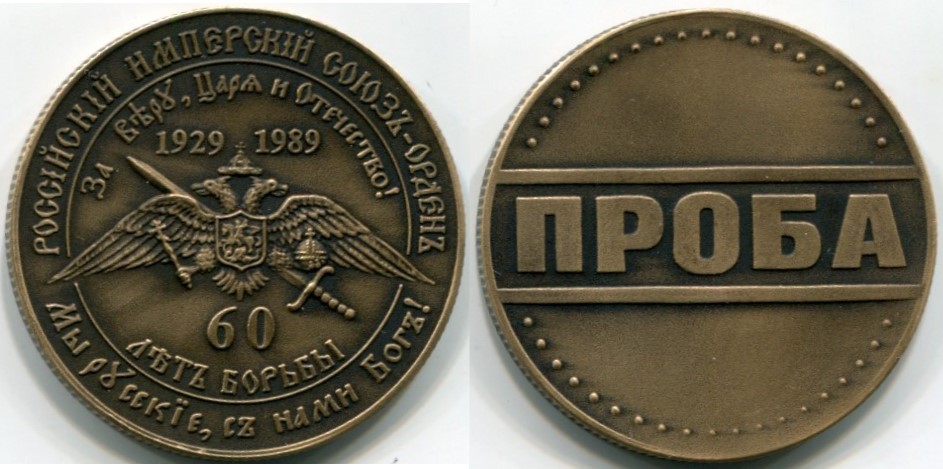
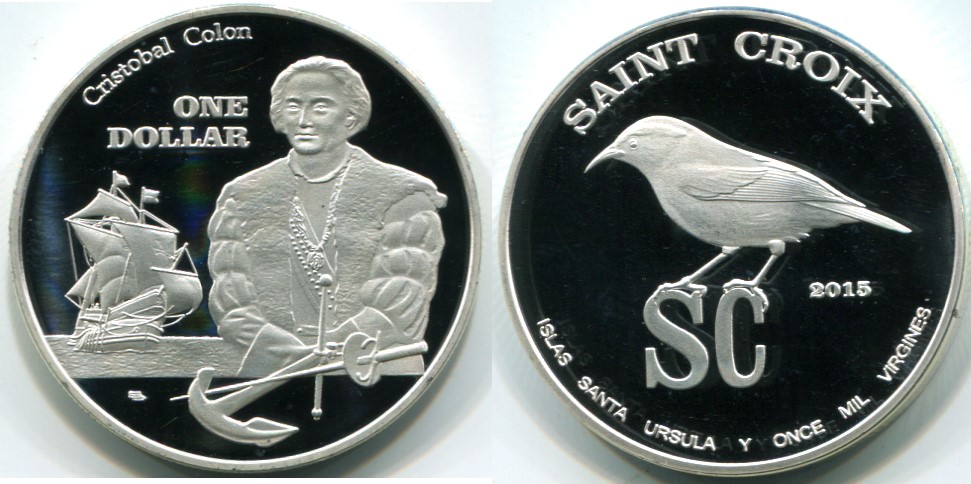 Christopher
Columbus and one of his ships is depicted on this unofficial 2015 dated
1 Dollar coin from St. Croix. Columbus landed on the island
in November 1493 and was attacked by the native Caribs
(Kalinagos). Over the years ownership of the island passed
between Spain, the Netherlands, the Knights of Malta, Great Britain,
France and Denmark. Denmark sold it, along with St. Thomas
and St. John to the United States in 1916, during World War
I. Today it is part of the United States Virgin
Islands. The obverse of the coin features
a Bananaquit bird, the state bird of the U.S. Virgin Islands, perched
on the letters “SC”. Below is the original Spanish name for
the Virgin Islands. The 40mm Proof coin is struck
on silver plated brass and has a mintage of just 250 pieces.
Christopher
Columbus and one of his ships is depicted on this unofficial 2015 dated
1 Dollar coin from St. Croix. Columbus landed on the island
in November 1493 and was attacked by the native Caribs
(Kalinagos). Over the years ownership of the island passed
between Spain, the Netherlands, the Knights of Malta, Great Britain,
France and Denmark. Denmark sold it, along with St. Thomas
and St. John to the United States in 1916, during World War
I. Today it is part of the United States Virgin
Islands. The obverse of the coin features
a Bananaquit bird, the state bird of the U.S. Virgin Islands, perched
on the letters “SC”. Below is the original Spanish name for
the Virgin Islands. The 40mm Proof coin is struck
on silver plated brass and has a mintage of just 250 pieces. Saint
John is the smallest of the three main United States Virgin
Islands. Approximately 60% is a National Park. This
unofficial 2015 1 Dollar coin of St. John depicts two native Island
Caribs on the reverse. In the 18th Century Denmark
established sugar plantations on the island and enslaved the Caribs to
work on the plantations. The native population was quickly
decimated by diseases. In 1917 Denmark sold the islands to
the United States. The obverse features a Bananaquit bird,
the state bird of the U.S. Virgin Islands, perched on the letters
“SJ”. Below is the original Spanish name for the Virgin
Islands: Islas Santa Ursla Y Once Mil Virgenes (Islands of St. Ursla
and Eleven Thousand Virgins). The 40mm Proof coin is struck on silver
plated brass and has a mintage of only 250 pieces.
Saint
John is the smallest of the three main United States Virgin
Islands. Approximately 60% is a National Park. This
unofficial 2015 1 Dollar coin of St. John depicts two native Island
Caribs on the reverse. In the 18th Century Denmark
established sugar plantations on the island and enslaved the Caribs to
work on the plantations. The native population was quickly
decimated by diseases. In 1917 Denmark sold the islands to
the United States. The obverse features a Bananaquit bird,
the state bird of the U.S. Virgin Islands, perched on the letters
“SJ”. Below is the original Spanish name for the Virgin
Islands: Islas Santa Ursla Y Once Mil Virgenes (Islands of St. Ursla
and Eleven Thousand Virgins). The 40mm Proof coin is struck on silver
plated brass and has a mintage of only 250 pieces.


 This
scarce fantasy silver Hejaz 10 Piastres or 1/2 Riyal was made
to
appear to be an early coin of Hejaz. It is dated AH1334, Year
8 (1923) and bears the legends that was struck in Mecca (“Makka
al-Mukarrama”). In reality it was struck some years ago in
the United States. The coins is technically Uncirculated,
however was given an “antiqued” finish. The 27.8mm coin has a
reeded edge. It is a scarce coin and given the popularity of
Saudi Arabian related coins, is sure to be in demand.
This
scarce fantasy silver Hejaz 10 Piastres or 1/2 Riyal was made
to
appear to be an early coin of Hejaz. It is dated AH1334, Year
8 (1923) and bears the legends that was struck in Mecca (“Makka
al-Mukarrama”). In reality it was struck some years ago in
the United States. The coins is technically Uncirculated,
however was given an “antiqued” finish. The 27.8mm coin has a
reeded edge. It is a scarce coin and given the popularity of
Saudi Arabian related coins, is sure to be in demand.


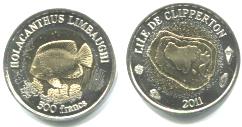


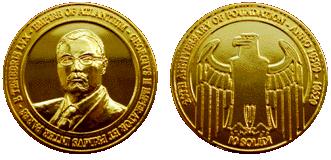

 For
over a year, Belgium has
not been able to create a national government because of
disagreements between the French speaking portions and the Dutch
speaking portions of the country. Despite the lack
of a
national government (or maybe because of a lack of a national
government), Belgium is doing better economically than most of
Europe. A number Belgians have advocated breaking the country
into two separate nations. Flanders is the Dutch speaking part of
Belgium. This 2010 1 Euro coin was created for the
Flemish Republic, which does not yet exist. One side has a
map of Flanders with the legend Vlaams €uro (Flemish Euro).
The other side features a Flemish lion.
For
over a year, Belgium has
not been able to create a national government because of
disagreements between the French speaking portions and the Dutch
speaking portions of the country. Despite the lack
of a
national government (or maybe because of a lack of a national
government), Belgium is doing better economically than most of
Europe. A number Belgians have advocated breaking the country
into two separate nations. Flanders is the Dutch speaking part of
Belgium. This 2010 1 Euro coin was created for the
Flemish Republic, which does not yet exist. One side has a
map of Flanders with the legend Vlaams €uro (Flemish Euro).
The other side features a Flemish lion.

 Because
of its remoteness in Antarctica, most of Marie Byrd Land has not been
claimed by any sovereign nation, though it has been claimed by various
micro-nations. It was named by explorer Admiral Richard E. Byrd in 1929
after his wife. I am sure she deserved it for putting up with his
numerous explorations and adventures. In 2011 a trimetallic 10 Dollar
was issued for this remote area. One side of the 27mm coin pictures
Pope John Paul II and commemorates his beatification on May 1, 2011. There is a
certain irony in
a coin being issued honoring the Pope for the only continent that
the Pope never visited. The other side shows a map of the territory
and a penguin.
Because
of its remoteness in Antarctica, most of Marie Byrd Land has not been
claimed by any sovereign nation, though it has been claimed by various
micro-nations. It was named by explorer Admiral Richard E. Byrd in 1929
after his wife. I am sure she deserved it for putting up with his
numerous explorations and adventures. In 2011 a trimetallic 10 Dollar
was issued for this remote area. One side of the 27mm coin pictures
Pope John Paul II and commemorates his beatification on May 1, 2011. There is a
certain irony in
a coin being issued honoring the Pope for the only continent that
the Pope never visited. The other side shows a map of the territory
and a penguin. 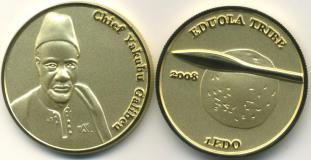
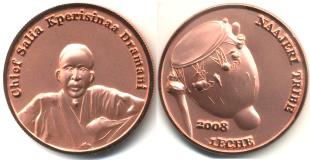

 COINS OF AMERICAN
INDIAN NATIONSCOINS
OF
WESTEROS - GAME OF THRONESTABLE OF
CONTENTS FOR THE INTERESTING STUFF CATALOG
ALPHABETICAL LISTING OF
COINS AND BANKNOTES IN THE INTERESTING STUFF CATALOGWEB SITE MAP & SEARCH
ENGINESECURE ON-LINE CREDIT CARD ORDER PAGE
ORDERING INFORMATION
COINS OF AMERICAN
INDIAN NATIONSCOINS
OF
WESTEROS - GAME OF THRONESTABLE OF
CONTENTS FOR THE INTERESTING STUFF CATALOG
ALPHABETICAL LISTING OF
COINS AND BANKNOTES IN THE INTERESTING STUFF CATALOGWEB SITE MAP & SEARCH
ENGINESECURE ON-LINE CREDIT CARD ORDER PAGE
ORDERING INFORMATION